Article
Husky vs Malamute: Two Sled Dogs, Two Very Different Jobs
They share a postcode, a colour palette and a fondness for snow, but one was built to race and the other to haul. Here's how to tell them apart, according to the people who write the rules.
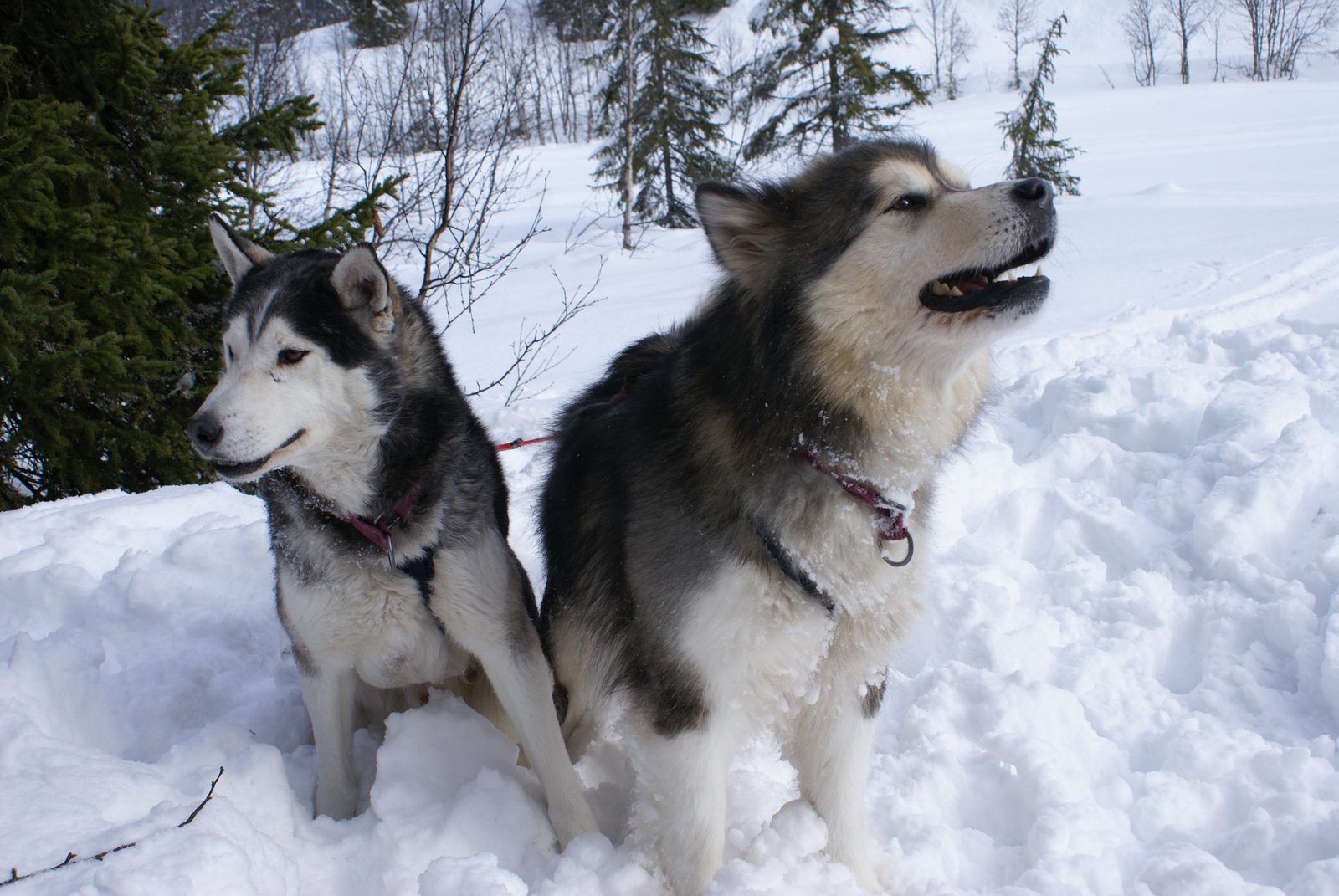

Sooner or later, at any snowy dog show, someone points at a big, wolfish, grey-and-white dog and says, with total confidence, “Look, a husky.” Often they’re wrong.
The Siberian Husky and the Alaskan Malamute get mixed up more often than almost any other pair of breeds. Both have upright ears, thick double coats and faces that look painted on. The FCI even files them in the same drawer: Group 5, Section 1, Nordic Sledge Dogs [3][4].
But the breed standards, the official blueprints each breed is judged against, describe two quite different animals. The American Kennel Club sums it up in five words on its Malamute page: “Huskies are racers; Malamutes are freighters” [5]. Everything else follows from that.
Built for different loads
Start with size, because the standards treat it in opposite ways.
The Siberian Husky standard sets hard limits. Dogs stand 21 to 23½ inches at the shoulder and bitches 20 to 22 inches. A dog over 23½ inches or a bitch over 22 inches is disqualified outright [2]. Weights run from 45 to 60 pounds for dogs and 35 to 50 pounds for bitches, which the standard calls “extreme height and weight limits.” The AKC calls the Siberian a “medium-sized working dog, quick and light on his feet,” and adds a lovely balancing act: he should never look “so heavy or coarse as to suggest a freighting animal; nor is he so light and fragile as to suggest a sprint-racing animal” [2].
The Malamute standard has no height disqualification at all. Instead it describes “a natural range in size” and names “desirable freighting sizes”: 25 inches and 85 pounds for males, 23 inches and 75 pounds for females [1]. FCI puts those at 63.5 cm and 38 kg for males, and 58.5 cm and 34 kg for females [3]. So the Malamute’s ideal male is taller than the tallest Siberian allowed in the ring, and about 25 pounds heavier than the heaviest.
The build follows the job. The Malamute is “powerful and substantially built,” with a deep chest, heavy bone and legs that must show “tremendous propelling power” [1]. Its feet are “of the snowshoe type.” The Siberian, by contrast, was bred for “carrying a light load at a moderate speed over great distances” [2]. One is a lorry; the other is a long-distance runner.
Eyes, tails and coats
The Siberian Husky’s eyes “may be brown or blue in color; one of each or parti-colored are acceptable” [2]. The famous odd-eyed husky stare is fully within the rules.
The Malamute standard goes the other way. Eyes are “brown, almond shaped,” with dark preferred, and “Blue eyes are a disqualifying fault” [1]. It’s the only disqualification in the whole AKC Malamute standard. The FCI agrees [3]. The UK’s Royal Kennel Club is a little gentler, calling blue eyes “highly undesirable” rather than disqualifying [12].
Then check the back end. The Siberian’s tail is a “well furred tail of fox-brush shape,” carried in “a graceful sickle curve,” and the standard counts a “highly plumed tail” as a fault [2]. The Malamute’s tail is carried over the back with “the appearance of a waving plume,” and its standard specifically says it is not “short furred like a fox brush” [1]. Each standard, in effect, uses the other breed’s tail as its warning example.
The coats differ too. The Siberian’s double coat is medium in length, “never so long as to obscure the clean-cut outline” of the dog [2]. The Malamute wears “a thick, coarse guard coat” over a dense, oily, woolly undercoat one to two inches deep [1]. Colour is a weaker tell, since both breeds come in greys, blacks and reds with white, though the Malamute standard calls its cap and face markings “a distinguishing feature” [1].
Freighters from Alaska, racers from Siberia
The Malamute takes its name from the Mahlemiut, whom the AKC describes as an Inuit people who settled around Kotzebue Sound in northwestern Alaska [5]. The Alaskan Malamute Club of America says the name refers to a regional dialect of Alaskan Iñupiaq, and it admits that the breed’s early history is “largely conjectural” [6]. The AKC says the dogs were made “to haul heavy loads at low speeds over long distances” [5].
The standard is blunt about that purpose. The Malamute’s “function as a sledge dog for heavy freighting in the Arctic must be given consideration above all else,” and it “is not intended as a racing sled dog designed to compete in speed trials” [1]. The AKC adds that some Malamutes were selected in 1933 to help Admiral Richard Byrd on his Antarctic expedition [5]. AKC recognised the breed in 1935 [5].
The Siberian Husky’s story starts across the Bering Strait. The Siberian Husky Club of America says the breed was developed by the Chukchi people of northeastern Asia “as an endurance sled dog” [8].
The club’s history pages place the first arrivals in Nome around the time of the 1909 All Alaska Sweepstakes. That was a 408-mile race with a $10,000 prize [7]. The visitors weighed only 40 to 52 pounds, and locals mocked them as “Siberian Rats.” The rats came third. More imports followed, and a team of them won in 1910 [7].
Awkwardly for trivia nights, the FCI lists the Siberian’s country of origin as the U.S.A., not Russia [4]. AKC recognised the breed in 1930 [7].
The race against diphtheria
In January 1925, diphtheria broke out in Nome. The antitoxin was hundreds of miles away, and the only way through was by dog sled. According to the Cleveland Museum of Natural History, 20 mushers and more than 150 dogs relayed the serum from Nenana to Nome in about 127 hours [11].
Leonhard Seppala, a Siberian Husky man, set out from Nome with 20 Siberians and his lead dog, Togo [7]. After meeting the serum, Seppala and Togo crossed back over Norton Sound in a blizzard [7]. The National Park Service says Togo led the team across the most dangerous stretch of the route, and he was 12 years old at the time [9].
The last leg belonged to Gunnar Kaasen and his lead dog, Balto. They took over the serum on 1 February and reached Nome early on 2 February, after a 53-mile run at fifty below [11]. According to the Smithsonian, the next driver was asleep when Kaasen arrived, so he simply kept going [10]. Balto arrived in Nome, and arriving in Nome is how you get famous. A statue of him went up in Central Park that December [10]. The SHCA notes that the statue honours all the serum-run dogs [7].
The NPS says Balto was “considered the backup dog” [9]. Togo, the old dog who had done the hardest part, got less of the glory.
What the standards say about temperament
The Siberian Husky is “friendly and gentle, but also alert and outgoing.” He “does not display the possessive qualities of the guard dog, nor is he overly suspicious of strangers or aggressive with other dogs” [2]. His expression is “keen, but friendly; interested and even mischievous” [2].
The Malamute is “an affectionate, friendly dog, not a ‘one man’ dog,” a “loyal, devoted companion, playful in invitation, but generally impressive by his dignity after maturity” [1]. The Royal Kennel Club adds that the breed “tends to show dominance to other dogs” [12].
So when someone points at a big grey dog and says “husky,” check the eyes, the tail and the bulk. If it looks like it could tow your car, it’s probably a Malamute.
Sources
- American Kennel Club, Official Standard of the Alaskan Malamute (approved 12 Apr 1994, effective 31 May 1994) images.akc.org/pdf/breeds/standards/AlaskanMalamute.pdf
- American Kennel Club, Official Standard of the Siberian Husky (approved 9 Feb 2021, effective 12 May 2021) images.akc.org/pdf/breeds/standards/SiberianHusky.pdf
- FCI Standard No. 243, Alaskan Malamute (official valid standard 9 Mar 2023) fci.be/Nomenclature/Standards/243g05-en.pdf
- FCI Standard No. 270, Siberian Husky (official valid standard 14 Nov 2022) fci.be/Nomenclature/Standards/270g05-en.pdf
- American Kennel Club, Alaskan Malamute breed page (history, did-you-know) www.akc.org/dog-breeds/alaskan-malamute/
- Alaskan Malamute Club of America, "AMCA History" www.alaskanmalamute.org/amca-history
- Siberian Husky Club of America, "Siberian Husky History" www.shca.org/siberian-husky-history
- Siberian Husky Club of America, "The Siberian Husky" www.shca.org/the-siberian-husky
- National Park Service, "Togo" www.nps.gov/people/togo.htm
- Smithsonian Magazine, "This Heroic Dog Raced Across the Frozen Alaskan Wilderness to Deliver Life-Saving Medicine, but His Contributions Were Long Overlooked" www.smithsonianmag.com/history/this-heroic-dog-raced-across-the-frozen-alaskan-wilderness-to-deliver-life-saving-medicine-but-his-contributions-were-long-overlooked-180985905/
- Cleveland Museum of Natural History, "100 Years After the Great Serum Run, Balto's Legacy Endures" (23 Jan 2025) www.cmnh.org/learn/science-blog/2025/01/23/100-years-after-the-great-serum-run-baltos-legacy-endures
- The Royal Kennel Club, Alaskan Malamute breed standard (last updated 1 Aug 2025) www.thekennelclub.org.uk/breed-standards/working/alaskan-malamute/
The Dog Codex is an editorial reference, not veterinary advice. Quotations come from the sources listed above; follow the links for the full context.