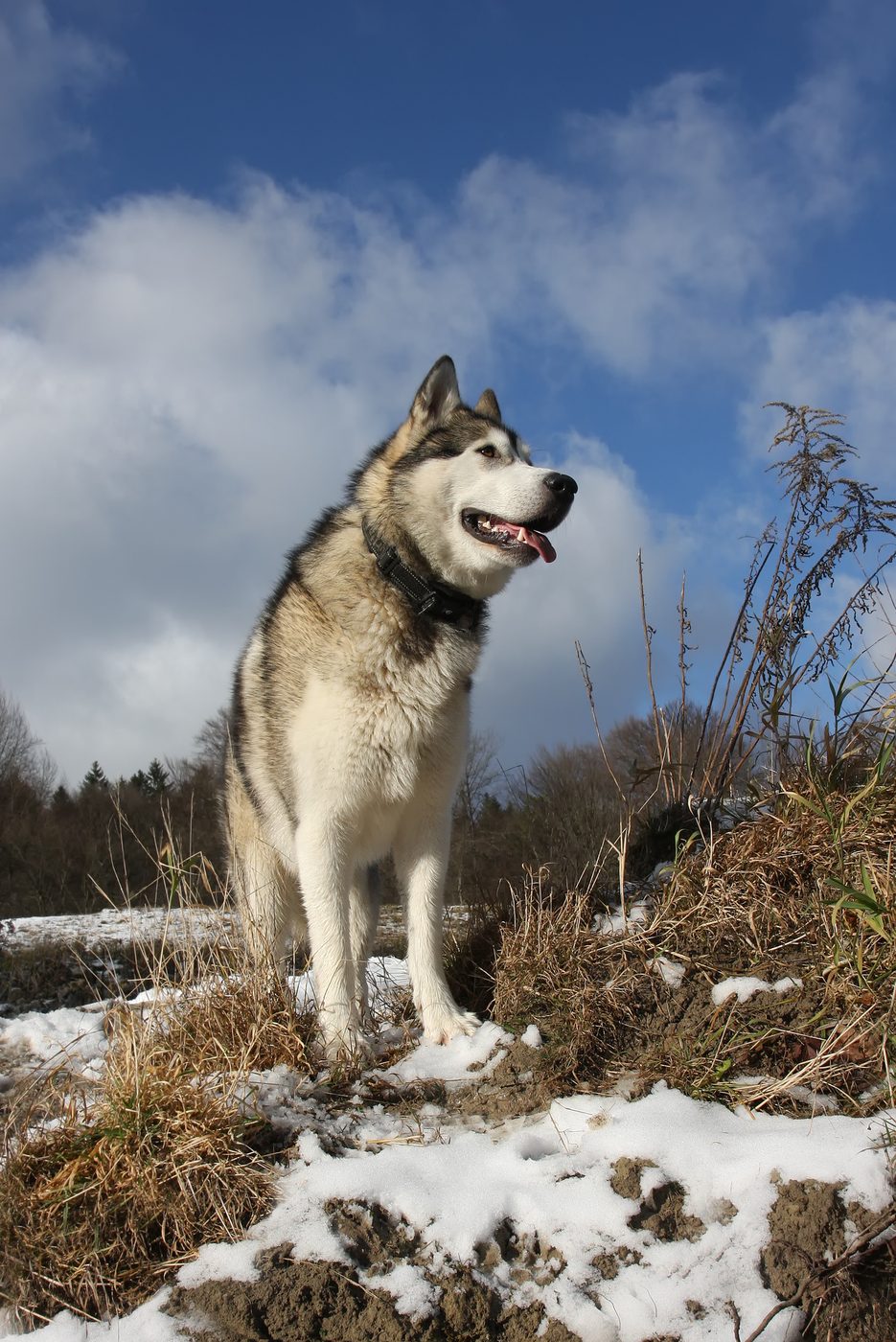
Working group · United States (Alaska)
Alaskan Malamute
- SizeLarge
- Height~58–64 cm
- Weight~34–39 kg
- GroupWorking
- EnergyHigh
Photo: Richard Bartz, CC BY-SA 2.5, via Wikimedia Commons

Overview
The Alaskan Malamute is the heavy-haulage end of the sled-dog world: a broad-headed, deep-chested, heavy-boned Arctic spitz built for pulling, not sprinting. AKC's standard calls it "one of the oldest Arctic sled dogs," a "powerful and substantially built dog with a deep chest and strong, well-muscled body," and it is unusually blunt about purpose: the Malamute "is structured for strength and endurance," and any trait, "including temperament," that interferes with that work "is to be considered the most serious of faults." AKC's breed history puts the job description in five words: "Huskies are racers; Malamutes are freighters." The Royal Kennel Club calls it "the strongest of the sled dogs."
History
AKC's breed history says the name comes from the Mahlemiut, "an Inuit tribe that settled in Kotzebue Sound of northwestern Alaska," who developed a dog "to work in packs to haul heavy loads at low speeds over long distances." The Alaskan Malamute Club of America (AMCA) says the name refers to the regional dialect of the Alaskan Iñupiaq people of the northeastern Seward Peninsula, around Kotzebue Sound, and it cautions that the breed's "history and early development are largely conjectural." According to AMCA, the Gold Rush that began in 1896 made dog teams very expensive and led to crossbreeding of the native freighting dogs. AMCA describes three foundation strains: Kotzebue (dogs from Arthur Walden, taken over by Milton and Eva Seeley at Chinook Kennels in Wonalancet, New Hampshire), M'Loot (Paul Voelker's line) and Hinman-Irwin. AKC says some Malamutes were selected in 1933 to aid Admiral Richard Byrd's Antarctic expedition, and AMCA says Chinook Kennels supplied dogs for the Byrd expeditions. AKC recognized the breed in 1935, the same year, AMCA notes, that the Alaskan Malamute Club of America was formed. After heavy losses in the Second World War, the AMCA Illustrated Standard says only about 30 registered dogs remained by 1947, so the stud book was reopened. Alaska named the Malamute its official state dog in 2010 (House Bill 14). FCI gives the country of origin as the U.S.A.
Type
These are desirable freighting sizes, not limits. AKC and FCI give males 25 in (about 63.5 cm) and 85 lb, females 23 in (about 58.5 cm) and 75 lb; the Royal Kennel Club's preferred sizes are dogs 64 cm and 39 kg, bitches 58 cm and 34 kg. The kilogram figures differ only because each registry rounds 85 lb differently. AKC and FCI stress a "natural range in size" and say size should not outweigh type, proportion and movement. Unlike the Siberian Husky, whose AKC standard disqualifies dogs over 23½ in and bitches over 22 in, the Malamute has no height disqualification. Depth of chest is about half the height at the shoulder, and the body is longer than it is tall; the Royal Kennel Club asks for a dog "heavily boned, powerfully built, not too compact and never appearing short on the leg."
A thick, coarse guard coat, "never long and soft," over a dense, oily, woolly undercoat one to two inches deep (AKC). The coat is relatively short to medium on the sides and longer around the neck and shoulders, down the back, and in the breeching and plume, and it is usually shorter in summer. AKC and FCI colours run from light gray through intermediate shadings to black, sable, and shadings of sable to red, with white on the underbody, parts of the legs, the feet and the face; "the only solid color allowable is all white." Face markings, a cap over the head with the face all white or marked with a bar and/or mask, are "a distinguishing feature." Eyes are brown, and blue eyes disqualify under AKC and FCI (the Royal Kennel Club calls them "highly undesirable"). The tail is carried over the back with "the appearance of a waving plume."
Temperament
AKC and FCI use the same words: "The Alaskan Malamute is an affectionate, friendly dog, not a 'one man' dog. He is a loyal, devoted companion, playful in invitation, but generally impressive by his dignity after maturity." The Royal Kennel Club's standard adds that the breed "tends to show dominance to other dogs." AKC's breed copy says Malamutes "are not especially suited to be guard dogs because they tend to be friendly with everyone they meet," and notes that they "typically don't bark much, but they are vocal and will 'talk.'"
Energy
Stamina for hauling rather than speed. AKC's standard asks for a gait that is "steady, balanced, tireless and totally efficient" and says the breed "is not intended as a racing sled dog." AKC's exercise copy: "A strong, athletic dog with tremendous endurance, designed to carry heavy loads, a Mal requires daily exercise." It suggests outlets such as hiking, backpacking, weight pulling, sledding and skijoring.
Intelligence
AKC's training copy calls Malamutes "highly intelligent but also independent and willful, often to the point of stubbornness."
Intelligence here means typical trainability, guided by Stanley Coren's survey of obedience judges. It is not a verdict on any one dog.
Care
Grooming
AKC recommends brushing every day with a pin brush and metal comb, adding an undercoat rake during the twice-yearly shed; a pet "can go six to eight weeks between baths," and nails should be trimmed regularly. The Canadian Kennel Club takes a lighter view: "a thorough brushing from time to time." The breed is shown naturally, with trimming allowed only to tidy the feet.
Health notes
The parent club's 2022 health statement requires hip dysplasia screening, an eye examination and a DNA test for Alaskan Malamute polyneuropathy (AMPN), an inherited neuromuscular disease. It also recommends elbow, cardiac and thyroid screening and DNA tests for cone degeneration ("day blindness") and primary ciliary dyskinesia. AMCA also describes chondrodysplasia ("dwarfism"), an inherited skeletal disorder, and keeps an open database of confirmed carriers. AKC's breed page also lists thrombopathia and von Willebrand's disease among conditions breeders screen for. Screening reduces uncertainty; it cannot guarantee an individual dog's future health.
Ordinary care
Plan for daily exercise that uses strength and endurance, daily brushing with extra work during the twice-yearly shed, and regular nail trims (AKC). AKC's training copy warns that digging may be impossible to train out of a Mal, so fencing should continue into the ground. For a puppy, ask for the AMCA-required results (hips, eyes and the AMPN DNA test) on both parents, plus the recommended elbow, cardiac, thyroid, cone-degeneration and PCD results.
Facts
- Freighter, not racer: AKC's standard says the Malamute "is not intended as a racing sled dog designed to compete in speed trials."
- The standard calls for feet "of the snowshoe type," with protective hair between the toes.
- "When the dog is at work, the ears are sometimes folded against the skull" (AKC and FCI).
- The tail should look like "a waving plume," not "short furred like a fox brush." The Siberian Husky's tail is the fox brush.
- AKC says Malamutes "typically don't bark much," but they talk and howl, and "sirens will often set them off."
- AKC says the Malamute was one of four breeds on the 1984 AKC centennial stamps.
- Alaska named the Alaskan Malamute its official state dog in 2010.
The Dog Codex is an editorial reference, not veterinary advice. Health notes summarize conditions that appear in breed literature; they do not diagnose an individual dog and do not replace examination by a licensed veterinarian.