Toy group · United Kingdom
Yorkshire Terrier
- SizeToy
- Height~18–20 cm (AKC profile)
- Weightup to 3.2 kg (AKC/FCI)
- GroupToy
- EnergyModerate
Photo: Svenska Mässan, CC BY-SA 4.0, via Wikimedia Commons
_Grupp_3,_YORKSHIRETERRIER,_NO_UCH_SE_UCH_Oxzar_Amazing_Bel%E2%80%99s_Toffy_(24310212305).jpg)
Overview
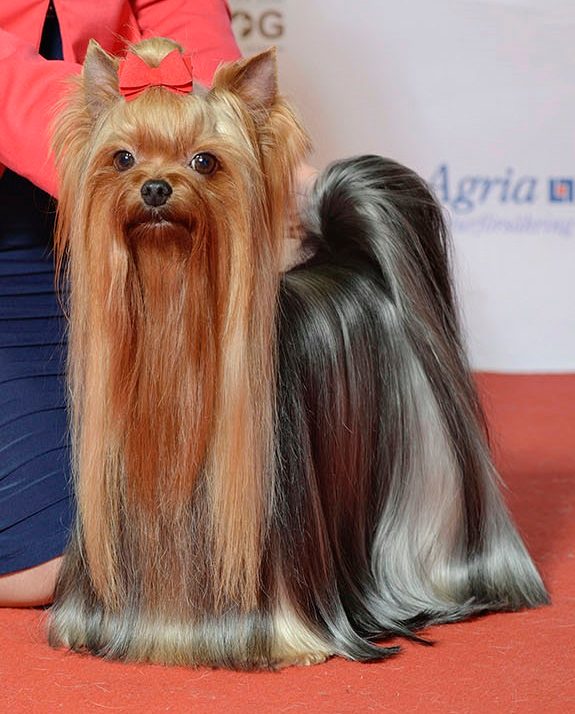
The Yorkshire Terrier is a toy terrier from the mill towns of Yorkshire, famous for its long, silky coat of dark steel blue and rich golden tan, parted down the back and falling straight on each side. It earned its keep catching rats in mines and mills before becoming a fashionable Victorian lapdog, and it still has the spirit of a working terrier. The AKC standard calls for a high head carriage and a confident manner that suggest vigor and self-importance.
History
The Yorkshire Terrier grew out of the Industrial Revolution. Scottish workers who moved south to the mines and textile mills of Yorkshire brought their small terriers, including the silky, blue and tan Clydesdale Terrier, now extinct. These were crossed with local dogs such as the old Black and Tan Terrier and the Waterside Terrier, and the Maltese and the Skye Terrier are also thought to be in the mix. The dogs kept the mills and workers' homes free of rats. First seen around the 1850s, and shown at first as the Broken Haired Scotch Terrier or Toy Terrier, the breed took the name Yorkshire Terrier in 1870. Its foundation sire was Huddersfield Ben, born in 1865. The Yorkie soon became a favorite house pet of fashionable ladies, and the AKC recognized it in 1885.
Type
Both standards set only a weight limit: the AKC says a Yorkshire Terrier must not exceed 7 lb, and the FCI gives up to 3.2 kg. Neither gives a height, though the AKC breed profile suggests 7 to 8 in (18 to 20 cm). The body is neat, very compact and well proportioned, with a rather short, level back and the same height at shoulder and rump.
The coat is glossy, fine and silky, moderately long and perfectly straight, and may be trimmed to floor length. It is a single coat with no undercoat, which the parent club compares to human hair. The body is a dark steel blue, not silver, from the back of the neck to the root of the tail, and the head, chest and legs are a rich golden tan, darker at the roots than at the tips. Puppies are born black and tan and turn blue and tan as they mature. The fall on the head is traditionally tied up with one or two bows.
Temperament
The FCI describes an alert, intelligent toy terrier, spirited with an even disposition, and notes that it keeps the terrier's hunting instinct, whether for a toy in the house or a rodent in the garden. The AKC adds that Yorkies love their owners and are eager to please, and it recommends early, gentle socialization with new people, places and dogs.
Energy
Moderate. The AKC suggests a couple of short walks a day at a steady pace, with the odd burst of play such as chasing a ball. Yorkies can also do well in obedience, rally and agility.
Intelligence
Stanley Coren's The Intelligence of Dogs ranks the Yorkie 27th, among his 'above average working dogs'. The AKC calls Yorkies very intelligent and eager to please, says they respond far better to praise and treats than to harsh correction, and notes that many work as therapy dogs.
Intelligence here means typical trainability, guided by Stanley Coren's survey of obedience judges. It is not a verdict on any one dog.
Care
Grooming
A long coat needs brushing every day and a bath every week or two, and the hair on top of the head is either trimmed short or tied up in a topknot to keep it out of the eyes. Many owners keep their Yorkies in one of the shorter clipped styles. The parent club recommends daily tooth cleaning, wiping the corners of the eyes daily if they tear, and trimming the nails at least every two weeks.
Health notes
The parent club calls the Yorkshire Terrier a generally healthy breed with a life expectancy of 12 to 15 years; the AKC gives 11 to 15. For a CHIC number, the Orthopedic Foundation for Animals requires an eye examination (recommended at 1, 3 and 6 years of age, before breeding) and a patellar luxation evaluation; Legg-Calvé-Perthes and hip X-rays, a thyroid test and DNA banking are optional. The club also encourages DNA tests for progressive retinal atrophy (PRA-prcd) and primary lens luxation, which are not part of CHIC. Other conditions it lists for discussion with a breeder include liver shunt, microvascular dysplasia, protein-losing enteropathy, encephalitis, degenerative myelopathy, hyperuricosuria and Legg-Calvé-Perthes disease. As in all toy breeds, regular tooth brushing matters. The AKC suggests limiting how high a puppy jumps, to protect the knees.
Ordinary care
Daily care centers on the coat, teeth and eyes, along with short daily walks. Keep puppies from jumping down from heights, which the AKC says helps protect against slipping kneecaps. When choosing a puppy, ask to see the parents' knee and eye results.
Facts
- A 4-pound Yorkie named Smoky, found in a foxhole in the New Guinea jungle during the Second World War, flew combat missions with an American airman, survived 150 air raids and ran telegraph wire through a narrow pipe to help build an airbase. After the war she visited veterans' hospitals, and the AKC calls her the first documented therapy dog.
- Nearly every Yorkshire Terrier alive today traces back to Huddersfield Ben, born in 1865 and named for his hometown. He was a show winner and a rat-catching champion, and though he weighed about 11 pounds himself, his puppies were typically half that.
- In Britain the Yorkie is still shown standing on a decorative box. The Kennel Club says it is the only breed shown this way, a habit dating from early shows, where it was displayed on a silk cloth or cushion.
- Yorkie puppies are born black and tan. The steel blue comes in as they grow up.
- Before it took its present name in 1870, the breed was shown as the Broken Haired Scotch Terrier or the Toy Terrier, a nod to its Scottish roots.
The Dog Codex is an editorial reference, not veterinary advice. Health notes summarize conditions that appear in breed literature; they do not diagnose an individual dog and do not replace examination by a licensed veterinarian.