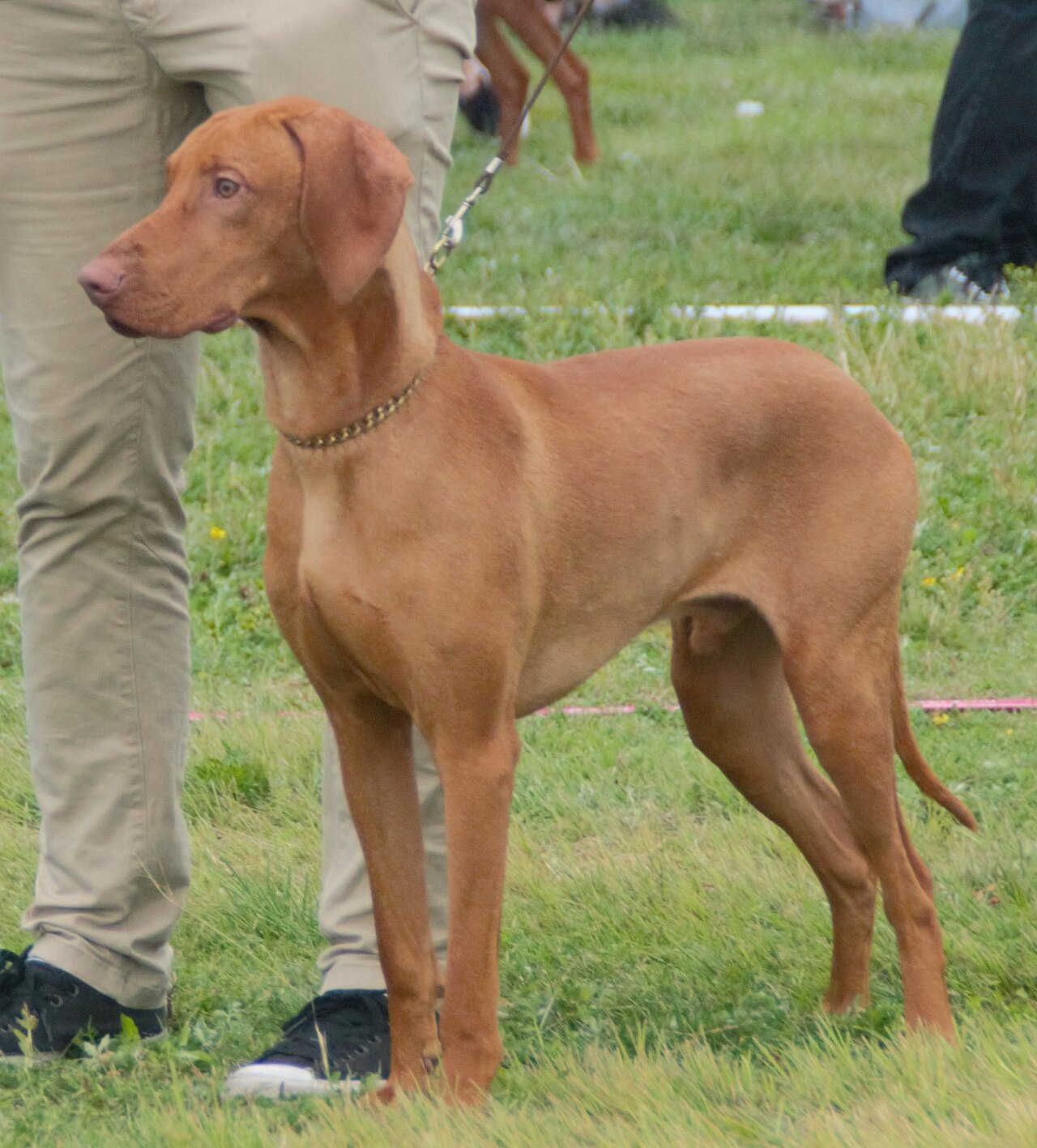
Sporting group · Hungary
Vizsla
- SizeMedium
- Height53.3–64 cm (registry- and sex-specific; AKC ideal males 55.9–61.0 cm and females 53.3–58.4 cm; FCI dogs 58–64 cm and bitches 54–60 cm)
- Weight20–30 kg (Royal Kennel Club); CKC dogs 22.75–29.5 kg and bitches about 4.5 kg less; AKC and FCI standards do not publish a numeric adult weight
- GroupSporting
- EnergyHigh
Photo: Canarian, CC BY-SA 4.0, via Wikimedia Commons

Overview
The Vizsla is a medium-sized Hungarian pointing dog with an unmistakable russet-gold coat, a lean but muscular outline, and the alert, connected manner of a dog bred to work closely with a hunter. AKC describes a robust yet rather lightly built hunting dog, while FCI calls for an excellent nose, firm pointing, strong retrieving ability, and willingness to work in field, forest, and water. That versatile point-and-retrieve identity is the centre of the breed: an athletic gundog and a highly people-oriented companion, without turning either standard description into a guarantee about an individual dog. This plate covers the smooth or short-haired Vizsla; the Wirehaired Vizsla is a separate breed.
History
Hungary is the country of origin listed by FCI, with AKC/Vizsla Club of America and CKC accounts likewise describing Hungarian origins. FCI traces ancestors into the Carpathian Basin with nomadic Hungarian tribes, cites fourteenth-century written and graphic references, and places the modern breeding programme in 1920, with recognition of the short-haired Hungarian Vizsla in 1936. The Vizsla Club of America describes selective maintenance through political upheavals and a near-extinction rebuild; its club history says a search found roughly a dozen true-type dogs from which the breed was rebuilt. That is useful parent-club history, not an independently quantified population record. Post-war arrivals led to a U.S. national club and AKC recognition in 1960. The original job was versatile pointing and retrieving across field, forest, and water: scenting, pointing, retrieving, and following scent while swimming.
Type
Medium-sized is directly supported by AKC and FCI descriptions, with a lean, elegant, athletic build rather than coarse substance. AKC ideal height is 22–24 inches for males and 21–23 inches for females; FCI gives 58–64 cm for dogs and 54–60 cm for bitches, while The Royal Kennel Club gives 57–64 cm and 53–60 cm. CKC lists standard sizes of 58.5 cm for dogs and 56 cm for bitches. These are registry and sex-specific ideals, not one universal band. Do not transfer the smooth Vizsla’s measurements or build to the separately registered Wirehaired Vizsla.
The smooth Vizsla has a short, dense, close-lying coat without a woolly undercoat. AKC describes a short, smooth, dense coat and disqualifies a distinctly long coat; FCI adds that body hair is coarse and hard to the touch while the head and ears are thinner and silkier, and The Royal Kennel Club describes a short, straight, dense, smooth, shiny coat. Standard colour is russet gold or golden rust, with registry-specific wording for shades and small permitted white chest or toe markings. The Wirehaired Vizsla’s harsh, denser undercoated coat and facial furnishings do not belong in this smooth-breed description.
Temperament
The standard picture is lively, friendly or gentle-mannered, affectionate, sensitive, and trainable. AKC describes a natural hunter with a good nose and above-average ability to take training, while FCI calls the breed lively, friendly, evenly tempered, easy to train, and strongly willing to maintain contact with its handler. FCI also says the Vizsla cannot bear rough treatment and must be neither aggressive nor shy; the VCA standard treats sensitivity and gentle manners as essential to the ideal. Reward-based, consistent training is a sensible match for that working partnership, but socialization, experience, breeding, and the individual dog still matter.
Energy
High: the Vizsla is a working Sporting gundog with documented drive, endurance, and a versatile point-and-retrieve role in field, forest, and water. AKC describes power, drive, and endurance in the field; FCI requires a versatile worker with scenting, pointing, retrieving, and swimming ability; The Royal Kennel Club describes a lively hunting dog. The VCA adds practical owner guidance about vigorous daily exercise, regular opportunities to run, mental stimulation, and ongoing training. Those sources support a high-engagement badge, not a fixed minute count; age, development, conditioning, weather, health, and the individual dog should shape the routine.
Intelligence
High trainability is a fair shorthand for the standards’ excellent nose, aptitude for training, easy-going cooperation, and strong handler contact; it is not a published intelligence ranking or a promise of effortless obedience. Clear, reward-based work can channel pointing, retrieving, recall, scent games, swimming, obedience, agility, tracking, and other structured activities. The breed’s sensitivity and hunting interests make thoughtful teaching of settling, independence, and safe management important, and individuals vary.
Intelligence here means typical trainability, guided by Stanley Coren's survey of obedience judges. It is not a verdict on any one dog.
Care
Grooming
The short, smooth coat needs ordinary, regular maintenance rather than elaborate styling. A hound mitt or brush can remove dirt and loose coat after outdoor work; occasional bathing, functional nail care, dental care, and routine checks of the thin hanging ears, eyes, feet, skin, and coat are sensible. After fields or swimming, look for burrs, cuts, moisture, irritation, or foreign material and ask a veterinarian about safe ear care. Coat length and the absence of a woolly undercoat do not establish allergen output or predict exactly how much hair an individual dog leaves in a home.
Health notes
Only screening protocols named in the Vizsla Club of America’s Official Health Statement, approved 20 November 2024, are listed here; no prevalence, lifespan, or diagnosis is inferred. For breeding stock, VCA says an AKC DNA number and a permanent CHIC number are strongly recommended. Its core screens are hip dysplasia evaluation through OFA or PennHIP at 24 months or older; autoimmune thyroiditis evaluation through OFA, repeated every other year to keep CHIC information current; and an annual eye examination by a board-certified ACVO ophthalmologist registered with OFA. The statement also lists optional breeding-stock screens for elbow dysplasia, cardiac evaluation, a long-haired DNA test, and skeletal dysplasia (SD3) DNA testing. OFA explains that a CHIC number records completion and public release of breed-specific tests; it does not mean every result was normal. Ask for current, identifiable results and discuss the individual dog with a veterinarian.
Ordinary care
Care should follow the dog the standards describe: a mobile, scent-oriented pointing and retrieving partner meant to work with a person. Build everyday life around regular, age-appropriate movement and opportunities to use the nose and brain—field training, retrieving, tracking, scent work, swimming, obedience, agility, and other structured activities can all be useful, but no single sport is required. Use calm, reward-based training for recall, loose-lead walking, impulse control, retrieving manners, settling, and safe behaviour around wildlife and water. Young dogs need gradual conditioning rather than forced repetitive impact or exhaustion; adults and seniors need exercise adjusted for fitness, weather, mobility, and veterinary advice. Keep body condition under review and request the named VCA/OFA health documentation rather than accepting a general claim that parents are healthy.
Facts
- The VCA explains vizsla as a Hungarian word meaning “pointer,” a concise name for a breed whose standards still centre pointing work.
- It is a three-environment gundog: FCI, AKC, and CKC describe work across field or upland country, forest, and water.
- Pointing and retrieving belong together; FCI calls for firmness on point and excellent retrieves, while CKC describes water retrieving.
- FCI places the modern breeding programme in 1920 and recognition of the short-haired Hungarian Vizsla in 1936.
- The VCA records AKC recognition in 1960, when the Vizsla became the 115th breed recognized by the American Kennel Club.
- The smooth coat is part of the working identity: short, close, and without a woolly undercoat, with registry-specific russet-gold colour wording.
- A CHIC number records completed and public tests, not a guarantee that every result is normal.
- The Wirehaired Vizsla is a separate breed under FCI Standard No. 239, not a rough-coated variety of this smooth Vizsla plate.
The Dog Codex is an editorial reference, not veterinary advice. Health notes summarize conditions that appear in breed literature; they do not diagnose an individual dog and do not replace examination by a licensed veterinarian.