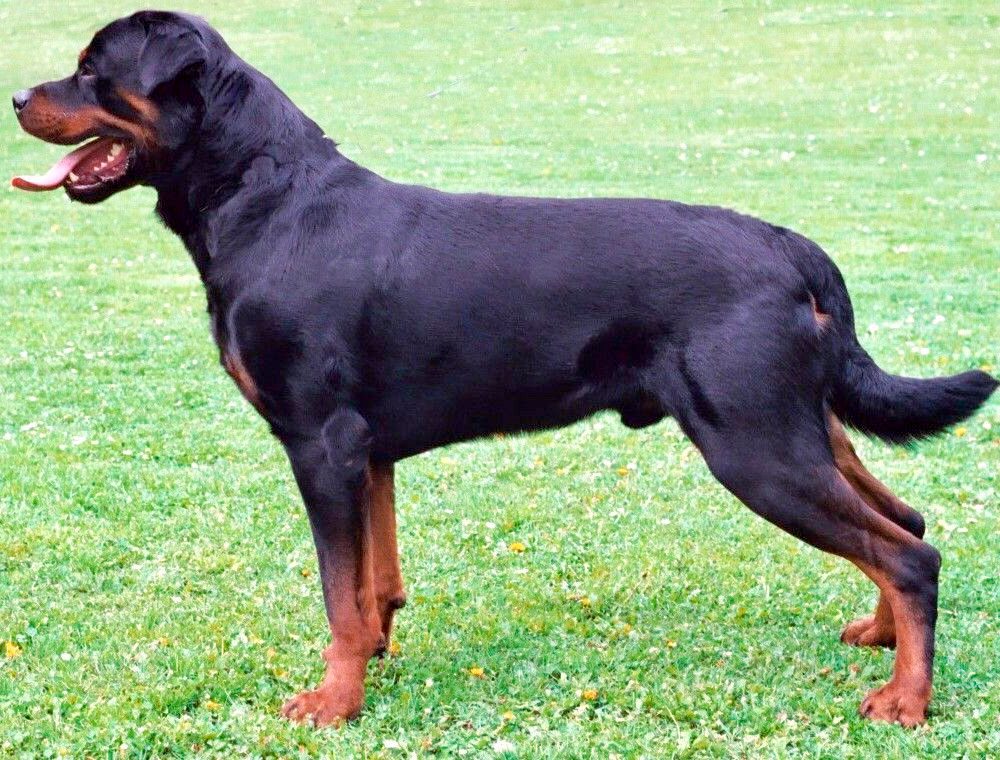
Working group · Germany
Rottweiler
- SizeLarge
- Height56–69 cm (AKC)
- Weight~36–61 kg (AKC profile)
- GroupWorking
- EnergyModerate
Photo: Dr. Manfred Herrmann Allgemeiner Deutscher Rottweiler-Klub (ADRK) e.V. http://www.ADRK.de, CC BY-SA 3.0, via Wikimedia Commons

Overview
The Rottweiler takes its name from the old free city of Rottweil in southern Germany, where it was known as the butcher's dog and worked driving and guarding cattle and pulling carts. The AKC standard describes a medium large, robust and powerful dog, black with clearly defined rust markings, and a calm, confident and courageous temperament with a self-assured aloofness toward strangers. The FCI calls it good-natured, placid, very devoted, obedient and eager to work, and a companion, service and working dog.
History
The Rottweiler is a German working breed—FCI lists Germany as the country of origin—shaped around the old cattle town of Rottweil in the southwest. Clubs still tell a Roman drover-dog story about mastiff-type cattle dogs that came over the Alps with the legions; they treat it as colour and tradition, not a paper trail. Later registry dates stay separate: AKC first registrable 1931, CKC recognized 1938, FCI definitive acceptance 1955.
Ask where the Rottweiler begins and most kennel clubs reach for Rome. FCI, ADRK, AKC, and CKC all describe mastiff-type cattle-driving dogs travelling with legions over the Alps, guarding people, stock, or supplies. The AKC judges’ study guide is frank: the origin is “not a documented record.” The Rottweiler Club of Canada calls Roman descent a likelihood, not a ledger. Good colour for the chapter—attributed theory, not a proven foundation line.
In the club telling, those Roman-route dogs reached the country around present-day Rottweil and met local stock. FCI and ADRK talk about a natural mix with native dogs; The Kennel Club mentions mastiff-type dogs blending with sheepdog blood. None of that is a surviving mating register. The sequence that holds up is simpler: a Roman-era theory, a local working population, and a later name taken from the old city of Rottweil.
Nineteenth-century Rottweil was a serious cattle mart. ADRK describes drives toward Breisgau, Alsace, and the Neckar valley. FCI and CKC put the dog’s main work in driving and guarding cattle, defending handlers and property, and watching market goods. That is the strongest regional foundation: a tough livestock dog shaped by butchers, dealers, and drovers.
Clubs still call it the Rottweil butcher’s dog—FCI’s phrase, and in German *Rottweiler Metzgerhund*. Butchers kept what worked: a dog that could drive cattle, guard people and property, and pull a cart. Keep “butcher’s dog” as an historical label, not a separate breed or a single founding guild.
The money-pouch story travels with that label. KC, CKC, AKC, and the Rottweiler Club of Canada repeat the tale of market cash tied around the dog’s neck to put thieves off. AKC’s study guide calls it a legend. Fine as attributed club tradition—not as independently verified economic history.
Cattle work gave way to carts, then to engines. ADRK says railways and other vehicles displaced the old useful jobs; CKC says mechanized transport threatened the livelihood; AKC ties the decline to industrial-era rail. The sources support a nineteenth-century transition, not one universal cutoff date stamped on every town.
How thin the type ran is hard to measure. AKC notes only one Rottweiler at the 1882 Heilbronn show; the Rottweiler Club of Canada frames 1882–1910 as a climb from obscurity to national notice. Those are club and registry snapshots—not a census of the whole breed. The revival looks like fanciers keeping useful dogs, then public-service demand opening a new path.
German standardization came in steps. The Rottweiler Club (UK) dates an International Club for Leonbergers and Rottweiler Dogs to 1899, with a first Rottweiler breed standard in 1901, and a German club in 1907 meant to keep purity, breeding records, a fixed standard, and working qualities. Those are attributed milestones—not proof that one 1901 page instantly produced the modern dog.
ADRK’s own founding labels need both dates. The current ADRK statute traces the foundation back to 1907. Club history dates the Allgemeiner Deutscher Rottweiler-Klub (ADRK) itself to August 1921; ADRK’s English pages present it as Germany’s only VDH-recognized Rottweiler association, with long breeding supervision. Report 1907 as predecessor/continuity in the statute, and 1921 as formal ADRK formation in the club history—without silently picking one.
As Germany’s VDH-recognized Rottweiler association, ADRK sets binding breed characteristics and keeps studbook, breeding, aptitude, and performance records. Its standard still names companion, service, guide, working, and family-dog purposes; its history says selection prized fitness, intelligence, endurance, and driving ability. That is institutional standardization on a regional working population—not proof every historical dog looked alike.
Early in the twentieth century, police forces were shopping for breeds. ADRK says Rottweilers were tested and officially recognized as police dogs in 1910. CKC repeats the police-dog turn, especially in Europe; The Kennel Club notes modern armed-forces and police use. The sources support a documented shift from cattle and cart work toward police and other service—not a claim that police work erased every other job.
Britain’s path is club chronology first. The Rottweiler Club says the first UK import arrived in 1936 and showed in the Kennel Club’s miscellaneous “Any Other Breed…” classes, with first registration as a breed in its own right in 1965. Post-war establishment followed Captain Roy Smith’s 1953 imports and club formation in 1960. Current KC pages list the breed in the Working group but do not publish a Rottweiler-specific recognition year. Treat 1936 and 1965 as the club’s UK timeline, not as independently verified KC archival dates.
In the United States, AKC’s breeds-by-year list makes the Rottweiler first registrable in 1931. AKC history puts a dog in the stud book that year, places the breed in the Working Group, and dates the first AKC standard publication to 1935. An ARC judges’ study guide says “recognized” in 1935—a wording clash. Safest labels: AKC first registrable 1931; first AKC standard publication 1935, with the study-guide’s 1935 “recognition” wording flagged rather than erased.
The American Rottweiler Club formed in 1973 as the national parent club and became an AKC member club in 1991. Those are parent-club dates, not the breed’s AKC recognition year. Later ARC materials put weight on carting, breed evaluation, and working titles.
Canada’s CKC standard labels the Rottweiler “RECOGNIZED: 1938,” Group III Working. The PDF’s January 2006 effective date is a revision stamp, not the recognition year. Keep CKC 1938 distinct from AKC 1931 and FCI 1955.
FCI lists Rottweiler No. 147 with Germany as country of origin, German as the authentic language, Group 2 Molossian/Mastiff type, and a required working trial. Definitive acceptance is 1 January 1955; the current valid standard was published 15 June 2018 (English 24 July 2018). FCI dates sit beside ADRK and national registry chronology—they do not replace them.
Working trials and utility titles run through club and registry life without being every dog’s story. FCI subjects the breed to a working trial. ADRK documents breeding aptitude, performance exams, IGP, and Schutzhund in its governing material. AKC’s working-titles list ties the American Rottweiler Club to DVG America titles including BH, SchH, IPO, IGP, tracking, and utility. The Rottweiler Club (UK) records Working Trials and IPO as control, agility, tracking, and protection. Documented avenues—not one unbroken sport history for the whole breed.
Modern standards still point at the old job. FCI calls for a companion, service, and working dog with a working trial. ADRK wants compact power, agility, and endurance. The Kennel Club stresses strength, manoeuvrability, endurance, courage, biddability, and natural guarding instincts. CKC keeps a strong willingness to work; AKC asks for calm confidence, courage, adaptability, and the same willingness to work. Ideals descended from foundation function—not a lab proof that every historical and modern dog shares one silhouette.
Temperament language belongs to the standards. The Kennel Club wants good-natured, self-assured, courageous, biddable dogs with natural guarding instincts, and keeps nervous, aggressive, or vicious temperament outside the ideal. FCI uses good-natured, placid, devoted, obedient, biddable, self-assured, steady, and fearless. AKC describes self-assured aloofness and an inherent desire to protect home and family. Stick to those attributed terms—no “aggressive breed” shorthand, and no leap from guarding instinct to a universal behaviour claim.
Sources
- FCI nomenclature — Rottweiler (147)
- FCI Standard No. 147 — Rottweiler (PDF)
- ADRK — History
- ADRK — Standard
- ADRK — Statute (PDF)
- AKC — Rottweiler History
- AKC — Breeds by Year Recognized
- ARC Judges Education Breed Study (PDF)
- AKC — Official Standard of the Rottweiler (PDF)
- AKC — Recognized Working Dog Organizations & Titles (PDF)
- The Kennel Club — Rottweiler
- The Kennel Club — Rottweiler breed standard
- Canadian Kennel Club — Rottweiler
- Canadian Kennel Club — Rottweiler standard (PDF)
- The Rottweiler Club (UK) — About/history
- Rottweiler Club of Canada — History
- American Rottweiler Club — History
Type
The AKC standard asks for males of 24 to 27 in (61 to 69 cm) and bitches of 22 to 25 in (56 to 63.5 cm), preferably mid-range, and gives no weight; the AKC breed profile suggests 95 to 135 lb (43 to 61 kg) for males and 80 to 100 lb (36 to 45 kg) for bitches. The FCI asks for males of 61 to 68 cm, with 65 to 66 cm the correct height, weighing about 50 kg, and bitches of 56 to 63 cm, with 60 to 61 cm correct, weighing about 42 kg. Both describe a compact, powerful dog a little longer than tall, and the FCI calls it neither heavy nor light, neither leggy nor weedy.
The outer coat is straight, coarse, dense, of medium length and lying flat, with an undercoat on the neck and thighs that should not show through. The dog is always black with clearly defined rust to mahogany markings: a spot over each eye, and markings on the cheeks, the sides of the muzzle, the throat, the chest, the legs and under the tail. The AKC asks that the markings cover no more than ten percent of the body and that the dog be shown untrimmed, and both standards treat a long coat as a disqualification.
Temperament
The AKC standard describes a calm, confident and courageous dog with a self-assured aloofness that does not lend itself to immediate and indiscriminate friendships. It responds quietly, with a wait-and-see attitude, to what goes on around it, and has an inherent desire to protect home and family. The FCI asks for a self-assured, steady and fearless dog, very alert yet even-tempered. In the show ring the AKC does not penalize an aloof or reserved dog, and notes that an aggressive or belligerent attitude toward other dogs should not be faulted; a shy Rottweiler is excused, and the FCI disqualifies shy, nervous, vicious or excessively suspicious dogs.
Energy
Moderate. The AKC describes a muscular, athletic breed that should exercise every day and loves swimming, walking and trotting with its people. Rottweilers learn carting easily and do well at herding, tracking and obedience.
Intelligence
Stanley Coren's The Intelligence of Dogs ranks the Rottweiler 9th for working and obedience intelligence. The AKC standard calls it an intelligent dog with a strong willingness to work, and the AKC finds it highly trainable and eager to please, though some can be stubborn. It recommends discipline that is consistent, fair and firm without being rough.
Intelligence here means typical trainability, guided by Stanley Coren's survey of obedience judges. It is not a verdict on any one dog.
Care
Grooming
The AKC recommends weekly brushing and regular baths. Shedding is moderate for most of the year and heavier twice a year, usually in spring and fall. Teeth should be brushed and nails trimmed weekly; the AKC finds a grinding tool especially effective for nails.
Health notes
The AKC calls Rottweilers generally healthy and gives a life expectancy of 9 to 10 years. Inherited problems that can be passed on include hip and elbow dysplasia, several eye problems, bleeding disorders, heart defects and cancer. For a CHIC number from the Orthopedic Foundation for Animals, a Rottweiler needs OFA hip and elbow evaluations and, at 24 months or older, an eye exam and a heart exam. The American Rottweiler Club requires these tests of its members' breeding dogs, strongly recommends that the heart exam be done by a board-certified cardiologist using echocardiography, and requires that every litter have at least one parent clear of the gene for juvenile laryngeal paralysis and polyneuropathy (JLPP), a fatal inherited disease.
Ordinary care
The AKC says Rottweilers should be trained from an early age, and that leadership, puppy socialization, basic training classes and living in the owner's home are the keys to a well-mannered dog. It describes them as people dogs that do not do well isolated, and advises against roughhousing, which may encourage aggression.
Facts
- According to the AKC, after a sale at market the drover often tied the money in a purse around the Rottweiler's neck, trusting the dog's looks to put off robbers.
- The FCI standard says the Rottweiler was tested with other breeds for German police service and officially recognized as a police dog in 1910.
- The current AKC standard, effective in 2022, describes both tails: docked, leaving one or two vertebrae, and undocked, carried straight or curved upward and allowed to hang at rest. The FCI standard describes only the natural tail.
The Dog Codex is an editorial reference, not veterinary advice. Health notes summarize conditions that appear in breed literature; they do not diagnose an individual dog and do not replace examination by a licensed veterinarian.