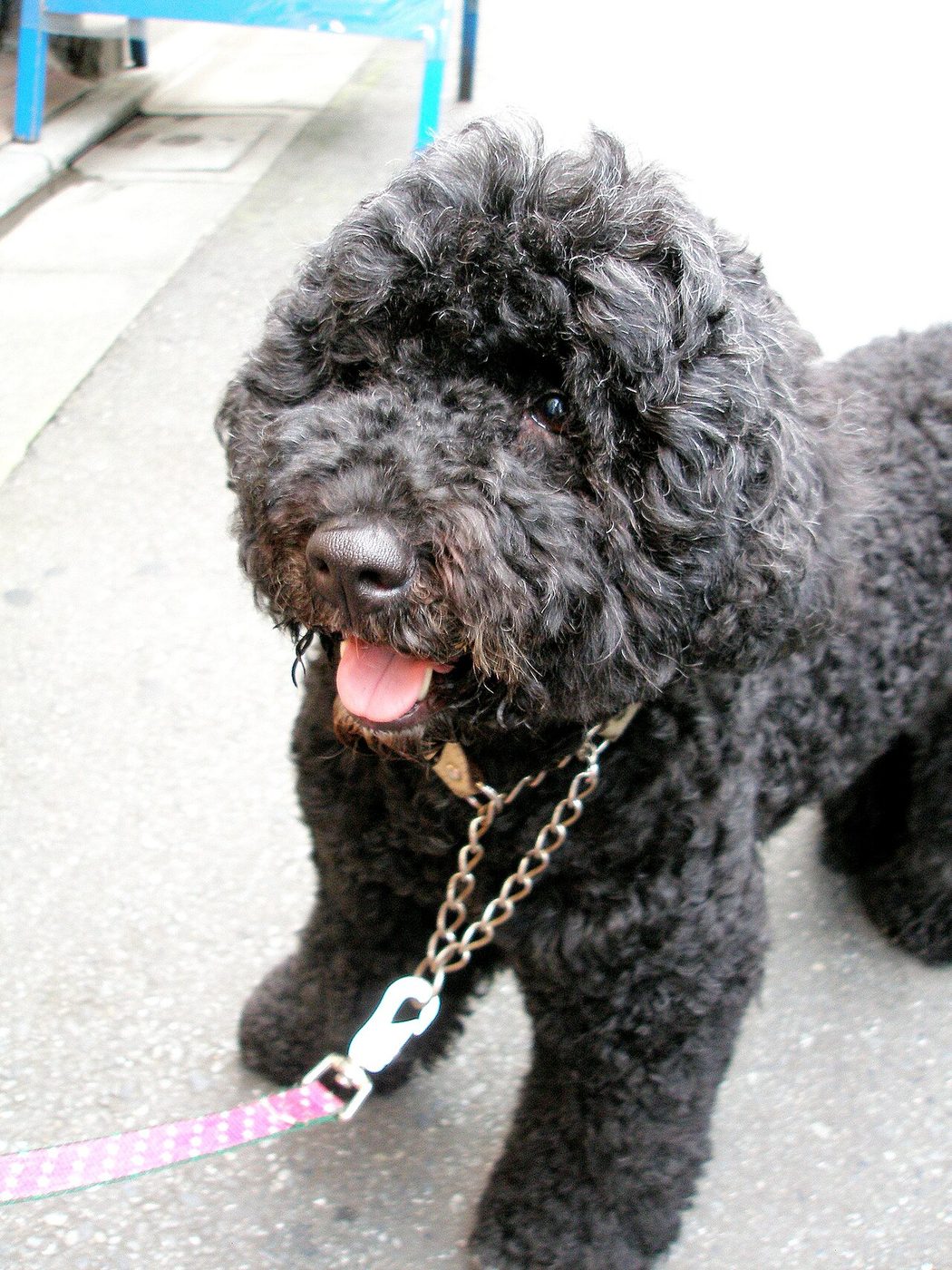
Working group · Portugal
Portuguese Water Dog
- SizeMedium
- Height43.2–58.4 cm (registry- and sex-specific; AKC males 50.8–58.4 cm / females 43.2–53.3 cm; FCI/Royal Kennel Club/CKC males 50–57 cm and females 43–52 cm)
- Weight15.9–27.2 kg (AKC sex-specific); FCI/Royal Kennel Club/CKC males 19–25 kg and females 16–22 kg
- GroupWorking
- EnergyHigh

Overview
The Portuguese Water Dog is a robust, medium-sized coastal worker whose outline still reads as a fisherman’s partner: webbed feet, a thick rudder-like tail, substantial bone, and a profuse curly or wavy single coat with no undercoat. For centuries along Portugal’s coast, fishermen prized a spirited yet obedient dog able to put in a full day’s work in and out of the water—swimming, diving, retrieving broken nets, herding schools of fish toward nets, and carrying messages between boats and shore. AKC calls it a highly intelligent utilitarian breed and a loyal companion and alert guard; FCI describes an inseparable fisherman’s companion that also guards boat and property. That dual identity matters: athletic water worker and household partner in the standards’ own language—not a promise that every individual will dive for a net or suit every lifestyle.
History
Portugal is the country of origin listed by FCI, with the Clube Português de Canicultura describing an autochthonous coastal breed later concentrated in the Algarve as fishing methods changed. AKC, CKC, and The Royal Kennel Club likewise identify Portugal and the fishing tradition. Parent-club and AKC historical writing credit Portuguese shipping magnate Vasco Bensaude with locating remaining working dogs in the Algarve and founding Algarbiorum Kennels; his dog Leão (often dated 1931–1942 in club histories) is described as the modern foundation sire and model for the written standard—treat that rescue narrative as attributed club history. Regional club material quoting PWDCA also cites an early written description dated to 1297 of a black-coated water dog clipped in a lion-like fashion; that medieval anecdote is club-transmitted colour, not a verified continuous pedigree. The Portuguese Water Dog Club of America formed in 1972; AKC admitted the breed to the Miscellaneous Class on 3 June 1981, accepted stud-book registration effective 1 August 1983, and made it eligible for the Working Group from 1 January 1984. FCI records definitive acceptance on 1 February 1955; CKC recognition is recorded in 1979.
Type
Medium-sized is directly supported by AKC’s “robust, medium build,” CKC’s “medium-sized, sturdy, athletic swimming dog,” and FCI’s “dog of medium proportions.” FCI describes an almost square outline with length approximately equal to height; AKC and CKC describe a dog that is slightly longer than tall (“off square”). Attribute those proportion notes to the registry rather than forcing one silhouette claim. Height and weight bands above quote each registry; do not treat them as a blended midpoint or a healthy-weight prescription for every dog.
A profuse single coat of strong hair covering the whole body evenly (thinner in the underarms and groin), with no undercoat. Two varieties are recognized without preference: curly—compact cylindrical curls, somewhat lustreless—and wavy—falling gently in waves with a slight sheen (FCI also describes the long/wavy variety as slightly shiny and woolly). AKC and CKC state no preference between curly and wavy; FCI names long-and-wavy versus shorter-and-curly varieties. Double coat, sparse coat, naturally short close-lying hair, and wispy or wiry texture are major faults under AKC. Lion and retriever clips are conformation presentations, not separate coat types: either correct clip is acceptable without discrimination under AKC/CKC. Colour includes black, white, and various tones of brown, plus black or brown with white; attach white-marking placement claims to the registry, as FCI is more restrictive than AKC/CKC wording.
Temperament
The standard temperament is spirited, intelligent, self-willed or wilful, brave, fatigue-resistant, and obedient to its handler. AKC says the dog obeys its master with facility and apparent pleasure; major faults include shy, vicious, or unsound behavior. FCI calls the breed exceptionally intelligent, impetuous, wilful, courageous, sober, and resistant to fatigue, with a severe, penetrating, attentive expression. The Royal Kennel Club summarizes a pleasant disposition, self-willed but very obedient to owner, brave and tireless. That pairing—drive plus partnership—is the practical heart of the description: selected to work closely with a fisherman, enter water willingly, retrieve, and stay useful through a long day. Consistent, reward-based training and early socialization are a sensible reading of those sources; individuals still vary with breeding, health, experience, and management.
Energy
High / working engagement: AKC’s summary statement calls for a dog able to do a full day’s work in and out of the water. FCI and CPC emphasize swimming, diving, fatigue resistance, and a multitude of fishing tasks. The Royal Kennel Club calls the breed a tremendously energetic fisherman’s dog with great swimming and diving traits; CKC describes a robust, tireless dog ready for a full day’s work in or out of the water. Useful outlets can include swimming and water work, retrieving, boat or dock activities, obedience, agility, tracking, and rally—documented utilization, not a fixed daily minute count. Age, conditioning, weather, health, and individual drive still shape the right plan.
Intelligence
High trainability is a fair shorthand for standards language that calls the breed highly intelligent (AKC) or exceptionally intelligent (FCI), obedient to its handler, and built for utilitarian water work and partnership. Clear, reward-based training can channel retrieving, water work, recall, impulse control, obedience, agility, tracking, and other structured sports. The same sources describe a self-willed or wilful streak; engagement and fair handling matter, and no plate predicts how every dog will behave with strangers, other dogs, or household routines.
Intelligence here means typical trainability, guided by Stanley Coren's survey of obedience judges. It is not a verdict on any one dog.
Care
Grooming
The coat needs regular, hands-on maintenance. The Portuguese Water Dog Club of Great Britain describes weekly brushing and combing for a retriever trim, with clipping or scissoring about every 6–8 weeks, and more frequent combing for a longer lion clip. After swimming, rinse out salt, chlorine, and debris so the coat does not mat or irritate skin. Hair can grow in the ear canal; ear care, nail trimming, and dental care belong in ordinary routines. Companion households often keep a shorter retriever or working clip; show presentation may use either lion or retriever clip. Inspect feet, webbing, ears, eyes, skin, and the plume after water or field work. Standards describe coat structure and the absence of undercoat—not allergen output or shedding lifestyle claims.
Health notes
Only conditions and screening protocols named by a parent club, registry, or kennel-club health programme are listed; no prevalence, lifespan, or diagnosis is inferred. The Portuguese Water Dog Club of America’s health statement (board-approved material hosted by AKC, dated 7 September 2020 in the statement itself) recommends clearances before breeding and recording them in the club’s Health & Litter Log, with verification through OFA. Its minimum recommended panel includes OFA hip certification at 2 years or older (Fair, Good, or Excellent) on both parents; current yearly Eye Certification Registry / CAER examination (passing) on both parents; and DNA tests for prcd-PRA, EOPRA, Microphthalmia Syndrome (MO), GM-1, and JDCM, with at least one parent normal/non-carrier (or accepted clear-by-parentage where allowed). PWDCA also encourages DNA profiling and notes optional testing such as OFA elbows and the Improper Coat (IC-13) genetic test. The Portuguese Water Dog Club of Canada’s health page aligns closely and lists IC-13 among DNA items. The Royal Kennel Club places prcd-PRA under Good Practice and elbow dysplasia, hip dysplasia, GM1, and EOPRA under Best Practice. OFA explains that a CHIC number means required breed-specific tests were completed and results made public; it does not mean every result was normal. Request identifiable parental results and discuss the individual dog with a veterinarian.
Ordinary care
Care should match the dog the standards describe: a mobile, water-capable working companion built for stamina and partnership. Build everyday life around regular, age-appropriate movement and opportunities to swim, retrieve, problem-solve, and train. Water work is an especially natural outlet where safely available; obedience, agility, tracking, rally, and other sports can also use the breed’s documented intelligence and drive. Use calm, reward-based training for recall, impulse control, retrieving manners, boat or dock safety, and settling. Young dogs need gradual conditioning rather than forced repetitive impact or exhaustion; adults and seniors need exercise adjusted for fitness, weather, mobility, and veterinary advice. Keep coat, ears, feet, webbing, nails, and teeth on a routine; rinse after salt or chlorinated water. Keep body condition under review and do not treat a registry weight range as a feeding prescription. For a puppy or breeding prospect, ask for actual PWDCA/PWDCC/OFA or applicable national screening records—hips, current eye exam, and the DNA panel relevant to that programme—rather than a general claim that the parents are healthy.
Facts
- Cão de Água means “dog of water”; FCI and CPC use Cão de Água Português as the official breed name.
- Herding fish is in the standards: AKC, CKC, and The Royal Kennel Club describe driving schools of fish toward nets as part of the historic job.
- The thick, tapering tail helps in swimming and diving and is carried in a ring when the dog is attentive, per AKC, FCI, and CKC.
- Standards describe soft, hair-covered webbing extending to the toe tips.
- Curly and wavy are coat varieties within one breed—not two breeds; FCI lists long-and-wavy and shorter-and-curly varieties.
- Lion and retriever are clips, not coats; AKC and CKC accept either without discrimination when correctly presented.
- No undercoat is a standard requirement; AKC lists a double coat as a major fault.
- American Working Group competition began in 1984 after Misc. Class admission in 1981 and stud-book registration in 1983.
- FCI accepted the breed definitively on 1 February 1955.
- A CHIC number records completed, public tests—not a clean bill of health.
The Dog Codex is an editorial reference, not veterinary advice. Health notes summarize conditions that appear in breed literature; they do not diagnose an individual dog and do not replace examination by a licensed veterinarian.