Toy group · Germany
Pomeranian
- SizeToy
- Height18–24 cm (FCI)
- Weight1.4–3.2 kg (AKC; 1.8–2.7 ideal)
- GroupToy
- EnergyModerate
Photo: Blackoranges, Public domain, via Wikimedia Commons

Overview
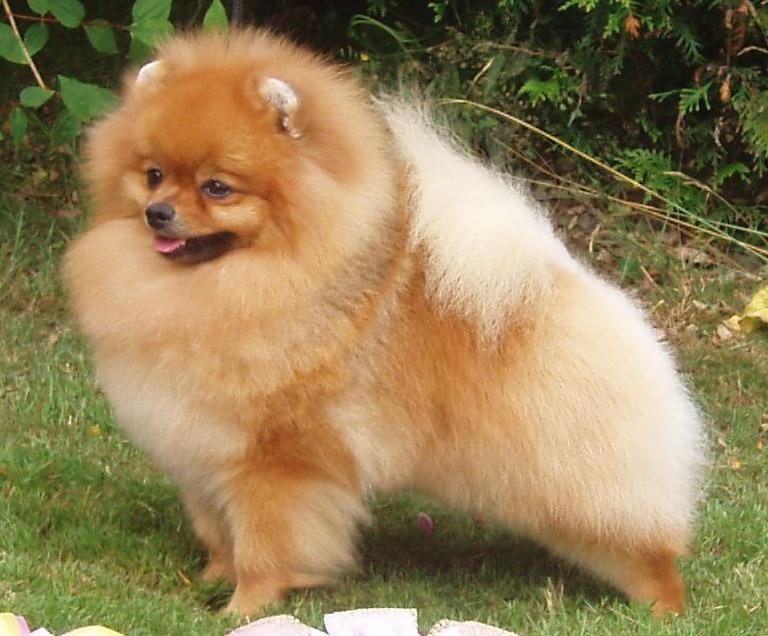
The Pomeranian is the smallest of the German Spitz family, a compact toy dog with a fox-like face, small upright ears, a profuse stand-off coat with a big ruff, and a plumed tail carried flat over the back. The AKC standard calls it alert, intelligent, buoyant and inquisitive, cocky and commanding on the move, and an extrovert with a vivacious spirit. It was bred down from larger spitz dogs and, helped along by Queen Victoria, became one of the best-loved toy breeds.
History
The Pomeranian belongs to the German Spitz family, which the FCI calls the oldest breed of dog in Central Europe. It takes its name from Pomerania, a Baltic region now divided between Germany and Poland, where these spitz dogs are thought to have first been bred smaller. The early dogs were much bigger than today's: the two that Queen Charlotte brought to England in 1767, painted by Gainsborough, reportedly weighed 30 to 50 lb. The breed was seen in Britain by 1870, and when the Kennel Club was founded in 1873 the first Pomeranians shown still weighed nearly 18 lb. Queen Victoria's enthusiasm changed everything. In 1888 she acquired Marco, a 12-lb dog from Florence, and went on to keep dozens of Pomeranians and show them in London. The American Pomeranian Club credits her with encouraging the trend toward smaller dogs. The AKC lists the breed as recognized in 1888, while the American club says full recognition came in 1900, the year the club was founded.
Type
The Pomeranian is a compact, square toy dog with a short back, as tall as it is long, and sturdy, medium bone. The AKC standard sets weight at 3 to 7 lb (1.4 to 3.2 kg), with 4 to 6 lb (1.8 to 2.7 kg) ideal for show dogs, but favors overall quality over size; it gives no height, though the AKC breed profile suggests 6 to 7 in (15 to 18 cm). The FCI sets height at 21 cm, give or take 3 cm, and asks for a weight in keeping with the size.
The double coat has a short, dense undercoat and long, harsh guard hairs that stand off from the body, forming a ruff around the neck and chest, feathering on the forelegs, a skirt on the hind legs and a plume on the tail. The AKC allows all colors, patterns and variations, judged equally, and names patterns such as brindle, parti, piebald, Irish and tan points; orange and red are the most familiar. The FCI lists white, black, brown, orange and grey-shaded, along with cream, sables, black and tan and white with patches, among others.
Temperament
The AKC standard describes an extrovert with great intelligence and a vivacious spirit: alert, inquisitive and buoyant, cocky and commanding. The FCI adds that the Toy Spitz is always attentive, lively and extraordinarily attached to its owner, very teachable, and neither timid nor aggressive, and calls its cheerful, companionable character ideal for a companion and a watchdog for house and apartment.
Energy
Moderate. The AKC standard calls the Pomeranian an active toy dog, and the AKC says that although Poms enjoy being lapdogs, they benefit from exercise and like the chance to run, play and go for walks. Many enjoy agility, rally and obedience.
Intelligence
Stanley Coren's The Intelligence of Dogs ranks the Pomeranian 23rd for working and obedience intelligence, in his 'excellent working dogs' tier. The AKC asks for an expression that shows its alert, intelligent nature, and the FCI calls the Toy Spitz very teachable and easy to train. Poms can excel in agility, rally and obedience, though housetraining takes patience and consistency.
Intelligence here means typical trainability, guided by Stanley Coren's survey of obedience judges. It is not a verdict on any one dog.
Care
Grooming
The profuse coat needs a thorough weekly brushing down to the skin with a pin brush and slicker to prevent mats. The AKC suggests a full groom, with bath, ears, nails and anal glands, every four to six weeks, done at home or by a groomer. Keep the nails short, and brush the teeth at the weekly grooming session.
Health notes
The AKC gives a life expectancy of 12 to 16 years. For a CHIC number, the Orthopedic Foundation for Animals requires an advanced cardiac exam, a patellar luxation evaluation, and one elective: either an ACVO eye examination or an autoimmune thyroiditis test. Hip and Legg-Calvé-Perthes X-rays are optional. The American Pomeranian Club names slipping kneecaps as the most common problem in the breed and hypothyroidism as very common, and also lists alopecia X ('black skin disease'), a coat loss for which there is no test; collapsing trachea, often heard as a honking cough; heart problems; low blood sugar in very small or very active puppies; and idiopathic epilepsy. The AKC suggests keeping Poms from jumping on and off furniture, which can injure joints or break bones.
Ordinary care
Poms are small enough to slip through gaps in fences and can be mistaken for prey by hawks and owls, so the AKC advises staying with them outdoors and watching for loose dogs on walks. Train them early to walk on a leash and come when called, keep them from jumping off furniture, and ask breeders for the parents' knee, heart and eye results.
Facts
- In the FCI's system the Pomeranian isn't a breed of its own but the smallest size of the German Spitz, which also comes as the Miniature, Medium and Giant Spitz and the Wolfsspitz, known outside Germany as the Keeshond. Germany itself didn't accept the name Pomeranian until 1974.
- Queen Victoria's first Pomeranian, Marco, came from Florence in 1888 and weighed 12 lb, far more than today's Poms. She went on to keep as many as 35, and asked for her Pomeranian Turi to be at her side on her deathbed.
- Of the three dogs known to have survived the sinking of the Titanic in 1912, two were Pomeranians.
- Queen Charlotte brought two Pomeranians, Phebe and Mercury, to England in 1767. Gainsborough painted them, and they were far bigger than today's breed, reportedly 30 to 50 lb.
- The Pomeranian is named after Pomerania, a region on the southern Baltic coast now split between Germany and Poland. The name Pommern is said to mean 'on the sea'.
The Dog Codex is an editorial reference, not veterinary advice. Health notes summarize conditions that appear in breed literature; they do not diagnose an individual dog and do not replace examination by a licensed veterinarian.