Toy group · France / Belgium
Papillon
- SizeToy
- Height20–28 cm (registry-specific; AKC 8–11 in / ~20.3–27.9 cm, DQ over 12 in; FCI about 28 cm; Royal Kennel Club 20–28 cm; CKC ideal 20.25–28 cm)
- Weight~2.3–4.5 kg (AKC breed-page summary 5–10 lb; FCI categories under 2.5 kg, or 2.5–4.5 kg dogs / 2.5–5 kg bitches, minimum 1.5 kg; AKC, CKC and Royal Kennel Club standards give no numeric weight — “in proportion to height”)
- GroupToy
- EnergyModerate

Overview
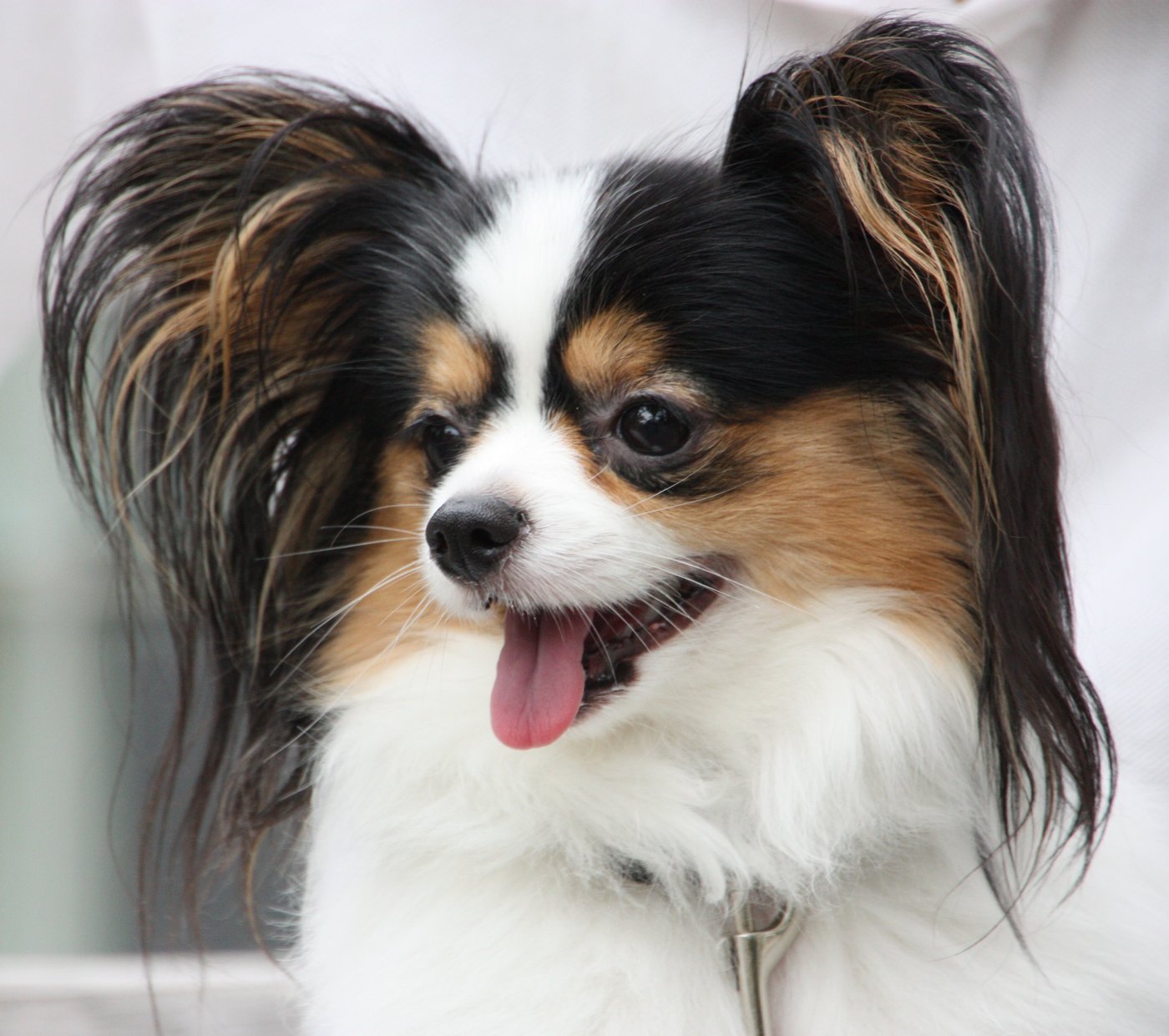
The Papillon is a small, fine-boned toy dog whose calling card is right there in the name. Papillon is French for butterfly, and the AKC standard opens by calling the breed “distinguished from other breeds by its beautiful butterfly-like ears.” When the ears are erect they are carried obliquely, fringed and open, and they move like a butterfly’s spread wings. When the ears are completely dropped, the dog is the Phalène — the moth. Under AKC, The Royal Kennel Club and the Canadian Kennel Club, Papillon and Phalène are one breed; under FCI they are two named varieties of the Continental Toy Spaniel (Épagneul nain continental), each eligible for its own CACIB. Beneath the ears is an elegant, light companion with a long, silky single coat, a white blaze preferred on the face, and a long plumed tail carried arched over the back. The standards agree on temperament in almost the same words: happy, alert and friendly (AKC and CKC); lively, intelligent, friendly and always alert, with no aggression (The Royal Kennel Club); FCI’s general appearance asks for a “lively personality” and eliminates aggressive or overly shy dogs. The butterfly ears are the visual hook, but the sources also insist this is not a fragile ornament. AKC’s breed page calls Paps “more robust than they look,” notes sporting-spaniel blood in the background and credits them as consistent winners at the highest levels of agility. The Papillon Club of America’s 2016 health statement describes “charming, affectionate, attractive, athletic toy dogs.” Court-spaniel elegance and a genuinely athletic little dog, both at once.
History
France and Belgium share the claim. FCI Standard No. 77 gives “ORIGIN: France, Belgium,” and FCI’s nomenclature entry lists the same pair. AKC’s breed-page summary panel lists France alone. The Canadian Kennel Club’s breed-information page says both the French and the Belgians claim the breed today, while tracing the early dogs from Italy into the courts of Europe. The name itself is not marketing folklore. The Royal Kennel Club’s standard puts it cleanly: Papillon “is derived from the shape and position of the ears. When erect they are carried obliquely like the spread wings of a butterfly, hence the name. When the ears are completely dropped this type is known as the ‘Phalene’ (Moth).” AKC’s breed page says papillon is French for butterfly, and that some dogs have erect ears while others, “known as the Phalene type,” have the ears down. FCI treats Papillon and Phalène as two varieties of one breed, the Continental Toy Spaniel; AKC, The Royal Kennel Club and CKC register both ear carriages under the Papillon name, and AKC notes that in Europe the drop-eared variety “competes with equality in the ring against the erect-eared type.” CKC adds chronological colour the other registries do not spell out the same way: originally all were small drop-eared spaniels; erect-eared dogs appeared sporadically in the 1700s and in rising numbers in the late 1800s; French and Belgian kennel clubs gave the erect-eared variety the name Papillon in 1933, and the original drop-eared dogs the name Phalène — a night moth with folded wings. CKC also flags, and gently sets aside, a popular story that Marie Antoinette coined “La petite Papillon.” AKC’s history writing places Papillons as companions for noblewomen and favourites in the royal courts of Europe for hundreds of years, appearing in portraits by Rubens, Rembrandt, Goya and Toulouse-Lautrec; developed in Renaissance times by crossing existing toy breeds with spaniels (early ancestors known as “dwarf spaniels”); and admired by Madame de Pompadour, Louis XIV and Marie Antoinette, whose Pap named Thisbe is said to have stood outside the prison where the queen awaited execution. AKC also says the French connection is strong, but that early breeding centres in Italy and Spain refined and popularised the dogs. The Royal Kennel Club’s A–Z page likewise places Papillon and Phalène as hugely popular in Europe’s royal courts and names Madame de Pompadour and Queen Marie Antoinette. CKC calls it “one of the oldest of the toy breeds,” notes works of art showing type breeding true for hundreds of years, and describes a Franco-Belgian breed with Italian roots. The painter lists, the named royal admirers and the Thisbe anecdote are attributed club and registry history colour. On the registry side, AKC registered its first Papillon in 1915 and the Papillon Club of America formed in 1935; the current AKC standard was approved on 10 June 1991 and took effect on 31 July 1991. FCI accepted the Continental Toy Spaniel on a definitive basis on 1 January 1954; its official valid standard was published on 17 September 1990. CKC recognition is recorded in 1935, with the current standard effective July 2015. The Royal Kennel Club’s standard was last updated in April 2025.
Type
Toy on this site’s size badge, matching the AKC Toy Group, FCI’s “Toy” utilization and “small de luxe Toy spaniel,” and the roughly 20–28 cm height band shared by AKC, The Royal Kennel Club and CKC. AKC and CKC say the body must be slightly longer than the height at the withers and “not a cobby dog”; FCI says the body is “somewhat longer than high”; The Royal Kennel Club says the dog “will appear slightly longer than high when properly furnished with ruff and hind fringes.” Fine-boned substance is required across AKC, CKC and FCI’s general appearance (“graceful yet robust”). Height bands are close but not identical: AKC sets 8–11 in (about 20.3–27.9 cm), with over 11 in a fault and over 12 in a disqualification; FCI says “about 28 cm”; The Royal Kennel Club gives 20–28 cm; CKC’s ideal is 20.25–28 cm, with over 28 cm a fault and under 20.25 cm or over 30.5 cm a disqualification. On weight, only FCI publishes numeric categories; AKC’s 5–10 lb figure is breed-page summary, not the Official Standard, which simply says weight is in proportion to height. These are conformation descriptions, not a healthy-weight target, and a veterinarian should judge an individual dog’s body condition — worth remembering in a breed AKC notes can be prone to getting overweight.
The coat is abundant, long, fine, silky, flowing and straight, with resilient quality, lying flat on the back and sides of the body, with a profuse frill on the chest and no undercoat (AKC, CKC and The Royal Kennel Club). Hair is short and close on the skull, muzzle, front of the forelegs, and from the hind feet to the hocks. The ears are well fringed, with the insides covered in silken hair of medium length; the backs of the forelegs are feathered; the hind legs have abundant breeches (culottes); and the tail carries a long, flowing plume. FCI adds that some dogs in good coat may have hair about 7.5 cm long at the withers and fringes of about 15 cm on the tail, and warns against woolly hair or an undercoat that would suggest Spitz cross-breeding. Colour rules differ by registry. AKC and CKC want a dog that is always parti-colour or white with patches of any colour or colours; on the head, colour other than white must cover both ears, back and front, and extend without interruption from the ears over both eyes. A clearly defined white blaze and noseband are preferred to a solidly marked head, and symmetry of facial markings is desirable. Body patches do not matter for size, shape or placement. Nose, eye rims and lips must be well-pigmented black. An all-white dog or a dog with no white is a disqualification under both AKC and CKC; CKC also names tricolour — black and white with tan spots over the eyes, inside the ears, on the cheeks, and possibly under the root of the tail. The Royal Kennel Club allows white with patches of any colour except liver, describes the same tricolour pattern, and finds any other colour or combination unacceptable. FCI admits all colours on a white background, requires white to be dominant on the body and legs, prefers a blaze on the head, faults a predominantly white head, and insists on pigmented lips, eyelids and especially the nose; a pink or pink-spotted nose is an eliminating fault. The Royal Kennel Club’s Characteristics section ties the preferred blaze to the butterfly image: head markings should be symmetrical about a narrow, clearly defined white blaze “to represent the body of a butterfly,” desirable but not essential.
Temperament
AKC asks for a dog that is “happy, alert and friendly. Neither shy nor aggressive.” The Royal Kennel Club describes one that is “lively, intelligent, friendly, with no aggression; always alert.” CKC’s standard mirrors AKC’s general-appearance language, and its breed-information page adds that the Papillon is happy, alert and intelligent — “one of the most trainable toy dogs,” excelling in obedience, rally and agility. FCI’s general appearance asks for a “lively personality” and treats aggressive or overly shy dogs as eliminating faults. AKC’s breed page calls the Papillon curious, active and eager to join family fun, and notes that a Pap may be unhappy and develop undesirable behaviours if left alone for long periods. The Papillon Club of America’s health statement describes charming, affectionate and athletic dogs. Read together, the sources describe an engaged, people-oriented companion with real trainability — neither a sedentary lap ornament nor a promise about any individual dog’s behaviour with strangers, children or other animals.
Energy
Moderate, in line with this site’s other Toy plates. The standards still describe a lively dog: AKC’s general appearance is “of lively action”; The Royal Kennel Club’s temperament is “lively… always alert”; FCI asks for an easy and elegant gait and a lively personality. AKC’s exercise copy says Papillons are active, smart dogs that want to play — indoors they enjoy retrieving, outdoors they will run after squirrels and insects — and CKC’s activity note says they are hardy and lively, need exercise, and can be satisfied with regular walks and retrieving games. The athletic side is genuine. AKC says sporting-spaniel blood helps explain why Paps are “among the more athletic and biddable toy dogs,” and that they are excellent agility dogs and consistent winners at the sport’s highest levels. The Papillon Club of America’s genetics articles call Papillons “the top performance dog from the toy group,” frequently starring in obedience and agility, with some excelling in tracking and herding. Documented outlets include agility, obedience, rally, tracking and, per the club, herding. Not every dog will take to every sport, and no registry sets a fixed daily exercise figure.
Intelligence
Stanley Coren's The Intelligence of Dogs ranks the Papillon 8th for working and obedience intelligence, the highest of any toy breed. CKC calls it one of the most trainable toy dogs, and the AKC pictures an athletic, biddable toy that thrives in agility, obedience and rally. Clear, reward-based training and early socialization channel that eagerness well.
Intelligence here means typical trainability, guided by Stanley Coren's survey of obedience judges. It is not a verdict on any one dog.
Care
Grooming
For a long coat, maintenance is relatively light because there is no undercoat. AKC’s breed page says grooming every month or so is fine; between full sessions, run a comb or soft slicker through the hair inside the hind legs, behind the ears and on the culottes, where mats tend to form; bath every few months or when the dog is especially dirty; nails grow quickly and need regular trimming, especially dewclaws; and regular tooth brushing is vital. CKC’s breed page likewise recommends regular brushing, especially of the hair on and behind the ears and between and on the back of the rear legs, and says bathing every few months is enough. The Papillon Club of America’s genetics articles put dental care high on the practical list for this small-jawed breed: regular brushing, scaling and professional dental care as needed.
Health notes
Only conditions and screening routes named by the Papillon Club of America, AKC, OFA/CHIC, a kennel-club health programme or peer-reviewed genetics are listed here, and no prevalence, lifespan or diagnosis is implied. Screening reduces uncertainty; it cannot guarantee an individual dog’s future health. OFA’s current CHIC requirements for the Papillon, set with the parent club, are an ACVO eye examination (screening recommended every two years), an OFA patellar luxation evaluation (minimum age 12 months), and one health elective from: a standard congenital cardiac exam with results registered with OFA, an OFA advanced cardiac exam, an OFA basic cardiac exam, a PRA1 DNA test registered with OFA, or an NAD DNA test registered with OFA. Like every CHIC breed, the dog must also be permanently identified by microchip or tattoo. That panel matches the Papillon Club of America’s Standing Resolution on CHIC (revised 2018, effective 1 January 2019). The club’s 2016 health statement (hosted by AKC) says breeders test dogs being bred so eyes, patellas and hearts are normal, to qualify for a CHIC number, and that the club has worked to develop DNA tests for problems that may occasionally occur, such as PRA-1 and NAD. AKC’s Toy Group health-testing page lists the national club’s recommended tests as Patella Evaluation, Cardiac Exam and Ophthalmologist Evaluation. The club’s Health Concerns article (Elaine S. Zech, on pcagenetics.com) describes patellar luxation as “by far the most frequent orthopedic problem found in the Papillon Breed,” notes progressive retinal atrophy as rarely seen and genetic, recommends cardiac evaluation for breeding stock, and flags inherited liver disorders (shunts / microvascular dysplasia), dental health in a small jaw, idiopathic epilepsy “not frequently found,” and cryptorchidism or monorchidism in males as club-level concerns. AKC’s breed page adds that Papillons are tough but very small — careful around stairs, furniture, larger animals and small children — and that responsible breeders screen for a fontanel (soft spot) in the top of the skull and for patellar luxation. On the DNA side, a 2013 PLOS ONE study by Ahonen, Arumilli and Lohi identified a breed-specific CNGB1 frameshift mutation associated with progressive retinal atrophy (PRA1) in Papillons and Phalènes; the Papillon Club of America describes a DNA test that identifies clear, carrier and affected dogs and encourages breeding carriers only to clears. A 2017 PLOS ONE study by Tsuboi and colleagues identified a PLA2G6 missense mutation associated with Papillon neuroaxonal dystrophy (NAD), matching the club’s DNA-test programme for that autosomal recessive, rapidly progressive neuropathy of young puppies. In the UK, The Royal Kennel Club lists prioritising genetic diversity and a DNA test for progressive retinal atrophy (pap-PRA / Pap-PRA1) as Good Practice, and DNA tests for neuronal axonal dystrophy (NAD / PLA2G6) and von Willebrand’s disease type I (vWD1), plus eye testing under the BVA/KC/ISDS Eye Scheme, as Best Practice. OFA notes that a CHIC number shows the required tests were completed and made public, not that every result was normal, so ask to see the actual results and their dates, and review the dog’s own health with a veterinarian.
Ordinary care
Care should follow the dog the standards describe: a tiny, fine-boned, lively companion that still wants to use its brain and body. Build everyday life around regular play and age-appropriate exercise, reward-based training and company. AKC’s training note stresses early socialization and obedience classes, and warns that Papillons may be unhappy if left alone for long periods. CKC emphasises positive training methods. Because of the small size both AKC and CKC flag, handle puppies carefully around stairs, furniture, larger dogs and young children. Groom for mats in the culottes and behind the ears, keep nails short (especially dewclaws), and take dental care seriously — the Papillon Club of America and AKC both put teeth high on the practical list. For a puppy or breeding prospect, ask for the parents’ actual OFA patella results (at or after 12 months for finals), a current ophthalmologist eye exam, and at least one of the CHIC electives — a cardiac exam and/or PRA1 or NAD DNA. Records beat a general assurance that the parents are healthy.
Facts
- The name is the ear: papillon is French for butterfly; The Royal Kennel Club and AKC both derive it from the obliquely carried, fringed erect ears.
- Moth when the wings fold: the drop-eared variety is the Phalène; FCI lists Papillon and Phalène as separate varieties of the Continental Toy Spaniel.
- In Europe, FCI registers puppies by ear morphology; AKC registers both types as Papillons.
- 1933 naming: CKC says French and Belgian kennel clubs gave the erect-eared dogs the name Papillon — and the drop-eared dogs Phalène — in 1933.
- Butterfly body optional but preferred: The Royal Kennel Club wants a narrow white blaze to “represent the body of a butterfly,” desirable but not essential; AKC and CKC prefer a clearly defined white blaze and noseband.
- No undercoat: AKC, CKC and The Royal Kennel Club all specify a single coat with no undercoat — one reason the long furnishings stay relatively easy to keep.
- Agility standout: AKC calls Paps excellent agility dogs and consistent winners at the sport’s highest levels; the Papillon Club of America’s genetics articles call them the top performance dog from the Toy Group.
- First AKC registration: 1915. Parent club formed in 1935.
- PRA1 has a gene address: a 2013 PLOS ONE study tied Papillon/Phalène PRA to a CNGB1 frameshift mutation.
- NAD does too: a 2017 PLOS ONE study tied Papillon neuroaxonal dystrophy to a PLA2G6 missense mutation, matching the club’s DNA-test programme.
The Dog Codex is an editorial reference, not veterinary advice. Health notes summarize conditions that appear in breed literature; they do not diagnose an individual dog and do not replace examination by a licensed veterinarian.