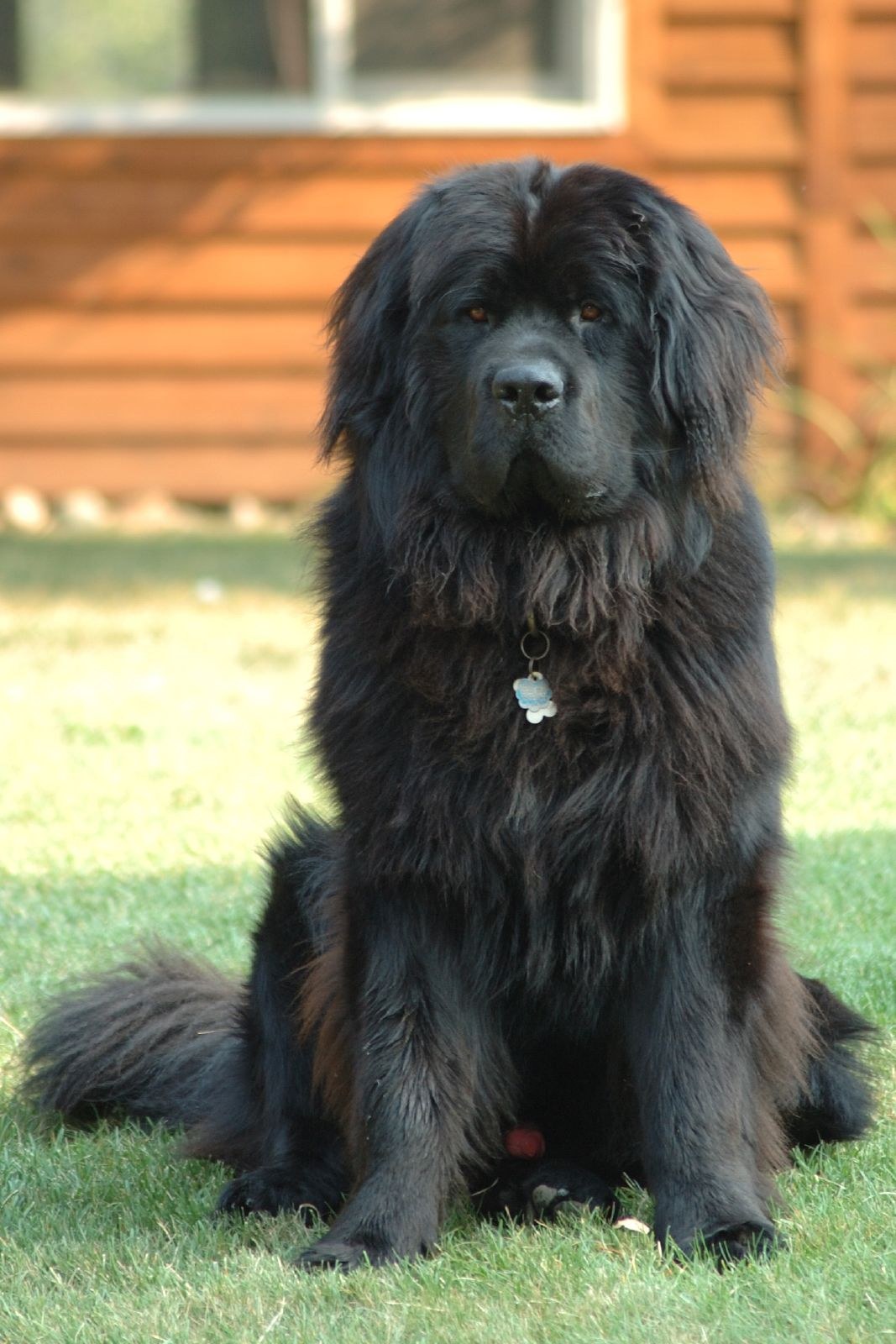
Working group · Canada (Newfoundland)
Newfoundland
- SizeGiant
- Height66–71 cm
- Weight45–69 kg
- GroupWorking
- EnergyModerate
Photo: DanDee Shots, CC BY 2.0, via Wikimedia Commons

Overview
The Newfoundland is a massive, heavily boned, deep-bodied working dog with a thick water-resistant coat, webbed feet and — the standards insist — a sweet heart to match the size. The AKC standard opens with temperament before anatomy: the Newfoundland is “a sweet-dispositioned dog that acts neither dull nor ill-tempered,” a “devoted companion,” and “a multipurpose dog, at home on land and in water… capable of draft work and possesses natural lifesaving abilities.” It then closes by naming sweetness of temperament “the hallmark of the Newfoundland; this is the most important single characteristic of the breed.” That pairing — huge strength, gentle nature, water instinct — is the whole story. FCI calls the breed “dignified, joyful and creative… known for his sterling gentleness and serenity.” The Royal Kennel Club puts it in four words: “Exceptionally gentle, docile nature.” The Canadian Kennel Club standard adds that any show of ill temper or timidity is severely faulted and bad temperament is a disqualification. The water-rescue reputation is well documented in registry and parent-club writing: AKC history calls the Newfoundland’s prowess as a rescuer “the stuff of legend,” The Royal Kennel Club describes modern dogs jumping from boats and even low-flying aircraft to rescue swimmers, and the Newfoundland Club of America has run formal water-rescue tests since the 1970s.
History
The breed takes its name from the island of Newfoundland, Canada. FCI’s nomenclature lists Canada as country of origin (with FCI itself holding patronage); AKC’s breed data likewise says Canada; The Royal Kennel Club notes that this large dog “takes his name from Northeast Canada where he was developed.” On ancestry the registries do not speak with one voice. FCI Standard No. 50 says the breed originated on Newfoundland from indigenous dogs and the big black bear dog introduced by the Vikings after the year 1100, and that by the time colonization began in 1610 the dog “was already largely in possession of his proper morphology and natural behaviour.” The CKC standard follows a similar outline but dates the Viking bear dogs to AD 1001. CKC’s breed-information page is franker still: “There are differing opinions,” including a Tibetan Mastiff theory and the Leif Ericsson “bear dog” story. The Royal Kennel Club takes another line entirely — that the breed was “not indigenous to Newfoundland” but that its ancestors arrived with European fishermen and were selected for well-sprung ribs, an oily waterproof coat and webbed feet. Those are competing registry accounts rather than a single settled pedigree. On the work itself the sources agree more closely. AKC’s standard calls the Newfoundland a multipurpose dog at home on land and in water, capable of draft work and with natural lifesaving abilities. FCI’s utilization line is “Sledge dog for heavy loads, water dog,” and its history says the breed’s features let it withstand extreme climate and the sea’s adversity while pulling heavy loads or serving as a water and lifeguard dog. CKC’s standard notes the same dual role as lifeguard and draught animal, and adds that the tail “acts as a rudder when the Newfoundland is swimming.” AKC history writing describes Canadian fishermen relying on Newfoundlands as shipboard working dogs who specialized in dramatic water rescues — “born swimmers, complete with partially webbed feet, and strong enough to save a grown man from drowning” — that also hauled fishing nets to shore and carted the day’s catch to market; AKC adds that “What the Saint Bernard is to the Alps, the Newfoundland is to the icy waters of the North Atlantic,” and that the breed “is still considered the premium water-rescue dog and is employed in that role the world over.” The Royal Kennel Club’s A–Z page lists towing fishermen’s carts, pulling logs, hauling in nets, retrieving lost equipment from the water, and in more recent times jumping from low-flying planes and helicopters to rescue swimmers. CKC’s breed information calls the Newfoundland “an excellent swimmer with a strong life-saving instinct” and speaks of “hundreds of documented water rescues.” The Newfoundland Club of America notes “many instances on record of Newfies saving lives in water disasters.” Formal water testing followed: according to the NCA’s water-work page, enthusiasts drew up plans in 1971 for a water trial, and the club sanctioned its first official rescue test two years later in Michigan. Today’s NCA divisions include Water Dog, Water Rescue Dog and Water Rescue Dog Excellent, alongside separate draft (carting) tests. The white-and-black pattern known as the Landseer is recognised by AKC, FCI, The Royal Kennel Club and CKC; CKC’s breed page says the variety took that name in Britain after the artist who featured it in A Distinguished Member of the Humane Society. AKC’s did-you-know notes that the breed was exported to England, where it was extensively bred, and that most pedigreed Newfoundlands today — even in Newfoundland — descend from English-born forebears; CKC’s breed page says Newfoundlands helped re-establish the Alpine rescue dogs at the Hospice of St. Bernard after a distemper epidemic. AKC recognised the breed in 1886; the current AKC standard was approved on 8 May 1990 and took effect on 28 June 1990. FCI accepted the breed on a definitive basis on 4 August 1954. CKC recognition is recorded in 1889.
Type
Giant on this site’s size badge, matching the registry averages and this site’s other giant Working breeds. All four major standards give averages rather than hard ranges for height — adult dogs about 71 cm (28 in), bitches about 66 cm (26 in) — and all add that large size is desirable only when balanced with structure, soundness and correct gait. Weight figures differ in form: AKC gives approximate bands (dogs 130–150 lb / about 59–68 kg, bitches 100–120 lb / about 45–54 kg); The Royal Kennel Club gives average bands (dogs 64–69 kg, bitches 50–54.5 kg); FCI and CKC give single averages around 68 kg for males and 54–54.5 kg for bitches. In outline, AKC describes a dog “slightly longer than tall,” with the distance from elbow to ground about half the dog’s height; FCI says body length exceeds height at the withers and “the body is compact,” with bitches slightly longer and less massive; The Royal Kennel Club asks for a well-balanced, compact dog with substantial bone that does not look heavy and inactive. AKC wants movement that gives “the impression of effortless power,” noting that “a slight roll of the skin is characteristic of the breed.” These are conformation descriptions, not a healthy-weight target; a veterinarian should judge an individual dog’s body condition — worth remembering in a breed AKC notes can be prone to putting on weight.
A flat, water-resistant double coat. AKC says it “tends to fall back into place when rubbed against the nap”; the outer coat is “coarse, moderately long, and full, either straight or with a wave”; the undercoat is soft and dense, “often less dense during the summer months or in warmer climates.” Hair on the face and muzzle is short and fine; the backs of the legs are feathered all the way down; the tail is covered with long dense hair. Excess hair may be trimmed for neatness; whiskers need not be trimmed. The Royal Kennel Club adds that the outer coat is “of coarse texture and oily nature, water resistant.” FCI says trimming and scissoring are not encouraged. CKC and FCI both disqualify a short, flat (Labrador-type) coat. Colour is where the registries part ways. AKC says “Color is secondary to type, structure, and soundness,” and recognises black, brown, gray, and white and black (Landseer); solid blacks, browns and grays may have white at the chin, chest, toes and/or tip of the tail, and any colours or combinations not specifically described are a disqualification. FCI recognises black, white and black, and brown — black being “the traditional colour,” white-and-black “of historical significance for the breed” — and disqualifies other colours and non-white markings on black or brown dogs. The Royal Kennel Club allows only black, brown (chocolate or bronze) and Landseer (white and black). The CKC standard is stricter still: traditional black or Landseer only, with any other colour — including brown — a disqualification. So gray is accepted by AKC alone among these four, and brown is accepted by AKC, FCI and The Royal Kennel Club but not under the CKC standard.
Temperament
Sweetness of temperament is, in the AKC standard’s own closing words, “the hallmark of the Newfoundland; this is the most important single characteristic of the breed.” The same standard opens by calling the dog sweet-dispositioned, neither dull nor ill-tempered, and a devoted companion, with an expression that reflects “benevolence, intelligence, and dignity.” FCI describes a dog that is “dignified, joyful and creative… known for his sterling gentleness and serenity,” and disqualifies aggressive or overly shy dogs. The Royal Kennel Club asks for an “exceptionally gentle, docile nature.” The CKC standard calls the breed “benevolent, intelligent, dignified but capable of fun… known for his sterling gentleness and serenity,” severely faults any show of ill temper or timidity, and disqualifies bad temperament. AKC’s training copy describes the puppy as “outgoing, intelligent, and curious… never timid, skittish, or aggressive,” says daily human contact is “absolutely essential,” and notes that Newfoundlands are eager to please but “don’t respond well to harsh corrections.” Breeding, socialization, health and daily life still shape each individual dog.
Energy
Moderate, in line with this site’s other giant Working plates and with AKC’s own exercise copy: “Newfoundlands need at least a half-hour of moderate exercise daily to stay healthy and happy.” The standards still describe a powerful working athlete — AKC wants “good reach, strong drive… effortless power”; The Royal Kennel Club’s general appearance is “strength, great activity and effortless power”; FCI warns against a “sluggish appearance.” Documented outlets are unusually varied: AKC lists swimming, carting and drafting competitions, agility, dock jumping, flyball, herding, obedience, rally and tracking, and the Newfoundland Club of America runs formal water-rescue and draft tests. Not every dog will take to every sport, and no registry sets a fixed daily minute count. Age, conditioning, weather, health and the individual dog shape the right amount.
Intelligence
High trainability fits the standards’ emphasis on intelligence and a devoted, eager-to-please companion, and the Newfoundland Club of America’s formal water-rescue and draft programmes. AKC’s training copy describes an intelligent, curious puppy that responds poorly to harsh corrections and well to daily human contact and gentle handling. Clear, reward-based training, early socialization and careful introduction to water for dogs destined for water work channel that disposition. Individuals and methods still vary; this is a guide to typical trainability, not a published ranking.
Intelligence here means typical trainability, guided by Stanley Coren's survey of obedience judges. It is not a verdict on any one dog.
Care
Grooming
A real commitment, and the sources say so plainly. AKC’s breed page says the heavy coat “requires thorough brushing at least once a week” with a slicker brush and long-toothed comb to remove dead hair and prevent mats; that becomes daily during shedding season, “which generally occurs twice a year,” and AKC adds that spayed and neutered Newfoundlands may shed year-round and need brushing several times a week. Trim nails regularly. AKC’s health note also says that, as with all drop-eared dogs, a Newfoundland’s ears should be checked regularly for signs of infection. CKC’s breed page: “The thick coat needs regular raking and brushing, especially during times of seasonal shedding.”
Health notes
Only conditions and screening routes named by the Newfoundland Club of America, AKC, OFA/CHIC, a kennel-club health programme or peer-reviewed genetics are listed here, and no prevalence, lifespan or diagnosis is implied. Screening reduces uncertainty; it cannot guarantee an individual dog’s future health. OFA’s current CHIC requirements for the Newfoundland, set with the parent club, are a hip evaluation (OFA radiographs or PennHIP, results registered with OFA), an OFA elbow evaluation, a cardiac evaluation (basic cardiac exam performed by a cardiologist, or an advanced cardiac exam), and a DNA-based cystinuria test from an approved laboratory with results registered with OFA — progeny may be cleared by parentage under OFA policy. Like every CHIC breed, the dog must also be permanently identified by microchip or tattoo. That panel matches the Newfoundland Club of America’s CHIC page and its position statement that breeding stock should be tested for hips, elbows, heart (cardiologist) and cystinuria (DNA or parentage), with thyroid, eyes and patellas strongly recommended where indicated. The club’s AKC-hosted health statement requires hips and elbow radiographs submitted to OFA, a DNA cystinuria test, and hearts by auscultation or echo by a board-certified cardiologist, and additionally recommends eye exams, patella palpation and thyroid blood testing. The club’s puppy-info page recommends echocardiogram for all breeding stock and lists accepted cystinuria DNA laboratories. AKC’s Working Group health-testing page lists the club’s recommended tests as Hip Evaluation, Elbow Evaluation, Cardiac Exam and Cystinuria (Newfoundland) DNA Test. A CHIC number means the required tests were done and results made public; the club stresses that CHIC “is not about normalcy.” On conditions named by those sources: hip and elbow dysplasia are required NCA/CHIC screenings, and The Royal Kennel Club lists the BVA/KC hip and elbow schemes under Good Practice. Subaortic stenosis (SAS) is described on the club’s cardiology page as a congenital, genetic heart defect most commonly seen in Newfoundlands, Golden Retrievers and Rottweilers — typically diagnosed in puppies 16 weeks or older — which is why the club requires a cardiologist cardiac exam and recommends echocardiography; the same page also covers patent ductus arteriosus and dilated cardiomyopathy. Genetics for SAS remain unsettled: Stern and colleagues (2014) reported a PICALM association in North American Newfoundlands that Drögemüller and colleagues (2015) did not find in European dogs, and there is no SAS DNA test in the CHIC panel. Cystinuria can cause stones in the urinary system; inheritance in Newfoundlands is autosomal recessive, and Henthorn and colleagues (2000) identified the causative SLC3A1 nonsense mutation that underpins the breed’s DNA test. AKC’s nutrition note warns that the breed can experience bloat (gastric dilatation-volvulus), a life-threatening condition in which the stomach distends and twists, and suggests multiple small meals and avoiding vigorous exercise around mealtimes as possibly helpful; the club maintains a dedicated bloat page. In the UK, The Royal Kennel Club lists a cystinuria DNA test and the BVA/KC hip and elbow schemes as Good Practice, and eye testing under the BVA/KC/ISDS Eye Scheme as Best Practice. Ask for identifiable hip, elbow, cardiologist-performed cardiac and cystinuria results (DNA or clear-by-parentage) for both parents, with dates, and review the dog’s own health with a veterinarian.
Ordinary care
Care should follow the dog the standards describe: a giant, heavily coated, gentle working dog built for water and draught work. Plan space, grooming time and transport for a dog that can reach roughly 45–69 kg. AKC says Newfoundlands are “definitely meant to live indoors with their human family” and enjoy outdoor activities, especially swimming, long walks and hikes; daily human contact is “absolutely essential.” Use early socialization, puppy classes and gentle, reward-based training; AKC warns that harsh corrections don’t work well, and that a puppy intended for water work should be carefully introduced to water by about four months. Build a grooming routine — weekly at minimum, daily in shedding season — check ears, trim nails, and manage food carefully: AKC flags both weight gain and bloat, and suggests multiple small meals with no vigorous exercise around mealtimes. For a puppy or breeding prospect, ask for the parents’ actual clearances: OFA or PennHIP hips, OFA elbows, a cardiologist cardiac exam (the Newfoundland Club of America recommends echocardiogram), and a cystinuria DNA result or clear-by-parentage status. Records beat a general assurance that the parents are healthy.
Facts
- Temperament comes first — literally: the AKC standard ends by calling sweetness of temperament “the most important single characteristic of the breed.”
- Webbed feet are in the standard: AKC calls the feet “webbed”; FCI says “webbing of toes is present”; CKC faults lack of webbing.
- The tail is a rudder: the CKC standard says it “acts as a rudder when the Newfoundland is swimming.”
- A coat that snaps back: AKC says the coat “tends to fall back into place when rubbed against the nap.”
- Water tests since the 1970s: the Newfoundland Club of America says water-trial plans date to 1971 and its first sanctioned rescue test was held in Michigan two years later.
- Rescue the handler: in the club’s senior water test, the dog must leap from a boat to rescue a handler who has “fallen” overboard.
- Named for a painter: CKC says the black-and-white Landseer is named for the artist who painted A Distinguished Member of the Humane Society.
- On the Lewis and Clark trail: AKC says a Newfoundland named Seaman travelled with the expedition.
- Byron’s tribute: AKC recounts Lord Byron’s monument at Newstead Abbey for his Newfoundland, Boatswain.
- One DNA change, one test: a 2000 study traced Newfoundland cystinuria to an SLC3A1 nonsense mutation — the basis of the breed’s DNA test.
The Dog Codex is an editorial reference, not veterinary advice. Health notes summarize conditions that appear in breed literature; they do not diagnose an individual dog and do not replace examination by a licensed veterinarian.