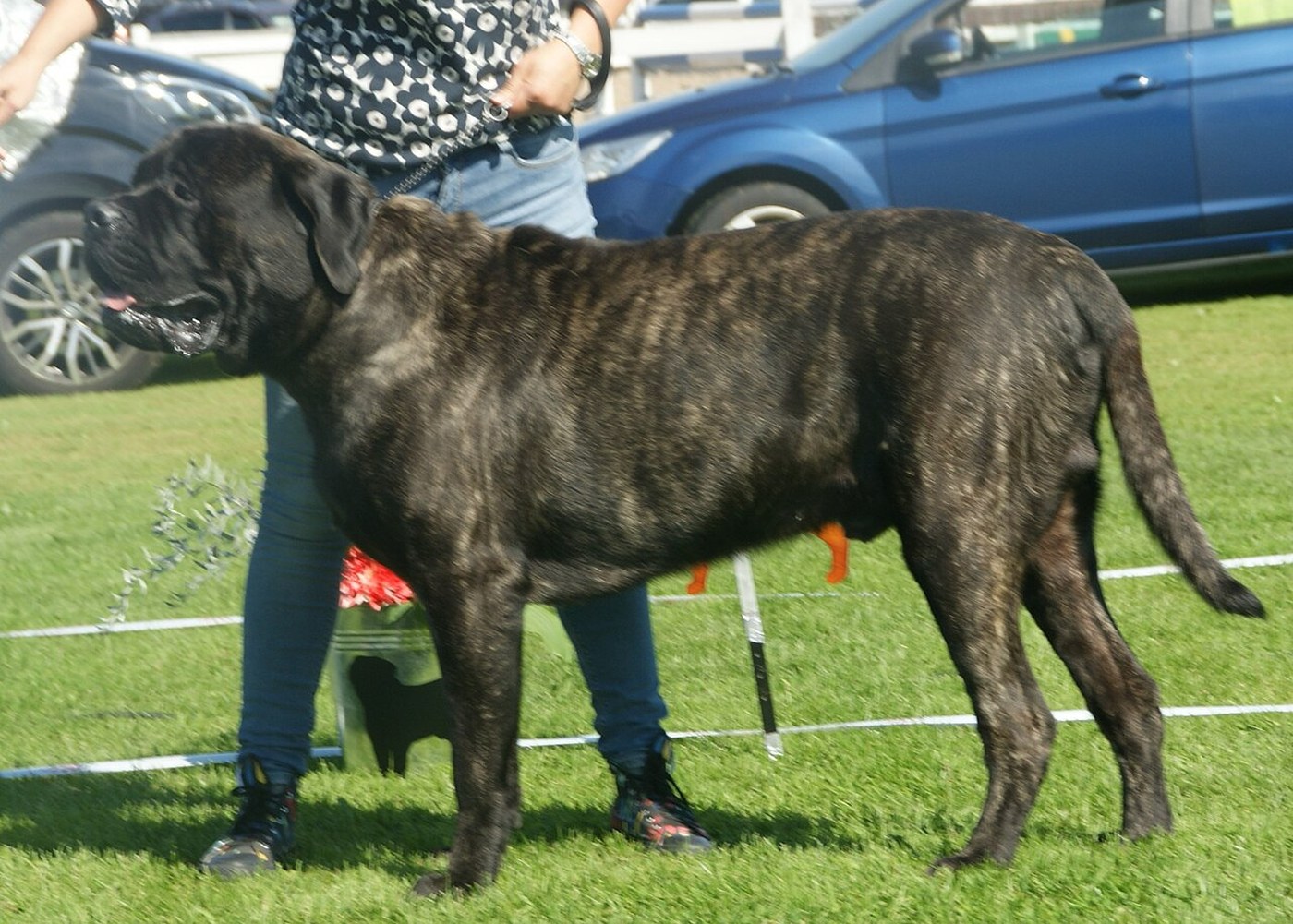
Working group · United Kingdom
Mastiff
- SizeGiant
- Height≥70 cm
- Weightnot specified in standards (AKC overview ~54–104 kg / 120–230 lb)
- GroupWorking
- EnergyModerate
Photo: Canarian, CC BY-SA 4.0, via Wikimedia Commons

Overview
The Mastiff is a giant British Molosser of massive, heavy-boned, rectangular build—grandeur and dignity in outline, historically and in modern standards a watch / security / estate guardian rather than a high-drive sport dog. Major registries agree on a short dense coat in apricot, fawn, or brindle with dark (ideally black) muzzle, ears, and nose; on minimum height floors for dogs and bitches in AKC/CKC (with no numeric maximum and no numeric weight in the Official Standards of AKC, FCI, KC, or CKC); and on temperament language of grandeur, courage, and docility / calm affection with guarding capability. FCI utilisation is "Watch and security dog" and the breed is not subject to a working trial. Plate energy is moderate guardian/companion scale. OEMC (UK parent club) and AKC expert-advice history both insist the correct breed name is Mastiff (not a mandatory "English" prefix); "English Mastiff" / "Old English Mastiff" remain common aliases.
History
Country of origin: Great Britain (FCI N° 264 MASTIFF). Modern standardisation is British/English. AKC history and the Old English Mastiff Club (OEMC) stress that the official breed name is simply Mastiff—attempts to require an "English" prefix have been unsuccessful; OEMC's club name uses "Old English" to differentiate clubs, not as the FCI/AKC breed title. FCI: definitive acceptance 11 May 1964; official valid standard publication 13 October 2010; utilisation Watch and security dog; Group 2, Section 2.1 Molossoid Mastiff type, without working trial. Brief Historical Summary (attribute): mastiff-type dogs encountered by Romans in Britain; Agincourt-era presence in club tradition; near-extinct in Britain after World War II with recovery aided by North American stock. AKC Breeds by Year Recognized: 1885 – Mastiff; Official Standard approved 12 November 1991, effective 31 December 1991; Working Group. AKC history article cautions against treating DNA as proving a single global progenitor and presents Britain as the original of the modern breed; Lyme Hall / Agincourt traditions and postwar reconstitution are club narratives to attribute carefully. Mastiff Club of America (MCOA) established 1929. OEMC founded 19 January 1883 at Crystal Palace; The Kennel Club lists the breed as a Vulnerable Native Breed. CKC Recognized 1889; effective January 2004. Do not invent Roman genetics or collapse recognition years (1883 / 1885 / 1889 / 1929 / 1964).
Type
Giant on this site's size badge (Great Dane–comparable). AKC: dogs minimum 30 in (~76.2 cm), bitches minimum 27½ in (~69.9 cm), no maximum. CKC: dogs minimum 76.25 cm (30 in), bitches 69.75 cm (27.5 in), no maximum. FCI and KC publish no numeric height—size judged with quality and soundness. Rectangular outline; depth of body over length of leg (AKC). No numeric weight in AKC, FCI, KC, or CKC Official Standards; AKC breed-page fact box 160–230 lb males / 120–170 lb females is overview marketing only.
Short or moderately short coarse outer coat with dense, close undercoat; long or wavy coats faulted (AKC). Colours: apricot, fawn, or brindle with dark/black muzzle, ears, and nose (AKC/FCI/KC; CKC apricot, silver fawn, or dark fawn brindle with dark pigment). Small white on the chest permitted in AKC; excessive white faulted or unacceptable/highly undesirable across registries. KC: any other colour or combination unacceptable.
Temperament
Standards centre on grandeur and good nature with courage and docility (AKC/CKC); calm, affectionate, and capable of guarding; usually indifferent to strangers; timidity unacceptable (FCI/KC). Dignity rather than gaiety. Do not badge good-with-kids or apartment-quiz claims.
Energy
Moderate. FCI utilisation is watch and security dog without a working trial; standards emphasise dignity and calm presence rather than high-drive sport work. Moderate exercise language in club and registry articles supports companion-scale work for a giant guardian—not Malinois-level drive, and not inventing exercise-minute prescriptions.
Intelligence
Stanley Coren's The Intelligence of Dogs places the Mastiff 72nd, in his lowest tier for working and obedience intelligence. The AKC notes a stubborn streak alongside a wish to please, so patience and consistency matter with a guardian this large.
Intelligence here means typical trainability, guided by Stanley Coren's survey of obedience judges. It is not a verdict on any one dog.
Care
Grooming
Short coat—vigorous brushing for the dense undercoat; not a hand-strip breed. Do not claim hypoallergenic status from standards.
Health notes
Only club/KC-named screens—no invented prevalences. Mastiff Club of America / mastiffhealth.org CHIC (updated materials 2025–2026): OFA hips (≥24 months); OFA elbows (≥24 months); ACVO eyes / CAER (≥24 months); cardiac evaluation (Congenital, Advanced, or Basic exam). Optional but recommended: autoimmune thyroiditis; cystinuria (PennGen nitroprusside urine in intact males and/or Type 3 DNA as an at-risk marker, not a diagnostic). Also named optional/award items: patellas; CMR1 DNA; DM DNA; dPRA DNA; shoulder OCD; vWF antigen (club notes no Mastiff-specific DNA for some markers). Prefer live mastiffhealth.org CHIC matrix over the older January 2016 Marketplace Health Statement PDF. AKC Working Group health-testing list aligns with hips, elbows, cardiac, ophthalmologist, plus optional DNA panels named by the club. The Kennel Club: Good Practice genetic diversity plus elbows and hips; Best Practice eyes; Breed Watch Category 3 (eyelid contact, excessive skin, fold dermatitis, obesity, unsound movement, incorrect hind/poor rear); Vulnerable Native Breed. Re-verify OFA CHIC MAST table at publish. Do not invent cancer or lifespan rates; KC Under 10 lifespan tile is overview marketing only.
Ordinary care
Massive watch/security companion needing joint-aware rearing as a slow-maturing giant. Prefer breeders who complete the full CHIC four (hips, elbows, eyes, cardiac) plus MCOA-recommended optionals where relevant, and KC hips/elbows/eyes schemes in the UK. No invented apartment, exercise-minute, or calorie rules beyond attributing giant size and guardian purpose already in the standards.
Facts
- The official breed name is Mastiff—not necessarily "English" (AKC; OEMC).
- Great Britain origin; FCI N° 264, definitive acceptance 1964, without working trial.
- AKC recognized the breed in 1885 (Working Group).
- The Old English Mastiff Club was founded 19 January 1883 at Crystal Palace.
- World War II nearly wiped out British stock; North American dogs helped reconstitution (FCI/KC/MCOA/OEMC narratives).
- Standards publish minimum height floors, not a maximum and not a numeric weight.
- Short coat in apricot, fawn, or brindle with a dark mask.
- CHIC core screens: hips, elbows, eyes, and cardiac.
- The Kennel Club lists the breed as a Vulnerable Native Breed and Breed Watch Category 3.
The Dog Codex is an editorial reference, not veterinary advice. Health notes summarize conditions that appear in breed literature; they do not diagnose an individual dog and do not replace examination by a licensed veterinarian.