Sporting group · Canada / United Kingdom
Labrador Retriever
- SizeMedium
- Height54–62 cm (AKC)
- Weight25–36 kg (AKC)
- GroupSporting
- EnergyHigh
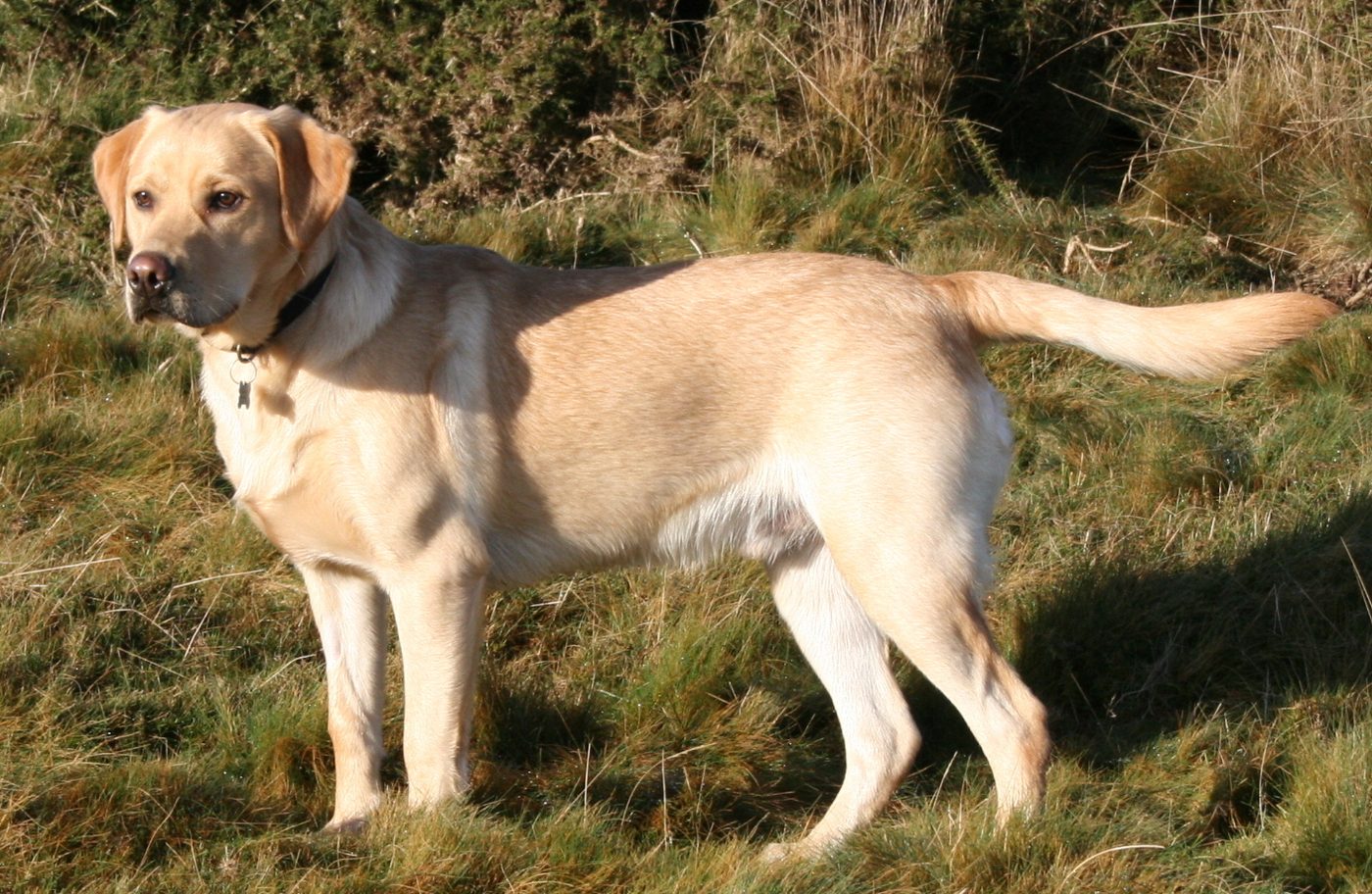
Photo: IDS.photos from Tiverton, UK, CC BY-SA 2.0, via Wikimedia Commons
.jpg)
Overview
The Labrador Retriever is a strongly built, short-coupled gundog with a dense, weatherproof coat, a thick 'otter' tail and kind, friendly eyes. Its ancestors were water dogs that helped fishermen on the coast of Newfoundland, and it was in Britain that sporting estates refined them into the retriever of today. The AKC standard describes a dog with the stamina to hunt waterfowl or upland game for long hours, the quality to win in the show ring and the temperament to be a family companion, kindly, outgoing and eager to please.
History
The Labrador’s working ancestors were the water dogs of Newfoundland’s coast, often called St. John’s dogs: short-coated animals that retrieved nets, lines, and fish from icy harbours. The Kennel Club and the FCI place that working history on the Newfoundland coast. The FCI’s country of origin for the standardized breed is Great Britain. The Canadian Kennel Club states that the Labrador Retriever originated and developed on the island of Newfoundland as an all-purpose water dog.
They are not the same dog as the Newfoundland. Period names for the smaller, short-coated water dog include lesser Newfoundland, St. John’s, and Labrador. How they first reached the island remains open: they arrived with European fishermen. No kennel club names a single founder breed. Deeper St. John’s ancestry is those fishermen’s dogs, not a documented progenitor.
The name Labrador is a geographic mismatch. The dogs came from Newfoundland, not the Labrador peninsula. The Kennel Club credits the Earl of Malmesbury with the name. The United States parent club reprints a letter from the 3rd Earl of Malmesbury to the 6th Duke of Buccleuch: “We always call mine Labrador dogs,” with a close coat that turns water off like oil and a tail like an otter.
Nineteenth-century British estates imported the dogs through Poole as gundogs. Parent-club history credits the 2nd Earl of Malmesbury with early imports around or before 1830, and the 5th Duke of Buccleuch, Lord John Scott, and the 10th Earl of Home around 1835. In the 1880s the 3rd Earl of Malmesbury sent Ned and Avon to the 6th Duke of Buccleuch — dogs the AKC treats as the modern British foundation. The FCI, more briefly, names Col. Peter Hawker and the Earl of Malmesbury as introducing the type to Britain in the late 1800s, and records Malmesbury Tramp as a tap root, following Lorna, Countess Howe.
In the homeland the type came under pressure. The Canadian Kennel Club notes that anti-dog legislation in Newfoundland almost wiped them out, and that the type was preserved in England. The AKC records nineteenth-century Newfoundland taxes on dogs not used for herding, and an 1885 British rabies quarantine that slowed further imports.
The breed was recognized by The Kennel Club in 1903 (parent-club chronology). The Kennel Club’s public page dates the first breed club to 1916. The Canadian Kennel Club recognized the Labrador Retriever in 1905.
The Labrador Retriever Club was formed in London on 5 April 1916 to keep purebred Labradors distinct after the Kennel Club allowed mixed retrievers to be registered under whatever breed the owner chose. The first chairman was the Hon. Arthur Holland-Hibbert (later Lord Knutsford); the secretary was Mrs Quintin Dick (later Lorna, Countess Howe). The club’s standard was accepted by the Kennel Club; FCI and later histories say it stood until 1950. The FCI also records a Yellow Labrador Club, founded in 1925.
The American Kennel Club recognized the Labrador Retriever in 1917. The United States parent club, the Labrador Retriever Club, Inc., was incorporated in New York in October 1931 (published dates clash between 7 and 24 October). The first AKC-licensed retriever field trial followed on 21 December 1931. The club’s first specialty was held on 18 May 1933 in New York City; best in show was F. B. Lord’s Boli of Blake, who became the first American champion Labrador on 1 November 1933. The FCI’s definitive acceptance is 24 December 1954.
Kennel Club, AKC, and FCI standards allow only wholly black, yellow, and liver/chocolate. Yellow ranges from light cream to fox red.
Parent-club writing treats the Labrador as one breed with two jobs. An essay published by the United States parent club warns against splitting field and show Labs into separate kinds. That is a club caution, not an official kennel-club variety split.
Sources
- The Kennel Club — Retriever (Labrador)
- The Kennel Club — Retriever (Labrador) breed standard
- FCI Standard No. 122, Labrador Retriever (PDF)
- FCI nomenclature — Labrador Retriever
- Canadian Kennel Club — Retriever (Labrador) standard (PDF)
- AKC — Labrador Retriever History
- AKC — American Kennel Club anniversary
- The Labrador Retriever Club, Inc. — Club History
- LRC, Inc. — Origin and Purpose of the Lab (PDF)
- The Labrador Retriever Club (UK) — History of the LRC
- Labrador Retriever Club of the Potomac — Standard
Type
The AKC standard asks for dogs of 22½ to 24½ in (57 to 62 cm) and bitches of 21½ to 23½ in (55 to 60 cm), and disqualifies any dog more than half an inch outside those heights, although the minimums do not apply under twelve months of age. It gives approximate working weights of 65 to 80 lb (29 to 36 kg) for dogs and 55 to 70 lb (25 to 32 kg) for bitches. The FCI standard gives only an ideal height, 56 to 57 cm for males and 54 to 56 cm for females, and no weight, but warns that its 'very active' Labrador rules out excessive body weight. Both want a strongly built, short-coupled dog, and the AKC wants it shown in working condition, well muscled and without excess fat.
The coat is short, straight and very dense, with a fairly hard feel, over a soft, weather-resistant undercoat that protects the dog from water, cold and rough cover. There are three colors: black, yellow from light cream to fox red, and chocolate (liver in FCI terms) from light to dark. A small white spot on the chest is permitted, and any other color is a disqualification. The tail is the breed's signature, very thick at the base and tapering toward the tip, clothed all round in short, dense coat to give the rounded 'otter' look.
Temperament
The AKC standard calls true Labrador temperament as much a hallmark of the breed as the otter tail: kindly, outgoing and tractable, eager to please and non-aggressive toward people or animals. Its gentle ways, intelligence and adaptability are, in the standard's words, what make it 'an ideal dog.' The FCI adds a few working touches, describing a good-tempered, very agile dog with an excellent nose, a soft mouth and a keen love of water, intelligent and biddable with a strong will to please. Both standards treat aggression or undue shyness as a serious failing.
Energy
High. The AKC standard describes a dog with the substance to hunt for long hours under difficult conditions, and the FCI calls it very active. The AKC describes the Labrador as an exuberant, very energetic breed that needs plenty of exercise every day, and names retrieving and swimming as its favorite outlets, along with hunting, field trials, agility, obedience, tracking and dock diving.
Intelligence
The FCI standard calls the Labrador intelligent, keen and biddable, with a strong will to please, and the AKC standard prizes the intelligence in its kind, friendly eyes. That trainability has carried the breed into search and rescue, detection and assistance work, and the Kennel Club notes its versatility as a guide dog.
Intelligence here means typical trainability, guided by Stanley Coren's survey of obedience judges. It is not a verdict on any one dog.
Care
Grooming
The Labrador's coat is easy to keep. The AKC suggests occasional baths, regular nail trimming and frequent tooth brushing.
Health notes
The AKC describes Labradors as healthy dogs overall, and asks responsible breeders to screen for hip and elbow dysplasia, heart disorders, hereditary myopathy and eye conditions including progressive retinal atrophy. Exercise-induced collapse can affect some young adults, and a DNA test lets breeders avoid producing it. Like other deep-chested dogs, Labs can develop bloat, a life-threatening twisting of the stomach, so owners should learn its signs. For a CHIC number from the Orthopedic Foundation for Animals, a Labrador needs OFA hip and elbow evaluations, an eye exam by a board-certified veterinary ophthalmologist, and DNA tests for exercise-induced collapse and the D locus (dilute) gene, plus a microchip or tattoo. The Labrador Retriever Club also recommends tests for centronuclear myopathy, the prcd form of PRA, the heart and the knees. A CHIC number shows that the tests were done and the results made public, not that every result was normal.
Ordinary care
Given the Labrador's strength and energy, the AKC calls early socialization and puppy training classes vital, ideally with gentle exposure to many people, places and situations between seven weeks and four months of age. Daily exercise matters, and retrieving and swimming are the breed's own favorites. Watch the dog's weight, since treats add up quickly.
Facts
- The Labrador never came from Labrador. Its ancestors lived on the island of Newfoundland, and the name is credited to the Earl of Malmesbury, who wrote that he always called his dogs 'Labrador dogs.'
- The last two known St. John's dogs, both elderly males, were found in a remote part of Newfoundland in the late 1970s. With no females left, the line ended with them.
- The AKC standard disqualifies any Labrador whose tail has been docked or whose natural carriage has been altered, a measure of how central the otter tail is to the breed.
The Dog Codex is an editorial reference, not veterinary advice. Health notes summarize conditions that appear in breed literature; they do not diagnose an individual dog and do not replace examination by a licensed veterinarian.