Working group · Germany
Great Dane
- SizeGiant
- Height72–90 cm (FCI)
- Weight~50–79 kg (AKC profile)
- GroupWorking
- EnergyModerate
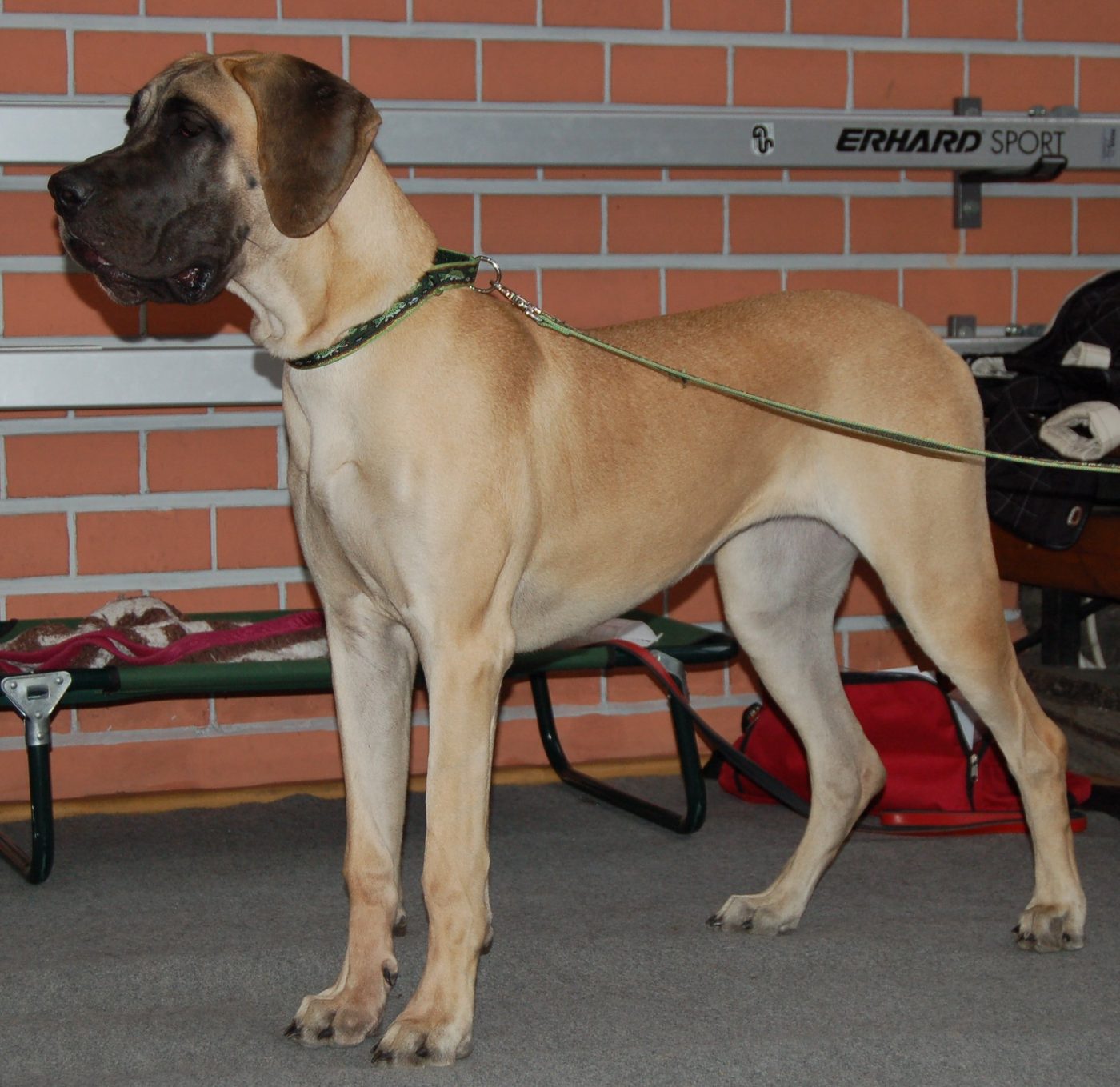
Photo: Lilly M, CC BY-SA 2.5, via Wikimedia Commons

Overview
The Great Dane combines great size and strength with dignity and elegance; the AKC standard calls it 'the Apollo of dogs.' Its ancestors were powerful German boarhounds, but today's Dane is meant to be spirited and courageous yet always friendly and dependable, and the FCI describes a loving, devoted companion and family dog that may be reserved with strangers but is never aggressive.
History
The Great Dane is German, not Danish. Its forerunners were the old Bullenbeisser and the hunting and boar hounds of the German states, dogs that the FCI places midway between the strong English Mastiff and the fast Greyhound. For a long time 'Dogge' simply meant any large, powerful dog, and the types went by many names, Great Dane among them; the AKC notes that the French called them Grand Danois, though no one knows why. In 1878 a committee of breeders and judges in Berlin decided to group all these varieties as the Deutsche Dogge, and the first standard followed at a Berlin show in 1880. The breed was a favorite of Otto von Bismarck. The Great Dane Club of America, one of the oldest parent clubs in the country, formed in 1889, and the AKC recognized the breed in 1887.
Type
One of the giant breeds, the Great Dane is square in build, with females allowed a little more length, and should never look clumsy or coarse. The AKC sets minimum heights of 30 in (76 cm) for males and 28 in (71 cm) for females, preferring 32 in (81 cm) or more and 30 in (76 cm) or more, and disqualifies dogs under the minimum. The FCI asks for 80 to 90 cm in males and 72 to 84 cm in females. No standard sets a weight, but the AKC breed profile gives 140 to 175 lb (64 to 79 kg) for males and 110 to 140 lb (50 to 64 kg) for females.
The coat is short, thick and smooth with a glossy shine. The AKC recognizes seven colors and patterns: fawn and brindle, both with a black mask; steel blue; glossy black; harlequin, white with torn black patches; mantle, black with a white collar, chest and legs; and merle, gray with black patches. Any other color is disqualified, as is a white dog with only merle patches. The FCI groups the colors into three varieties and disqualifies blind or deaf Danes and the mostly white 'porcelain' harlequins.
Temperament
The AKC standard asks for a Dane that is spirited and courageous, always friendly and dependable, and never timid or aggressive. The FCI describes a dog that is friendly, loving and devoted to its owners, possibly reserved with strangers, and confident, fearless and docile, with a high tolerance for provocation. The AKC adds that Danes are alert home guardians and people pleasers that make friends easily.
Energy
Moderate. Danes may seem sedate, but the AKC says they need daily exercise suited to their age, and two or three brisk walks a day can be enough. They can join jogs or hikes once they are 2 years old, when their joints have finished growing. Avoid hard exercise around mealtimes because of the risk of bloat. Many Danes enjoy agility, obedience, tracking, weight pulls and flyball.
Intelligence
Stanley Coren's The Intelligence of Dogs places the Great Dane 48th, in his average tier for working and obedience intelligence. The AKC says Danes are friendly and eager to please and respond well to firm, consistent training, which is a must for a dog this large and powerful.
Intelligence here means typical trainability, guided by Stanley Coren's survey of obedience judges. It is not a verdict on any one dog.
Care
Grooming
The short coat sheds little for most of the year, but on a dog this size that still adds up. Brush weekly with a medium-bristle brush, rubber mitt or hound glove, and daily during the once- or twice-yearly shedding season. Danes need only an occasional bath. Trim the nails regularly, since long nails can cause pain and trouble walking.
Health notes
Like other giant breeds, the Great Dane is short-lived; the AKC gives a life expectancy of 7 to 10 years. The AKC calls bloat (gastric dilatation-volvulus) the number-one killer of Danes, and many breeders and owners consider a preventive stomach tack (prophylactic gastropexy). Other concerns the AKC and the breed club name include heart disease and cardiomyopathy, cancer, autoimmune thyroid disease and hip dysplasia, as well as growing pains such as panosteitis in fast-growing puppies. For a CHIC number, the Orthopedic Foundation for Animals requires a hip evaluation (OFA or PennHIP), an ACVO eye exam, an autoimmune thyroiditis evaluation from an approved lab, and an advanced cardiac exam by a board-certified veterinary cardiologist that includes an echo, all registered with OFA.
Ordinary care
Early socialization and puppy classes matter, and the AKC calls obedience training a must for a dog this large and powerful. Feed several smaller meals a day rather than one big one and avoid vigorous exercise around mealtimes to lower the risk of bloat, and don't let a Dane get fat. Danes tend to follow their noses, so keep them leashed or behind a tall fence. Ask breeders for the parents' hip, eye, thyroid and cardiac results.
Facts
- Despite the name, the Great Dane is German. The French called it the Grand Danois, and no one knows why; in Germany it is the Deutsche Dogge.
- Scooby-Doo's designer, Iwao Takamoto, learned what makes a prize Great Dane from a breeder, then did the opposite for comedy: a hump back, bowed legs and a big chin. 'Even his color is wrong,' he said.
- The tallest dog on record was a Great Dane named Zeus, who measured 1.118 m (3 ft 8 in) at the shoulder in 2011. As of 2025 the tallest living male is another Great Dane, Reggie, at 1.007 m.
- The AKC breed standard calls the Great Dane 'the Apollo of dogs', after the Greek sun god.
- The German statesman Otto von Bismarck prized Great Danes and kept them as bodyguards.
The Dog Codex is an editorial reference, not veterinary advice. Health notes summarize conditions that appear in breed literature; they do not diagnose an individual dog and do not replace examination by a licensed veterinarian.