Sporting group · Scotland
Golden Retriever
- SizeLarge
- Height51–61 cm (FCI)
- Weight25–34 kg (AKC)
- GroupSporting
- EnergyHigh
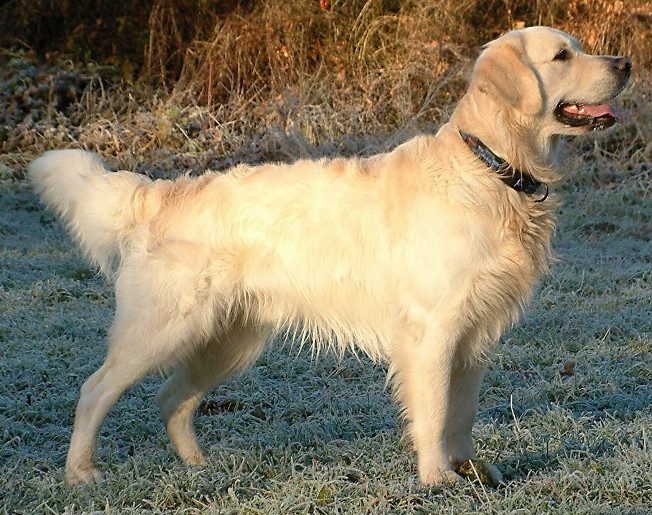
Photo: Janneke Vreugdenhil; derivative work by Anka Friedrich, Public domain, via Wikimedia Commons

Overview
The Golden Retriever is a Scottish gundog, bred in the Highlands in the nineteenth century to bring back shot game from land and water. The AKC standard describes a symmetrical, powerful and active dog with a kindly expression and a personality that is eager, alert and self-confident, and it insists that the Golden is primarily a hunting dog. Its dense, water-repellent coat comes in rich, lustrous shades of gold. Friendly, reliable and biddable, it has worked as a gundog, a guide for the blind and a search-and-rescue dog.
History
In the mid-nineteenth century, Dudley Marjoribanks (later Lord Tweedmouth) bred a yellow wavy-coated retriever to a Tweed Water Spaniel at Guisachan in the Scottish Highlands. Later additions to the root stock included Irish Setter and further retriever blood; a later Bloodhound cross appears in some club accounts and is denied in others. The goal was a specialist for retrieving shot game from land and water. The breed was exhibited in Britain in the early 1900s and recognized by the AKC in 1925.
The Golden Retriever was developed as a gundog on the Guisachan estate in the Scottish Highlands by Dudley Coutts Marjoribanks, later 1st Baron Tweedmouth. The Kennel Club credits a yellow dog from black Wavy Coated Retrievers, crossed with the Tweed Water Spaniel, producing four yellow puppies. Later additions to the root stock included Irish Setter and further retriever blood; a later Bloodhound cross appears in some club accounts and is denied in others. Lord Tweedmouth and his Guisachan retrievers are still remembered, and the estate is treated as the home of the breed.
Marjoribanks bought Guisachan in 1854. A fountain at Tomich, quoted on a GRCA page, records that he was born 29 December 1820, died 4 March 1894, and made his home at Guisachan from 1854 to 1894. He was created Baron Tweedmouth in 1881. He kept a private stud book, dated from 1835 in the Earl of Ilchester’s account or about 1840–1890 in the GRCA study guide. The book was made public in 1952 by his great-nephew, the 6th Earl of Ilchester, with further pedigree work by Elma Stonex. The American Kennel Club’s history of the breed says the book is kept at The Kennel Club.
The stud book, as published by Ilchester and the Golden Retriever Club in the United Kingdom, records Nous as “Lord Chichester’s breed. June, 1864, purchd. At Brighton.” Several GRCA and AKC pages date the purchase to 1865. He was a yellow puppy from a litter of black wavy-coated retrievers, bought from a cobbler in Brighton. Belle, a Tweed Water Spaniel of the Ladykirk breed, was given by a relative on the River Tweed. In June 1868 they produced the first litter of yellow retriever puppies at Guisachan. Tweed Water Spaniels are extinct.
The Kennel Club and Ilchester record four yellow puppies from that 1868 mating. Ilchester writes that Cowslip and Primrose were kept, Crocus was given to Marjoribanks’s son Edward, and Ada to Ilchester’s father. Friends of Guisachan treat Ada as a later Nous × Belle litter; Denise Flaim’s AKC history names Cowslip, Crocus, and Primrose only. Ada’s place in the 1868 litter is therefore disputed.
Linebreeding from that foundation continued to a last mating in 1889, according to the United Kingdom club, or to a last stud-book entry in 1890, according to the AKC and GRCA. Agreed outcrosses include another Tweed Water Spaniel, black wavy- or flat-coated retrievers, and an Irish or red setter. A later Bloodhound cross appears in Kennel Club, Canadian Kennel Club, and Ilchester accounts, and is denied by the 3rd Lord Tweedmouth, who told A. Croxton-Smith there was “never a trace of Bloodhound.”
Yellow retrievers were registered as Retrievers (Wavy or Flat-Coated) and shown in Flat-Coat classes of any other colour. The United Kingdom club dates the first exhibition to 1908, with Viscount Harcourt’s Culham dogs. Mrs W. M. Charlesworth, of the Noranby kennel, pressed for a separate breed; a GRCA study guide says she was nearly single-handedly responsible for recognition in 1913.
The Kennel Club’s own page records that the breed was recognised as a “yellow” or “golden” Retriever in 1913. When the Golden Retriever Club was established in 1920, that page says, the official breed name became Golden Retriever — a name change, not a later recognition. Club pages in the United Kingdom date the specialist club to 1911 and Kennel Club recognition of the club to 1913. The Kennel Club’s official name for the breed today is Retriever (Golden).
The club was formed in 1911 under Mrs Charlesworth for owners of yellow retrievers; in 1913 it was recognised by the Kennel Club and became The Golden Retriever Club. The 1911 standard excluded cream. In 1936 the colour clause was altered to “Any shade of gold or cream, but neither red or mahogany,” wording that remains in Kennel Club and FCI standards, which also permit a few white hairs on the chest only. Kennel Club registration colours are Cream, Gold, and Golden. The AKC standard calls for a rich, lustrous golden of various shades, with extremely pale or extremely dark colour undesirable. The Canadian Kennel Club describes lustrous golden cream to darkest gold.
A story once held that Tweedmouth’s yellow dogs came from a Russian circus troupe or from Russian trackers. Ilchester, publishing the stud book in 1952, identified Nous as Lord Chichester’s breed, purchased at Brighton, with no connection to Russian dogs. Mrs Charlesworth and Col. the Hon. W. le Poer Trench taught the circus story for decades; parent clubs now reject it. Trench exhibited dogs as “Yellow & Russian Retrievers & Trackers” until 1914 — one kennel’s claim, not an origin.
The American Kennel Club entered the Golden Retriever in its stud book in 1925. The first dog registered was Lomberdale Blondin, in November 1925; the second was Dan Hill Judy. The first AKC-registered litter was whelped on 12 December 1925. A Magoffin letter in GRCA archives gives 1936; that date does not replace the 1925 stud-book recognition. The Canadian Kennel Club recognised the breed in 1927. Clubs name Am. Can. Ch. Speedwell Pluto as a North American foundation sire: whelped in England in 1929, imported by Col. Samuel Magoffin of Rockhaven, British Columbia, and the first Golden to win Best in Show, at the Puget Sound Kennel Club in 1932. The Golden Retriever Club of America was incorporated on 6 May 1938 in Colorado. Its first national specialty was held 13–14 May 1940 at Thiensville/Mequon; best of breed was Beavertail Gay Lady. The first Golden Field Champion was Rip, in 1939. The FCI’s definitive acceptance is 2 December 1954; the FCI’s country of origin for the standardized breed is Great Britain.
Sources
- KC Retriever (Golden)
- KC standard
- FCI Standard N° 111
- FCI nomenclature 111
- CKC origin page
- CKC standard PDF
- AKC Flaim history
- AKC Breeds by Year Recognized
- AKC Retriever Field Trials History
- AKC Official Standard PDF
- GRCA AKC Breed Standard
- Golden Retriever Club (UK)
- UK GRC Club History
- UK GRC Origin
- UK GRC Working gundog
- GRCA Ilchester
- GRCA Elliott Early Ancestors
- GRCA Pepper Origins Revisited
- GRCA Illustrated Guide PDF
- GRCA Golden Retriever Firsts
- GRCA Notes and Quotes
- GRCA The Day We Met Dileas
- GRCA Elma Stonex
- Friends of Guisachan
Type
The FCI standard gives dogs 56 to 61 cm and bitches 51 to 56 cm at the withers. The AKC standard is a little taller and narrower: dogs 23 to 24 in (58 to 61 cm) and bitches 21½ to 22½ in (55 to 57 cm), with dogs more than an inch outside those heights disqualified. The AKC adds weights of 65 to 75 lb (29 to 34 kg) for dogs and 55 to 65 lb (25 to 29 kg) for bitches; the FCI gives none. The AKC wants a body slightly longer than tall, in a ratio of 12 to 11, and a dog shown in hard working condition.
The coat is dense and water-repellent over a good undercoat, firm and resilient to the touch, and may lie straight or wavy. It forms an untrimmed natural ruff, with moderate feathering on the backs of the forelegs and underbody and heavier feathering on the front of the neck, the backs of the thighs and the underside of the tail. The two main standards describe the color differently. The AKC asks for a rich, lustrous golden of various shades and calls a body color that is extremely pale or extremely dark undesirable. The FCI accepts any shade of gold or cream but not red or mahogany. Both allow only a few white hairs on the chest.
Temperament
Both standards describe a dog of kindly, friendly character. The AKC asks for a Golden that is friendly, reliable and trustworthy, eager, alert and self-confident, and it counts quarrelsomeness, hostility, or unwarranted timidity or nervousness as out of keeping with the breed. The FCI calls it biddable and intelligent, with natural working ability. The AKC describes Goldens as outgoing, loyal and eager to please, which makes them very easy to train.
Energy
High. The AKC standard describes an active, powerful hunting dog to be shown in hard working condition, and the AKC says that, like most sporting breeds, Goldens need plenty of exercise every day. Hunting, field trials, agility, obedience and tracking all suit them, and the AKC suggests checking with a vet before starting strenuous or high-impact activities.
Intelligence
The FCI standard calls the Golden biddable and intelligent, with natural working ability, and the AKC describes a dog so eager to please that it is very easy to train. That willingness has made Goldens familiar as gundogs, guides for the blind and search-and-rescue dogs.
Intelligence here means typical trainability, guided by Stanley Coren's survey of obedience judges. It is not a verdict on any one dog.
Care
Grooming
The AKC recommends a good brushing with a slicker brush once or twice a week, and daily sessions when the coat is shedding heavily. Baths help loosen dead hair, but the dog should be completely dry before brushing. The AKC standard allows the feet to be trimmed and stray hairs neatened, but not cutting or clipping that changes the natural coat or outline, and the breed club has reminded judges that the Golden is a natural dog that should not be sculpted or barbered.
Health notes
Cancer is the breed's great health concern. A Golden Retriever Club of America article estimates that about 60% of Goldens die of cancer, close to double the rate for dogs in general, with hemangiosarcoma affecting about one Golden in five and lymphoma about one in eight. The AKC asks breeders to screen for hip and elbow dysplasia, for eye conditions such as juvenile cataracts, pigmentary uveitis and progressive retinal atrophy, and for heart disease including subvalvular aortic stenosis. For a CHIC number from the Orthopedic Foundation for Animals, a Golden needs a hip evaluation by OFA or PennHIP, an OFA elbow evaluation, an annual eye exam by a board-certified veterinary ophthalmologist and a cardiac exam by a cardiologist, plus a microchip or tattoo. The breed club also asks that at least one parent of every litter be DNA tested clear of neuronal ceroid lipofuscinosis, a fatal inherited disease. A CHIC number shows that the tests were done and the results made public, not that every result was normal.
Ordinary care
The AKC recommends early socialization and puppy classes, with gentle exposure to many people, places and situations between seven weeks and four months of age. It also suggests checking a Golden's ears weekly for signs of infection, brushing the teeth often and keeping an eye on weight, since some Goldens put it on easily.
Facts
- For years a romantic story held that the breed descended from Russian circus dogs bought in Brighton. Marjoribanks's own stud book told a plainer tale, and the Earl of Ilchester, whose father received one of the first puppies, concluded from it that 'no Russian strain ever had a place in the Guisachan pedigrees.'
- The founding litter of June 1868 produced four yellow puppies, Cowslip, Primrose, Crocus and Ada, three of them named after spring flowers.
- The first Golden Retriever registered in the United States was Lomberdale Blondin, in November 1925.
The Dog Codex is an editorial reference, not veterinary advice. Health notes summarize conditions that appear in breed literature; they do not diagnose an individual dog and do not replace examination by a licensed veterinarian.