Sporting group · Germany
German Shorthaired Pointer
- SizeMedium
- Height53–64 cm (AKC)
- Weight20–32 kg (AKC)
- GroupSporting
- EnergyVery high
Photo: Rexness, CC BY-SA 2.0, via Wikimedia Commons
.jpg)
Overview
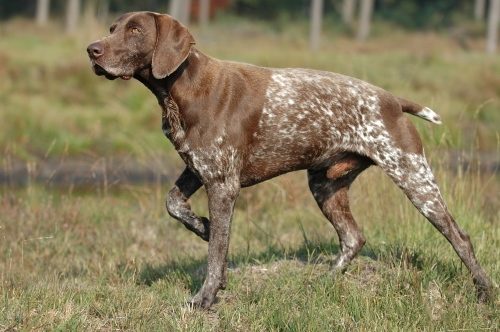
The German Shorthaired Pointer is a versatile hunter, in the AKC standard's words an all-purpose gun dog capable of high performance in field and water. It was bred in Germany to point, retrieve on land and water, and track wounded game, and the FCI asks for a build that ensures strength, endurance and speed. The AKC describes an aristocratic, well-balanced dog that gives the impression of medium size, friendly, intelligent and willing to please, with a keen enthusiasm for work. It comes in liver or black, solid or combined with white.
History
The FCI traces the breed's roots to the pointing dogs used with nets and falcons in the Mediterranean, which reached the German courts by way of France, Spain and Flanders; after the double-barreled gun appeared around 1750, the pointer began to become a versatile gun dog. German hunters wanted one dog that could find, point, retrieve and track. The AKC says that, by one widely held account, breeders working with Prince Albrecht zu Solms-Braunfels crossed the old Spanish pointer, the old German pointer and the Braque Français, with further crosses to the German Bloodhound and the French Gascon, and in the 1860s added English Pointer for speed and style. Prince Albrecht set down the breed's points, judging rules and simple field-trial rules, and the German stud book has been published since 1897. In the 1920s Dr. Charles Thornton of Missoula, Montana, imported a pair from Austria, and his bitch Senta v. Hohenbruch whelped the first documented American litter on 4 July 1925. The breed entered the AKC Stud Book in March 1930 and the Sporting Group in 1935.
Type
The AKC standard asks for males of 23 to 25 in (58 to 64 cm) weighing 55 to 70 lb (25 to 32 kg) and bitches of 21 to 23 in (53 to 58 cm) weighing 45 to 60 lb (20 to 27 kg), and severely penalizes dogs more than an inch over or under. The FCI standard is a little taller: 62 to 66 cm for males and 58 to 63 cm for bitches, with no weight given. The AKC allows a square dog or one slightly longer than tall and calls for a chest that gives an impression of depth rather than breadth. The AKC requires the tail to be docked to about 40 percent of its length; the FCI describes it as docked about halfway for hunting, or left natural, reaching the hocks, where docking is banned.
The coat is short and thick and feels tough to the hand, softer and shorter on the head and ears. The AKC accepts solid liver or liver and white (ticked, patched and ticked, or roan), and since 2022 the same patterns in black. It disqualifies any red, orange, lemon or tan and any solid white dog. The FCI lists solid brown, brown with small white markings on chest and legs, dark and light brown roan, white with brown head markings, and black in the same patterns, and it permits yellow-tan markings.
Temperament
The AKC standard calls the Shorthair friendly, intelligent and willing to please, with a keen enthusiasm for work and no sign of a nervous or flighty character. The FCI asks for a firm, balanced, reliable and restrained temperament, neither nervous, shy nor aggressive. The AKC adds that the breed needs a purpose, has a strong prey drive, and can be especially challenging between six months and three years of age.
Energy
Very high. The AKC describes boundless energy and recommends plenty of exercise twice a day, such as brisk half-hour walks morning and evening or running and play in a safely fenced area, along with swimming and dog sports. Because the breed is prone to bloat, the AKC advises against feeding right after hard exercise or exercising for at least an hour after a meal.
Intelligence
The AKC calls the GSP an intelligent breed that learns quickly with consistent training, and notes that it excels at field events, agility, obedience and dock diving. In Germany the breed is still bred under trial rules that test its versatility in the field.
Intelligence here means typical trainability, guided by Stanley Coren's survey of obedience judges. It is not a verdict on any one dog.
Care
Grooming
The AKC calls the coat easy to groom: a once-over with a brush or grooming glove every few days for most of the year, with more frequent brushing in the heavier shedding seasons, and an occasional bath with a gentle shampoo. Ears should be inspected and cleaned regularly and nails kept short.
Health notes
The AKC calls the German Shorthaired Pointer generally healthy, with a life expectancy of 10 to 12 years, but notes that it can be prone to hip dysplasia, eye conditions such as progressive retinal atrophy, and certain heart diseases. The breed can also suffer bloat, a sudden and life-threatening swelling and twisting of the stomach, and the AKC urges owners to learn its signs. For a CHIC number from the Orthopedic Foundation for Animals, a GSP needs a hip evaluation (OFA or PennHIP), an OFA elbow evaluation, a heart exam by a cardiologist at 24 months or older, eye exams every year until six years old, and a DNA test for cone degeneration. Thyroid and von Willebrand disease tests are optional.
Ordinary care
The AKC calls early training essential, with socialization, puppy classes and continued practice in basic obedience. It recommends two meals a day for adults, with the evening meal after the day's exercise, to lower the risk of bloat.
Facts
- Prince Albrecht zu Solms-Braunfels, an early patron of the breed, drew up not only its points and judging rules but also simple field-trial rules, and German Shorthairs are still bred under trial regulations that test them as all-round hunting dogs.
- The FCI standard prizes the dark brown roan coat for the opposite of visibility: its even mix of brown and white gives the dog an inconspicuous look that it calls valuable for practical hunting.
- The first documented American litter of German Shorthaired Pointers was born on 4 July 1925 to Senta v. Hohenbruch, a bitch imported from Austria by Dr. Charles Thornton of Missoula, Montana, who registered the puppies with the suffix 'of Everyuse.'
The Dog Codex is an editorial reference, not veterinary advice. Health notes summarize conditions that appear in breed literature; they do not diagnose an individual dog and do not replace examination by a licensed veterinarian.