Sporting group · United Kingdom
English Springer Spaniel
- SizeMedium
- Height48–51 cm (AKC ideals)
- Weight~18–23 kg (AKC)
- GroupSporting
- EnergyHigh
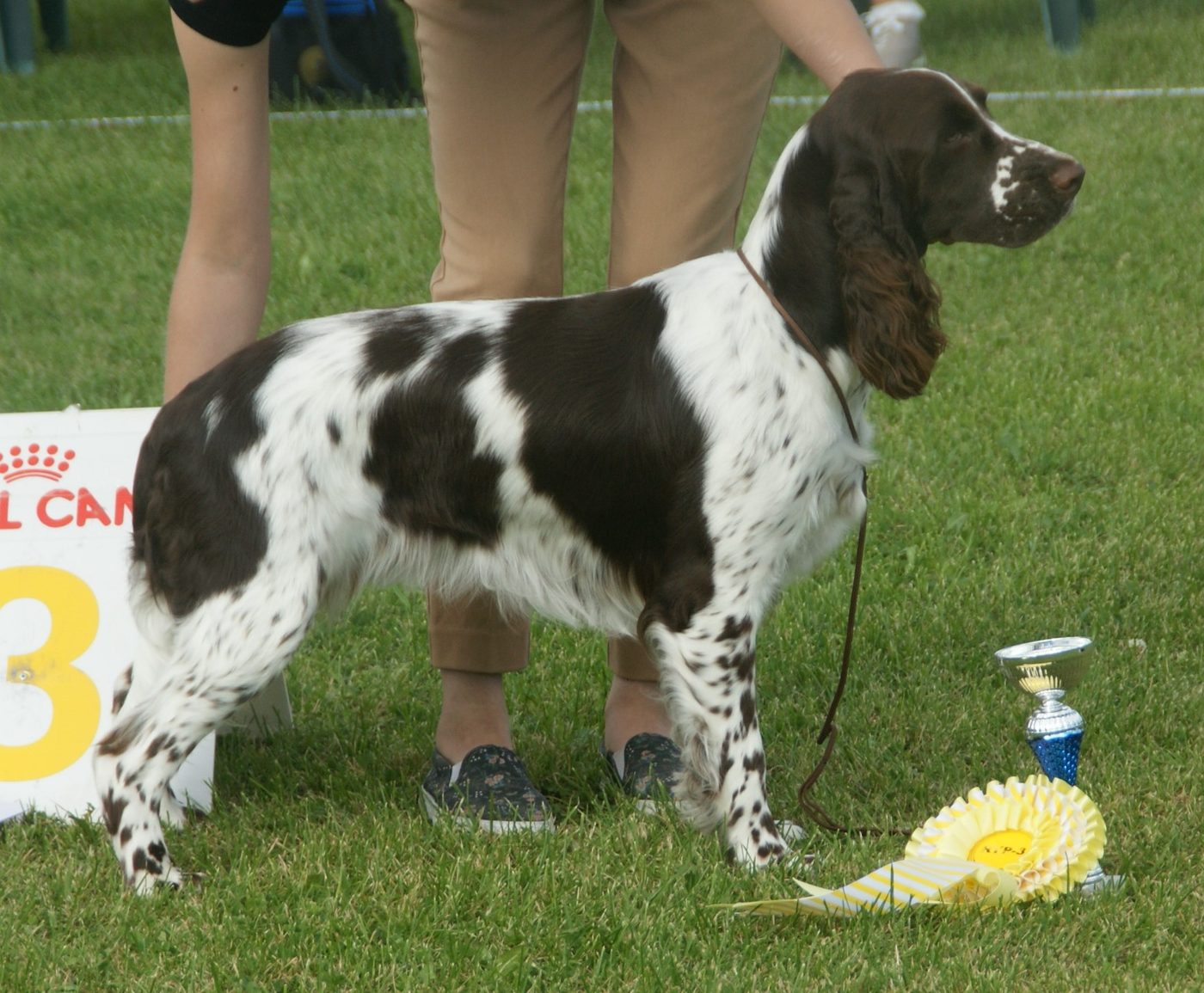
Photo: Canarian, CC BY-SA 4.0, via Wikimedia Commons

Overview
The English Springer Spaniel is a medium-sized British gundog bred to find game, flush or 'spring' it into the open, and retrieve it for the hunter. The FCI and Kennel Club call it the highest on leg and raciest in build of all the British land spaniels. Its long, pendulous ears, gentle expression and friendly wagging tail mark it as a spaniel, and the AKC standard says it 'looks the part of a dog that can go, and keep going, under difficult hunting conditions,' combining beauty and utility.
History
Spaniels have hunted in Britain for centuries, and dogs resembling today's Springer appear in 16th- and 17th-century paintings, flushing game for nets, hawks and coursing hounds and later for the gun. In the 19th century, puppies from the same litter could be sorted by size: the smaller 'cockers' hunted woodcock, and the larger 'springers' flushed game. The AKC traces the first pure line to Shropshire around 1800. In 1902 the breed was separated from its relatives under the name Springer, and the AKC registered its first English Springer Spaniel in 1910. In the United States, the English Springer Spaniel Field Trial Association was founded in 1924 and held the breed's first field trial on Fishers Island that October. Early Springers worked in the field one day and were shown the next, but by the early 1940s field and show breeding had begun to go separate ways.
Type
A medium-sized, compact sporting dog, slightly longer than tall, built to cover rough ground with agility and endurance. The AKC sets an ideal height of 20 in (51 cm) for males and 19 in (48 cm) for females and faults dogs more than an inch over or under. A well-proportioned 20 in dog weighs about 50 lb (23 kg) and a 19 in bitch about 40 lb (18 kg). The FCI and Kennel Club give an approximate height of 51 cm and no weight.
The Springer has a medium-length outer coat, flat or wavy, over a short, soft, dense undercoat, and together they make the dog largely waterproof, weatherproof and thornproof. The ears, chest, legs and belly carry moderate feathering. Accepted colors are liver and white or black and white, either of them with tan markings; the AKC also accepts blue or liver roan. The AKC says lemon, red or orange are not to place, and the Kennel Club rejects any other color.
Temperament
The AKC standard describes the typical Springer as friendly, eager to please, quick to learn and willing to obey, a tractable dog that is easy to handle in the field. The FCI and Kennel Club call it friendly, happy and biddable. In the show ring it should be poised and attentive, and the standards treat both aggression and timidity as faults.
Energy
High. The AKC standard says the Springer is built for endurance and suggests 'power, endurance and agility,' and the Kennel Club recommends more than two hours of exercise a day. Daily long walks and play keep it fit, and it also enjoys obedience, tracking, agility, rally and field work.
Intelligence
The AKC standard calls the Springer quick to learn and willing to obey, and the AKC describes it as lively and highly intelligent. Early socialization and puppy classes help it grow into a well-mannered companion, and it responds best to continued training and gentle guidance.
Intelligence here means typical trainability, guided by Stanley Coren's survey of obedience judges. It is not a verdict on any one dog.
Care
Grooming
Brush weekly to remove dirt and loose hair and keep the coat free of mats, working out tangles with a slicker brush or metal comb. The feet, head, neck and the area under the tail are usually trimmed for neatness, but the AKC standard asks for a natural look and penalizes over-trimming in the show ring. Check the long ears regularly for signs of infection, trim the nails, and brush the teeth often.
Health notes
The AKC describes English Springer Spaniels as generally healthy, with a life expectancy of 12 to 14 years; conditions sometimes seen include hip and elbow dysplasia and eye conditions such as progressive retinal atrophy. For a CHIC number, the Orthopedic Foundation for Animals requires a hip evaluation (OFA, or PennHIP at a minimum age of 24 months), an OFA elbow evaluation, an ACVO eye examination registered with OFA, a DNA test for crd4/cord1 PRA registered with OFA, and a DNA sample banked with either the ESSFTA/University of Missouri DNA bank or the OFA/CHIC DNA Repository. Optional CHIC tests are DNA tests for fucosidosis, phosphofructokinase (PFK) deficiency and degenerative myelopathy, autoimmune thyroiditis testing, and a cardiac exam. The ESSFTA also asks for an eye exam by a veterinary ophthalmologist within 12 months before breeding. In the UK, the Kennel Club recommends hip, elbow and eye testing (with gonioscopy) as a minimum.
Ordinary care
Springers want to be with their people, and the AKC notes that unwanted behavior can develop if one is regularly left alone for long periods. Give daily exercise and training, keep it under control on walks, since it is an active, forward explorer, and keep up with weekly brushing and ear checks. Ask breeders for the parents' hip, elbow, eye and PRA DNA results.
Facts
- The Springer gets its name from its job: it 'springs' game, flushing birds into the air for the hunter. Before guns, it flushed game for nets, falcons and greyhounds.
- English Springers and Cocker Spaniels were once born in the same litters. The smaller puppies became 'cockers' for hunting woodcock, and their bigger littermates became 'springers.'
- According to its British and FCI standards, the English Springer is the highest on leg and raciest in build of all the British land spaniels.
- Show and field Springers have gone separate ways. The last dual champion, a dog titled in both the field and the show ring, was made up in the early 1940s, and today's bench Springers tend to carry more coat and feathering than field-bred dogs, though the AKC has a single standard for both.
- Two US presidents have shared the White House with Springers: George H. W. Bush had Millie, and George W. Bush had Spot.
The Dog Codex is an editorial reference, not veterinary advice. Health notes summarize conditions that appear in breed literature; they do not diagnose an individual dog and do not replace examination by a licensed veterinarian.