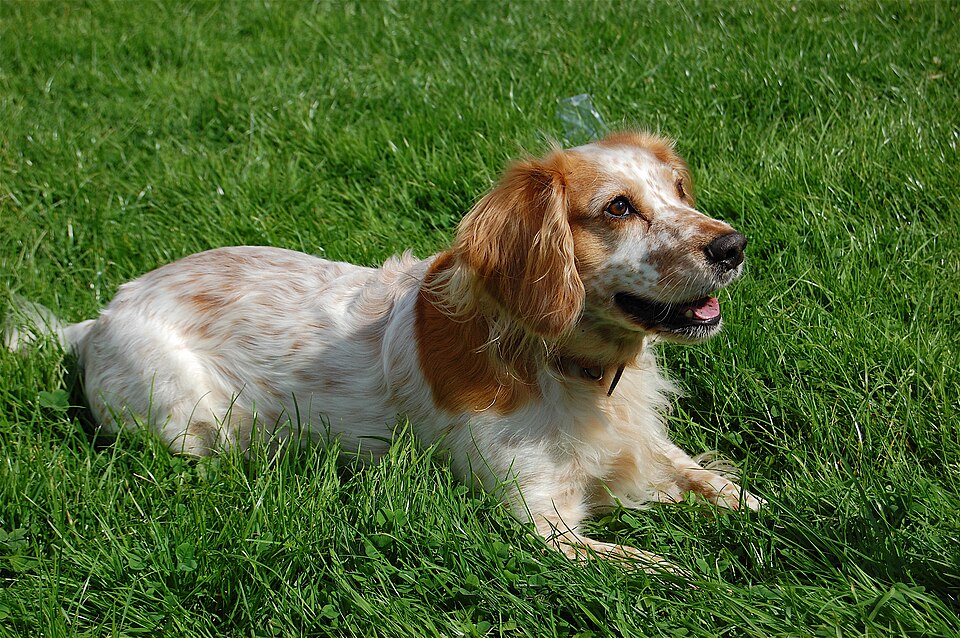
Sporting group · Great Britain
English Cocker Spaniel
- SizeMedium
- Height38.1–43.2 cm (AKC; sex-specific); FCI/Royal Kennel Club approximately 39–41 cm dogs and 38–39 cm females
- Weight11.8–15.4 kg (AKC; sex-specific); FCI/Royal Kennel Club approximately 13–14.5 kg
- GroupSporting
- EnergyHigh

Overview
The English Cocker Spaniel is a compact British gundog with a merry expression, a strong nose, a silky feathered coat, and the sturdy proportions to push through cover. AKC describes an active, merry sporting dog whose powerful, ground-covering gait can enter dense cover to flush and retrieve game. Its good looks stay connected to work: balance, sound movement, and moderation matter more than an exaggerated outline. In the United States, “Cocker Spaniel” usually means the separate American Cocker Spaniel; this plate is the taller, longer-muzzled English breed, registered by AKC under the explicit name English Cocker Spaniel.
History
Great Britain is the FCI-listed country of origin, and kennel-club histories place the modern breed in Britain among the older Land Spaniels. The name “cocker” is tied to the work of flushing woodcock; FCI and The Royal Kennel Club describe the historical “cocking spaniel,” while AKC also specifies retrieving game. Spaniels were once grouped by work, size, and terrain before modern registry boundaries settled. The English and American types later diverged in emphasis, and AKC recognized English Cocker Spaniel as a separate breed in 1946. FCI places the breed in Group 8, Section 2 Flushing Dogs, with a working trial; The Royal Kennel Club uses the title Spaniel (Cocker) in its Gundog group.
Type
Medium is the practical site label under AKC and CKC descriptions. AKC gives males 16–17 in (40.6–43.2 cm) and females 15–16 in (38.1–40.6 cm); FCI and The Royal Kennel Club give approximately 39–41 cm for dogs and 38–39 cm for females. The Royal Kennel Club’s separate breed-information page labels the Cocker “Small,” so registry size systems should not be treated as interchangeable. FCI notes that show Cockers tend to be sturdier and heavier than working counterparts; field and conformation emphases are within one breed, not separate AKC breeds.
Medium-length on the body, short and fine on the head, flat or slightly wavy, silky, and feathered. AKC says the coat should be well feathered but not so profuse that it interferes with field work; FCI and The Royal Kennel Club emphasize a flat, silky coat that is not wiry, curly, or excessively profuse. Standard colours include solids, parti-colours, tan markings, tricolours, and the listed roans, with wording varying by registry. Colour is a registry standard matter, not a health or temperament ranking.
Temperament
The standard picture is merry, affectionate, equable, and engaged. AKC and the English Cocker Spaniel Club of America describe a willing worker and faithful, engaging companion, neither sluggish nor hyperactive; The Royal Kennel Club calls the breed gentle and affectionate yet full of life, and FCI emphasizes merry movement and fearlessness in heavy cover. The English Cocker was selected to work closely with a person, follow scent, enter cover, and remain responsive in the field. Those are breed ideals rather than guarantees: socialization, humane training, breeding, health, and individual experience still shape the dog in front of you.
Energy
High: AKC calls the breed active and “alive with energy,” with a gait made for covering ground, dense cover, flushing, and retrieving. FCI classifies it as a flushing dog with a working trial, while The Royal Kennel Club describes scent-following, bustling movement, and fearlessness in cover. Purposeful movement, scent-led exploration, retrieving, field training, tracking, and structured learning can reflect that heritage. This is a standards-based working badge, not a numerical schedule, and “high” should not be read as a promise of hyperactivity—the AKC standard says neither sluggish nor hyperactive.
Intelligence
High trainability is a fair shorthand for a biddable, willing sporting worker selected to cooperate with a handler; it is not a published intelligence ranking or a guarantee of effortless obedience. Reward-based training can channel scenting, flushing, retrieving, recall, and household skills. Field-bred dogs may be more intensely selected for hunting ability than conformation-bred dogs, while both remain English Cockers and individuals vary.
Intelligence here means typical trainability, guided by Stanley Coren's survey of obedience judges. It is not a verdict on any one dog.
Care
Grooming
The coat needs routine, hands-on care. AKC recommends thorough brushing and combing at least weekly, with trimming about monthly around the feet, face, neck, underside of the ears, and under the tail; preserve natural lines rather than an exaggerated outline. Field coats may be lighter and conformation coats heavier, but inspect feathering, ears, feet, and undercarriage for tangles and burrs. Check the long, low-set ears regularly for debris, odour, redness, or discomfort and ask a veterinarian about safe cleaning technique.
Health notes
Only conditions and screening protocols named by the English Cocker Spaniel Club of America (ECSCA) health statement and CHIC guidance are listed; no prevalence or lifespan claim is inferred. ECSCA’s core recommendations are OFA hip evaluation, prcd-PRA DNA testing with results registered with OFA, and OFA patellar-luxation evaluation. Its CHIC guidance calls for at least two elective items from a list including autoimmune thyroiditis/thyroid evaluation, familial nephropathy (FN) DNA testing, BAER hearing testing, an ACVO/CAER eye examination, Adult Onset Neuropathy (AON) DNA testing, and EIC and AMS DNA tests. A CHIC number records completed testing and public disclosure; it does not mean every result is normal. Screening protocols can change, so request current, identifiable results for both parents and discuss the individual dog with a veterinarian.
Ordinary care
Build daily life around regular, age-appropriate movement and opportunities to use the nose and brain: brisk walks, retrieving, scent work, tracking, field training, and suitable dog sports can all be useful outlets. Use reward-based training for recall, loose-lead walking, impulse control, retrieving manners, and calm behaviour around distractions; young dogs need gradual conditioning rather than forced repetitive impact. Inspect ears, eyes, feet, feathering, nails, and teeth as part of ordinary care, and check for burrs and moisture after field or water work. For a puppy or breeding prospect, ask for actual hip, patella, prcd-PRA, and additional ECSCA screening documentation rather than a general claim that the parents are healthy.
Facts
- “Cocker” is a job name: FCI and The Royal Kennel Club connect it to woodcock, the gamebird these small spaniels were selected to flush from cover.
- Registry names differ: AKC distinguishes English Cocker Spaniel from Cocker Spaniel, while FCI and The Royal Kennel Club generally call the English breed Cocker Spaniel or Spaniel (Cocker).
- AKC recognized English Cocker Spaniel as a separate breed in 1946 after English and American types had diverged in emphasis.
- The English Cocker is a flushing dog with retrieving ability: FCI lists flushing work, while AKC describes flushing and retrieving game in dense cover.
- Field and show emphases are documented within the breed: field-bred dogs may carry less coat and show-bred dogs may be sturdier and more heavily coated.
- ECSCA’s CHIC framework combines hip, prcd-PRA, patella, and additional elective screening; a CHIC number records testing and disclosure, not a guarantee of normal results.
The Dog Codex is an editorial reference, not veterinary advice. Health notes summarize conditions that appear in breed literature; they do not diagnose an individual dog and do not replace examination by a licensed veterinarian.