
Overview
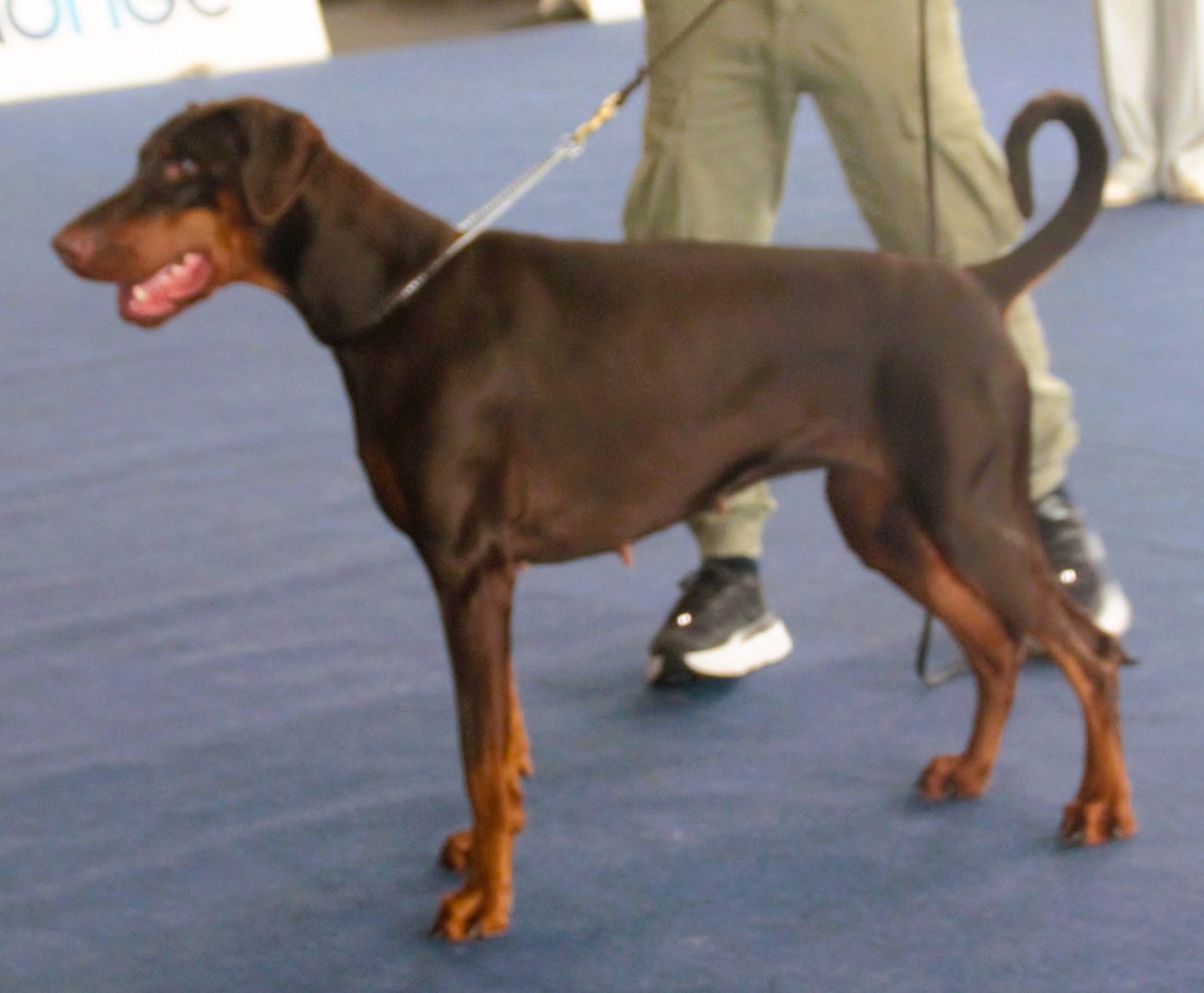
The Doberman Pinscher is a sleek, square-built German working dog, created in the late nineteenth century as a guard dog and later famous in police and military work. The AKC standard describes a dog that is compact, muscular and powerful, built for endurance and speed, and elegant and proud in bearing: energetic, watchful, determined, alert, fearless, loyal and obedient. Its short, hard coat is black, red, blue or fawn with sharply defined rust markings. The FCI describes it as a companion, protection and working dog, and also a family dog.
History
The Doberman is the only German breed named after the man who created it, Friedrich Louis Dobermann (1834 to 1894) of Apolda in Thuringia. Dobermann was a tax collector, a knacker and a part-time dog catcher, and in the 1870s he bred the sharpest dogs from the local pound into a guard dog for his rounds. The FCI says the foundation was the 'butcher's dog', an early Rottweiler type, crossed with a black and rust Thuringian shepherd dog; the AKC adds that the exact mix is unknown. The dogs became widely used as guard and police dogs, earning the nickname 'gendarme dog'. After Dobermann's death, Otto Göller, an Apolda liqueur maker, founded the first breed club and helped write the first standard, and around 1900 crosses to the Manchester Terrier and the Greyhound gave the breed its sleek lines. The AKC recognized the Doberman Pinscher in 1908.
Type
Both standards describe a square, compactly built, muscular and powerful dog, built for endurance and speed. The AKC asks for males of 26 to 28 in (66 to 71 cm), ideally about 27½ in, and females of 24 to 26 in (61 to 66 cm), ideally about 25½ in, and sets no weight; its breed profile suggests 75 to 100 lb (34 to 45 kg) for males and 60 to 90 lb (27 to 41 kg) for females. The FCI asks for males of 68 to 72 cm weighing about 40 to 45 kg and females of 63 to 68 cm weighing about 32 to 35 kg, prefers a medium size within that range, and disqualifies dogs more than 2 cm outside it.
The coat is short, hard, thick and close-lying. The AKC allows four colors, black, red, blue and fawn (Isabella), each with sharply defined rust markings above the eyes and on the muzzle, throat, forechest, legs, feet and below the tail, and disqualifies any other color. The FCI recognizes only black or brown with rust red markings and allows no undercoat.
Temperament
The AKC standard sums up the Doberman's temperament as energetic, watchful, determined, alert, fearless, loyal and obedient, and tells judges to dismiss any dog that is shy or vicious. The FCI describes a friendly, calm dog, very devoted to its family, with medium temperament and alertness and good contact with its owner; it is easy to train, enjoys working, and should be self-confident and fearless. The AKC adds that socialization from puppyhood and obedience training are imperative.
Energy
High. The AKC standard calls the Doberman energetic and built for great endurance and speed, and the FCI classes it as a working dog with a working trial. The AKC says it needs a lot of exercise and free play, such as long daily walks or hikes, and that obedience, tracking and agility exercise mind and body.
Intelligence
Stanley Coren's The Intelligence of Dogs ranks the Doberman 5th for working and obedience intelligence. The AKC calls Dobermans very intelligent, quick to learn and quick to respond, and the FCI calls the breed easy to train and requires a working trial.
Intelligence here means typical trainability, guided by Stanley Coren's survey of obedience judges. It is not a verdict on any one dog.
Care
Grooming
The AKC calls the Doberman a mostly 'wash and wear' breed. A quick daily going-over with a short-bristled brush or grooming mitt keeps the coat shiny; baths are seldom needed. Trim the nails at least monthly, brush the teeth regularly and wipe out the ears every few days.
Health notes
The AKC gives a life expectancy of 10 to 12 years. The breed club names heart disease (dilated cardiomyopathy), hypothyroidism, chronic active hepatitis and cervical vertebral instability (wobbler syndrome) as hereditary diseases in Dobermans, none of which can yet be predicted by a test. For a CHIC number, the Orthopedic Foundation for Animals requires a hip evaluation (OFA or PennHIP), an advanced cardiac exam that includes an echocardiogram and a Holter monitor, an autoimmune thyroiditis test, a DNA test for von Willebrand's disease (a clotting disorder that is mild in this breed), an ACVO eye exam, and the Doberman Pinscher Club of America's Working Aptitude Evaluation (WAE). The club also recommends repeating the thyroid test periodically. As a deep-chested breed, the Doberman can also suffer bloat, and the AKC urges owners to learn its signs. The club awards longevity certificates to dogs that reach 10 years.
Ordinary care
The AKC says the Doberman should live in the house with its people rather than outdoors, and that puppy classes, socialization and obedience training matter for a dog this strong. Plenty of daily exercise and a job, such as obedience, tracking or agility, round out its care. Ask breeders for the parents' heart, thyroid, von Willebrand's, eye and hip results.
Facts
- The FCI calls the Dobermann the only German breed named after its original breeder, Friedrich Louis Dobermann of Apolda.
- Outside North America the breed is called the Dobermann, with two n's, as in its founder's name. The AKC and the Canadian Kennel Club still use the older name Doberman Pinscher.
- Impressed by the breed's loyalty and courage, the United States Marine Corps adopted the Doberman Pinscher as its official war dog during the Second World War.
- The Doberman's rust markings follow a set map in the AKC standard: above each eye and on the muzzle, throat and forechest, on all four legs and feet, and below the tail.
- Otto Göller, the Apolda liqueur maker who founded the first Doberman club in 1899, was such a fan that he named a bitter from his distillery after the breed.
The Dog Codex is an editorial reference, not veterinary advice. Health notes summarize conditions that appear in breed literature; they do not diagnose an individual dog and do not replace examination by a licensed veterinarian.