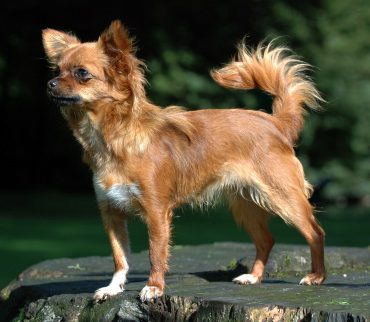
Toy group · Mexico
Chihuahua
- SizeToy
- Height~13–20 cm (AKC profile)
- Weight1–3 kg (FCI)
- GroupToy
- EnergyModerate
Photo: Bonnie van den Born, CC BY-SA 3.0, via Wikimedia Commons

Overview
The Chihuahua, the smallest pedigree breed in the world, takes its name from the largest state in Mexico. It is a graceful, alert, swift-moving little dog with a well-rounded apple head, large upright ears, full luminous eyes and a saucy expression, and it comes in smooth and long coats that are otherwise identical. The AKC standard credits it with 'terrier-like' self-importance, confidence and self-reliance, and the FCI calls it quick, alert, lively and very courageous.
History
The Chihuahua is most likely a native of Mexico, though its deeper origins are debated. The FCI points to the Techichi, a little dog of the Toltec civilization whose images decorated buildings in Tula and look much like today's Chihuahua, and the AKC repeats the theory that it was later crossed with the Xoloitzcuintli. The modern breed is named after the Mexican state of Chihuahua, where it became fashionable in the late 19th century, and interest soon spread to the United States: the judge and author James Watson bought a bitch named Manzanita in 1888. The AKC recognized the breed in 1904, and its first registered Chihuahua was Midget, owned by H. Raynor of Texas. The Chihuahua Club of America followed in 1923, and the long and smooth coats were split into separate varieties in 1952.
Type
The world's smallest pedigree breed is judged by weight, not height. The AKC disqualifies any Chihuahua over 6 lb (2.7 kg), and the Kennel Club prefers 4 to 6 lb (1.8 to 2.7 kg). The FCI sets 1 to 3 kg, ideally 1.5 to 2.5 kg, and disqualifies dogs under 1 kg or over 3 kg. The body is slightly longer than tall, and the AKC breed profile gives a height of about 5 to 8 in (13 to 20 cm). The standards call for a well-rounded apple head, and the FCI disqualifies the slender, long-legged 'deer type'.
There are two coats. The smooth coat is soft, close and glossy, with a ruff on the neck preferred and a furry tail. The long coat is soft and flat or slightly wavy, with fringed ears, a full plumed tail, feathering on the legs, pants on the hind legs and a large ruff. The AKC accepts any color, solid, marked or splashed. The FCI and the Kennel Club accept all colors except merle.
Temperament
Big personality, tiny frame: the AKC standard asks for an alert dog with 'terrier-like' self-importance, confidence and self-reliance. The Kennel Club describes a gay, spirited and intelligent dog, neither snappy nor withdrawn, and the FCI a quick, lively and very courageous one. A former Chihuahua Club of America president quoted by the AKC insists these are not frail, yappy 'ankle biters' but stable, friendly little dogs.
Energy
Moderate. The Chihuahua loves to run and play but can usually get enough exercise in a small space, and the AKC says trotting around after its people is often enough, with short, slow walks to keep it fit. Don't overexert one: if a Chihuahua is panting and struggling to keep up, the AKC advises picking it up and carrying it home.
Intelligence
The AKC calls the Chihuahua a very alert little dog of high intelligence that is eager to please and responds well to positive training. It is also well aware of how cute it is, so the AKC advises consistent rules from puppyhood and a firm but gentle hand for its terrier-like streak. Chihuahuas can excel in obedience and other sports.
Intelligence here means typical trainability, guided by Stanley Coren's survey of obedience judges. It is not a verdict on any one dog.
Care
Grooming
The smooth coat needs only occasional brushing and regular baths, while the long coat should be brushed at least once a week to prevent tangles and mats. Trim the nails regularly, check and clean the ears, and brush the teeth; good dental care is a must for this small mouth, and a vet may also suggest dental treats.
Health notes
Chihuahuas are long-lived; the AKC gives a life expectancy of 14 to 16 years, and the Chihuahua Club of America says many live into their mid to late teens. Conditions the AKC names include heart problems (patent ductus arteriosus and mitral valve disease), eye disease, slipping kneecaps and idiopathic epilepsy. For a CHIC number, the Orthopedic Foundation for Animals requires a cardiac evaluation (a basic or an advanced cardiac exam), an ACVO eye exam, and a veterinary evaluation of patellar luxation at a minimum age of 1 year, all registered with OFA. The club recommends repeating the heart check every year while a dog is being bred, to catch early mitral valve disease.
Ordinary care
Start training early and keep the rules consistent, since puppies that get away with things will try the same as adults. Positive, firm but gentle methods work best. Keep walks short and easy, brush the teeth regularly, and ask breeders for the parents' heart, eye and kneecap results.
Facts
- The Chihuahua is the smallest pedigree breed in the world, named after Mexico's largest state.
- Statues of the Techichi, a little dog of the Toltec civilization, decorated the buildings of Tula, and the FCI says they look very much like the present-day Chihuahua.
- The registries disagree about the soft spot on the skull: the AKC standard allows an apple dome skull 'with or without molera', while the FCI disqualifies dogs with an open fontanel.
- Gidget, the Chihuahua behind the 'Yo quiero Taco Bell' commercials, was meant to star in a single ad in 1997; the campaign ran until 2000.
- The first Chihuahua registered with the AKC, in 1904, was named Midget.
The Dog Codex is an editorial reference, not veterinary advice. Health notes summarize conditions that appear in breed literature; they do not diagnose an individual dog and do not replace examination by a licensed veterinarian.