Toy group · United Kingdom
Cavalier King Charles Spaniel
- SizeSmall
- Height30–33 cm (AKC)
- Weight5.9–8.2 kg (AKC)
- GroupToy
- EnergyModerate
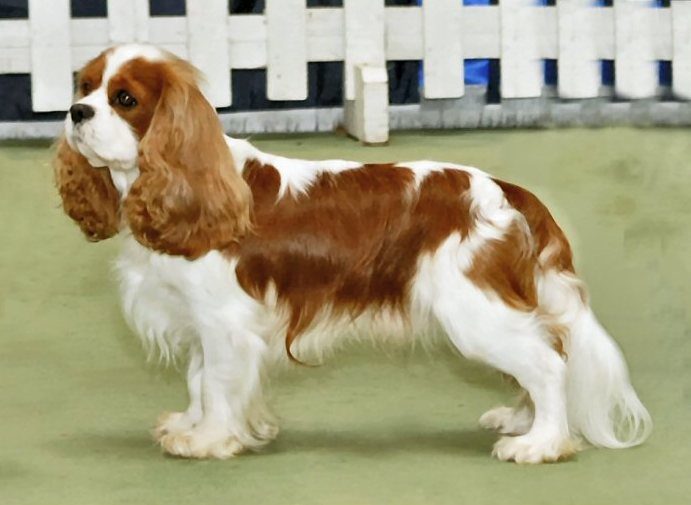
Photo: Andreweatock, CC BY-SA 3.0, via Wikimedia Commons

Overview
The Cavalier King Charles Spaniel is a graceful toy spaniel from Britain, revived in the 1920s to recapture the longer-nosed spaniels seen in paintings from the time of King Charles II. The AKC standard calls it active, gay and free in action, fearless and sporting yet gentle and affectionate, and treats its sweet, gentle, melting expression as a hallmark of the breed. It has a silky coat in four colors. The breed clubs ask breeders to screen for mitral valve disease, the breed's leading health concern.
History
Toy spaniels were favorites of the English court from at least the sixteenth century, and under Charles I and his son Charles II they became firmly established among the nobility. The first Duke of Marlborough kept a red and white strain at Blenheim Palace, which gave its name to the breed's chestnut and white color. In the nineteenth century, fashion favored a domed skull and a very short muzzle, and by about 1900 the King Charles spaniel had become the flat-faced dog now called the English Toy Spaniel. In the mid-1920s an American, Roswell Eldridge, went to England looking for the old long-nosed type. For five years he offered a prize of 25 pounds at Crufts for dogs like those in the pictures of Charles II's time, and in 1928, with a dog named Ann's Son as the model, fanciers drew up a standard and founded the Cavalier King Charles Spaniel Club. The Kennel Club recognized the Cavalier as a separate breed in 1945. The first Cavaliers reached America in 1952, and the AKC lists the breed as recognized in 1995; the American club dates full recognition to 1 January 1996.
Type
The AKC calls for a height of 12 to 13 in (30 to 33 cm) at the withers and a weight of 13 to 18 lb (5.9 to 8.2 kg), in proportion to height; the FCI, following the British standard, gives only a weight of 12 to 18 lb (5.4 to 8 kg) and sets no height. Both prefer a small, well-balanced dog within these limits. The body is nearly square, though slightly longer from shoulder to buttock than it is tall, with moderate bone.
The coat is silky and of moderate length, free from curl, though a slight wave is allowed, with long feathering on the ears, chest, legs and tail and on the feet. The standards ban trimming; only the hair between the pads may be tidied. There are four colors: Blenheim, rich chestnut on pearly white, often with a chestnut 'lozenge' or Blenheim spot on the top of the head; tricolor, black and white with tan markings; ruby, a solid rich red; and black and tan.
Temperament
Both standards describe a gay, friendly, non-aggressive dog with no tendency to nervousness; the FCI adds sporting, affectionate and absolutely fearless. The AKC calls the Cavalier sweet, gentle and very eager to please, and friendly with strangers and other animals.
Energy
Moderate. Both standards call the Cavalier active, and the FCI calls it sporting. The AKC notes that although it was bred as a lap dog, it descends from sporting spaniels and enjoys moderate exercise, walks with its owner and canine sports, while being just as happy to spend a quiet day at home.
Intelligence
Stanley Coren's The Intelligence of Dogs places the Cavalier 44th, in his average tier for working and obedience intelligence. The AKC still calls Cavaliers smart, eager to please and easy to train, and their sweet nature suits obedience, rally, agility and therapy work.
Intelligence here means typical trainability, guided by Stanley Coren's survey of obedience judges. It is not a verdict on any one dog.
Care
Grooming
The silky coat needs little more than regular brushing and an occasional bath. The AKC suggests checking the ears weekly for infection and trimming the nails at least once a month.
Health notes
The AKC gives a life expectancy of 12 to 15 years. The American club calls mitral valve disease, a degeneration of the heart's mitral valve, the breed's number one health concern; it is common in older dogs of all breeds but appears earlier in Cavaliers, though many dogs with a murmur still live to a good age. For a CHIC number, the Orthopedic Foundation for Animals requires a hip evaluation (OFA or PennHIP), an ACVO eye examination, a patellar luxation evaluation and a cardiac exam, either a basic exam by a board-certified cardiologist (recommended every year) or an advanced exam. Syringomyelia, in which fluid-filled cavities form in the spinal cord, is diagnosed by MRI; some dogs show few signs, while in others it causes pain and neurological problems, and the Kennel Club is running a screening project with the breed. British breeders are also asked to DNA test for episodic falling and curly coat/dry eye syndrome.
Ordinary care
Look for a breeder whose dogs have current heart, eye, hip and knee results, and ask about MRI screening for syringomyelia. Cavaliers keep their scenting and hunting instincts, so the AKC advises keeping them on a leash outdoors. Air-scratching near the neck, especially when excited or on a lead, is a sign of syringomyelia that is worth raising with a vet.
Facts
- The chestnut and white Blenheim color is named after Blenheim Palace, home of the first Duke of Marlborough, who bred red and white toy spaniels there that kept their sporting instincts.
- The modern Cavalier was rebuilt from old paintings. In 1927 a dog named Ann's Son won Roswell Eldridge's 25-pound prize at Crufts for the old long-faced type, and the first standard, drawn up in 1928, used him as its model.
- The name 'Cavalier' was chosen to tell the revived long-nosed dogs apart from the flat-faced King Charles spaniel, known in America as the English Toy Spaniel. The Kennel Club treated them as separate breeds from 1945.
- Many Blenheims carry a chestnut thumbprint on the top of the head, between the ears, called the lozenge or Blenheim spot. The FCI calls it a unique characteristic of the breed.
- The first Cavaliers reached the United States in 1952, but because there were so few, they waited decades in the AKC's Miscellaneous class. The breed became the AKC's 140th recognized breed, with the AKC listing 1995 and the parent club dating it to 1 January 1996.
The Dog Codex is an editorial reference, not veterinary advice. Health notes summarize conditions that appear in breed literature; they do not diagnose an individual dog and do not replace examination by a licensed veterinarian.