Working group · Italy
Cane Corso
- SizeLarge
- Height58–70 cm (FCI)
- Weight40–50 kg (FCI)
- GroupWorking
- EnergyHigh
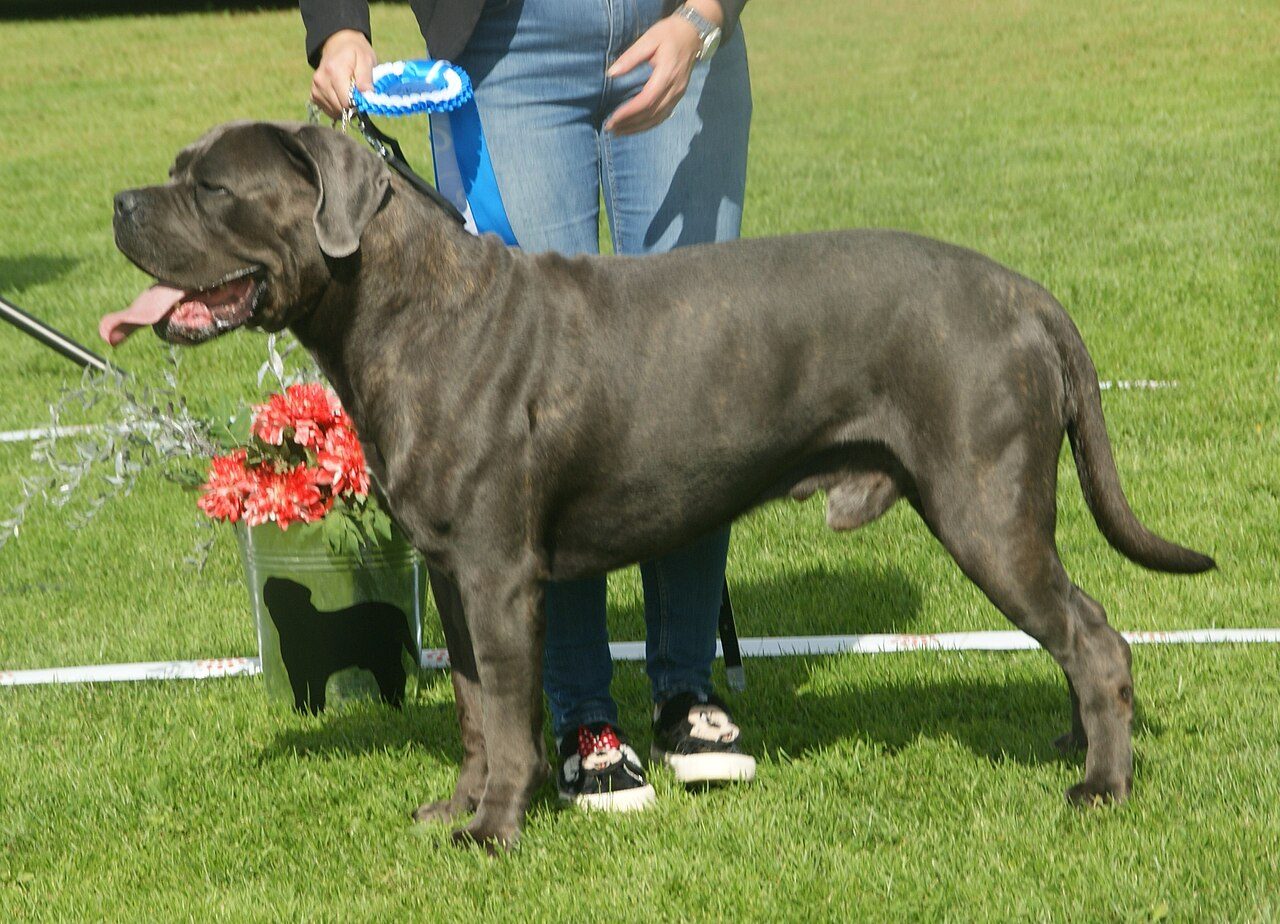
Photo: Canarian, CC BY-SA 4.0, via Wikimedia Commons

Overview
The Cane Corso is an Italian mastiff, a muscular, athletic dog with a large head and a short, stiff coat that moves with surprising ease and elegance. For centuries it guarded farms and property in southern Italy and helped with cattle and with hunting difficult game such as wild boar. The AKC standard calls it an unequaled protector of its property and owners, intelligent and easily trained, and docile and affectionate with its owner. Of Italy's two native mastiffs, the Corso is the lighter and more athletic; the Neapolitan Mastiff is the heavier.
History
The FCI calls the old Roman Molossian the breed's direct ancestor, and breed historians trace it to the war dogs of Rome. Once found all over Italy, the Corso had retreated by the twentieth century to Apulia and the neighboring regions of the south, where it worked on farms as a guard, drover and hunter. Changes in farming and two world wars left it close to extinction by the middle of the century. In the 1970s a handful of Italian enthusiasts went looking for the dogs they remembered from childhood, and a 1980 litter bred by the Malavasi brothers in Mantua produced the dogs used as the model for the first standard. Italy's first breed club, the Società Amatori Cane Corso, followed in 1983. The FCI accepted the breed provisionally in 1996 and definitively in 2007. The first Cane Corsi came to the United States in 1988, and the AKC recognized the breed in 2010.
Type
The FCI describes the Cane Corso as medium to large, a robust, sturdy dog with some elegance and lean, powerful muscle; the AKC calls it a medium-large Molosser with a strong skeleton. The FCI asks for males of 64 to 68 cm and females of 60 to 64 cm, allowing 2 cm either way, and weights of 45 to 50 kg for males and 40 to 45 kg for females. The AKC asks for males of 25 to 27½ in (64 to 70 cm) and females of 23½ to 26 in (60 to 66 cm), with weight in proportion to height. Both describe a rectangular dog, about a tenth longer than it is tall.
The coat is short, stiff, shiny and dense, with a light undercoat that the AKC notes grows thicker in cold weather. Colors are black, shades of gray and fawn, and red, all of which may be brindled; fawn and red dogs have a black or gray mask that stops at the eyes. A small white patch on the chest or toes is allowed. The FCI disqualifies semi-long or fringed coats and large white patches, and the AKC disqualifies tan markings like those of black-and-tan breeds.
Temperament
The AKC standard describes the Cane Corso as an unequaled protector of its property and owners: intelligent and easily trained, noble and majestic, and docile and affectionate with its owner, loving with children and family. The FCI calls it a guardian of property, family and livestock, extremely agile and responsive, and disqualifies dogs that are aggressive or overly shy.
Energy
High. The FCI classes the Cane Corso as a versatile utility dog with a working trial and calls it extremely agile and responsive. The AKC says it needs serious exercise, suggesting a brisk walk or run of at least a mile morning and evening, and mental work too, since it was bred to work and is happiest with a job to do.
Intelligence
The AKC standard calls the Cane Corso intelligent and easily trained. The AKC adds that it is eager to please and responds far better to praise and rewards than to harsh correction, and that early socialization and puppy classes are a must for a dog this big and strong.
Intelligence here means typical trainability, guided by Stanley Coren's survey of obedience judges. It is not a verdict on any one dog.
Care
Grooming
Grooming is simple. The AKC suggests a weekly brush with a medium-bristle brush, rubber mitt or hound glove, daily during the spring shed, along with regular nail trims, ear checks and tooth brushing.
Health notes
The AKC gives a life expectancy of 9 to 12 years. For a CHIC number, the Orthopedic Foundation for Animals requires a hip evaluation (OFA or PennHIP), an OFA elbow evaluation, a cardiac exam (basic or advanced), a patellar luxation evaluation, and DNA tests for neuronal ceroid lipofuscinosis (NCL1) and dental retinal skeletal anomaly (DSR); an ACVO eye exam, a thyroid test and banking DNA with the OFA/CHIC repository are optional. As a large, deep-chested breed, the Corso can suffer bloat, and the AKC suggests owners learn its warning signs. The AKC also lists hip dysplasia, idiopathic epilepsy, demodectic mange and eyelid problems among the conditions breeders screen for.
Ordinary care
The Cane Corso is big, strong and naturally protective, and the AKC stresses early socialization with people and other dogs, puppy classes and obedience training, done with rewards rather than harsh methods. It needs daily exercise and something to do. When choosing a puppy, look for parents with the club's recommended health screening.
Facts
- The breed's name is usually traced to the Latin cohors; the FCI glosses it as 'protector, guardian of the farmyard', and the AKC as roughly 'bodyguard dog'.
- By the middle of the twentieth century the Cane Corso was nearly extinct. Italian enthusiasts began reviving it in the 1970s, founded the first breed club in 1983, and won FCI acceptance in 1996.
- The breed reached America thanks to a wedding. On his way to a ceremony in Sicily, the American Michael Sottile spotted a Corso herding cows by the road, stopped to talk to the farmer, and in 1988 imported the first Cane Corsi to the United States.
- One of the Corso's old farm jobs was helping at farrowing time: it held a protective sow's attention, by the snout or ear, while the farmer slipped in to collect the piglets.
- The AKC, which recognized the breed in 2010, allows cropped or natural ears and a tail docked at the fourth vertebra or left natural. The FCI standard asks for uncropped ears and a natural tail.
The Dog Codex is an editorial reference, not veterinary advice. Health notes summarize conditions that appear in breed literature; they do not diagnose an individual dog and do not replace examination by a licensed veterinarian.