Sporting group · France
Brittany
- SizeMedium
- Height44.5–52 cm
- Weight13.5–18.1 kg
- GroupSporting
- EnergyHigh
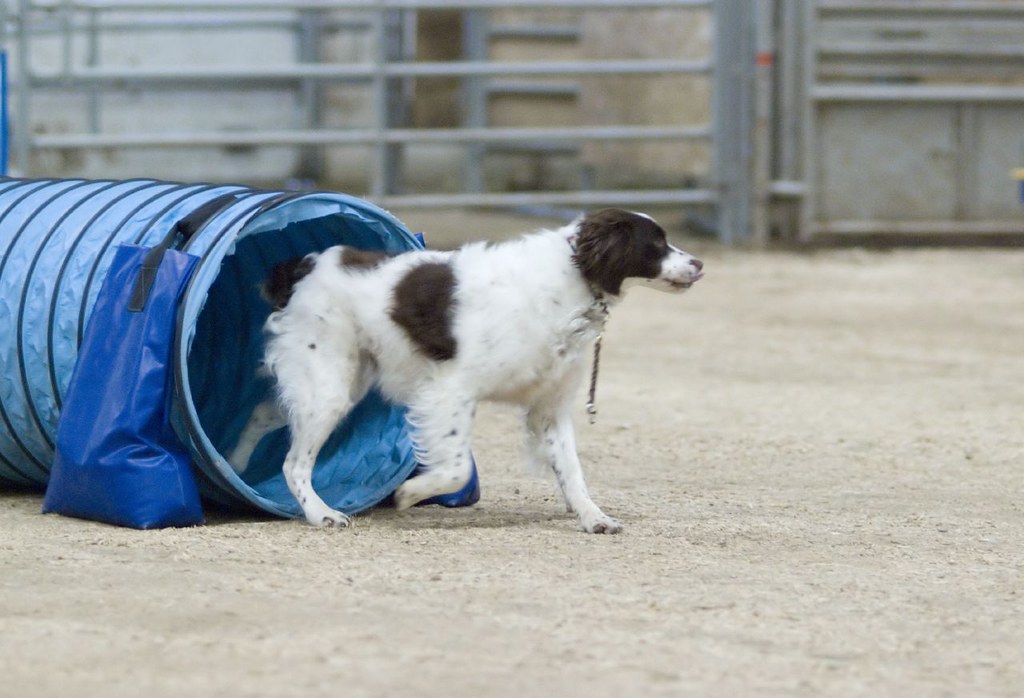
Photo: Ron Armstrong (SheltieBoy), CC BY 2.0, via Wikimedia Commons

Overview
The Brittany is a compact French pointing dog with a short back, a square outline, a quick ground-covering gait, and a dense but not lavish coat. The AKC standard calls for a medium-sized dog that is strong, vigorous, energetic, and quick without becoming clumsy. Its proportions and movement make the purpose visible: this is a field dog built to search, point, and retrieve, not a decorative small spaniel. A Brittany can be an affectionate companion, but its working identity should lead the plate: exercise, training, and safe opportunities to use its nose and body need to be planned rather than left to chance.
History
France, specifically the centre of Brittany. FCI lists France as the origin, and the Club de l’Épagneul Breton gives the same origin. The breed developed in rural Brittany as a compact, hardy hunting dog, selected for courage, compact construction, and versatile work in difficult cover. FCI describes a versatile pointing dog for any game and terrain, with scenting ability, spontaneous and sustained pointing, retrieving, and aptitude for training. A first standard was drafted in 1907 and adopted at Loudéac on 7 June 1908. The breed reached North America in the 1920s; AKC recognized it in 1934 and changed the official U.S. name from Brittany Spaniel to Brittany on 1 September 1982. FCI and several other registries retain Épagneul Breton or Brittany Spaniel terminology.
Type
Medium-sized by the AKC standard, compact and square rather than heavy. AKC and CKC publish 17½–20½ in (about 44.5–52 cm); FCI gives males 48–51 cm and females 47–50 cm, with a 1 cm tolerance at either limit, while The Kennel Club publishes sex-specific ideals of 48–51 cm for dogs and 47–50 cm for bitches. AKC and CKC publish about 30–40 lb (13.5–18.1 kg); FCI and The Kennel Club do not publish a numeric adult weight. FCI’s phrase “smallest of the pointing breeds” is a comparison within its functional category, not a small-dog classification.
A dense, medium-length coat that is flat or slightly wavy, never curly. AKC says the texture is neither wiry nor silky; the head and ears carry relatively short hair, and the legs have some feathering without profuse furnishings. FCI describes shorter hair on the head and front of the limbs, with heavier feathering behind the limbs. Colours vary by registry: AKC allows orange and white or liver and white in clear or roan patterns and disqualifies black in the coat; FCI and The Kennel Club also describe white-and-black or black-tricolour varieties. These colour rules are registry standards, not health or temperament rankings.
Temperament
The standard picture is alert, happy, sociable, and mentally balanced. AKC calls for a happy, alert dog, neither mean nor shy; FCI adds adaptability, an intelligent and attentive expression, sociability, and mental balance. The Kennel Club describes the breed as gentle and affectionate yet lively and exuberant. The hunting traits are not incidental: FCI calls the Brittany a versatile pointing dog with early hunting passion, scenting ability, field range, pointing, retrieving, and aptitude for training. These are ideals for breeding and judging, not a behavioral guarantee; early socialization, humane training, and the individual dog’s history still matter.
Energy
High: this is a working gundog in the standards’ own terms. FCI lists pointing dogs as the utilization and requires a working trial; The Kennel Club describes a very energetic hunt-point-retrieve dog, while AKC calls the breed strong, vigorous, energetic, and quick. Long walks, running, field training, scent work, retrieving, and appropriate dog sports may all be useful outlets, but no single activity or fixed number of daily minutes is prescribed. A young dog’s exercise must be adjusted for age, development, conditioning, weather, and veterinary advice.
Intelligence
High trainability is a fair shorthand for FCI’s intelligent expression and aptitude for training, together with the American Brittany Club’s biddable-worker description; it is not a published intelligence ranking. Clear, reward-based training can channel the dog’s search, pointing, retrieving, and recall skills. The same enthusiasm can become difficult to manage if the dog has no safe work or structured learning, and individuals vary.
Intelligence here means typical trainability, guided by Stanley Coren's survey of obedience judges. It is not a verdict on any one dog.
Care
Grooming
This is a relatively practical sporting coat. A regular brush and comb-through of the leg feathering can remove debris and reveal tangles or burrs after field work; the ears should be inspected after work in cover or water, and nails and teeth need ordinary routine care. The AKC standard calls for only light trimming to neaten the head and neck for presentation. Do not infer a shedding, allergy, or hypoallergenic claim from coat texture.
Health notes
Only conditions and screening protocols named by the American Brittany Club, registry, or OFA are listed; no prevalence or lifespan claim is inferred. The ABC breeder health-check document recommends a CHIC protocol including an OFA or PennHIP hip evaluation, an annual eye examination by a boarded ACVO ophthalmologist from ages 2 through 8, and one additional OFA examination: cardiac, elbow-dysplasia, patellar-luxation, or thyroid evaluation. The ABC Code of Ethics separately names hip and elbow dysplasia, primary epilepsy or seizure disorder, retinal atrophy and other eye disorders, heart defects, undescended testicles, and other inheritable defects as breeding concerns. OFA explains that a CHIC number records completed tests with public results; it does not mean every result is normal. Verify current recommendations and ask for actual reports.
Ordinary care
Care should start with the dog the standards describe: an athletic, scent-driven pointing dog with a strong appetite for purposeful activity. Plan humane training in recall, impulse control, field manners, and safe retrieving; use fenced or otherwise secure spaces because a dog following game scent may travel farther than expected. Hunting, scent work, tracking, retrieving, and dog sports can provide appropriate outlets, but a Brittany does not need to hunt competitively to benefit from nose work and structured learning. Maintain the lightly feathered coat, inspect ears and feet after brush or water work, remove burrs promptly, keep nails and teeth in order, and keep routine veterinary appointments. For a breeder puppy or adult, request named hip, eye, and additional cardiac/elbow/patella/thyroid documentation rather than a general claim that the parents are healthy.
Facts
- AKC changed the official U.S. name from Brittany Spaniel to Brittany on 1 September 1982 because American fanciers viewed the dog as more a pointing breed than a flushing spaniel.
- The breed may be born tailless or with a naturally short tail; local law, veterinary rules, and registry policy govern tail practices.
- FCI calls the Brittany the smallest of the pointing breeds, while AKC calls it medium-sized: those statements use different comparisons.
- FCI and The Kennel Club describe pointing or hunt-point-retrieve work; the American Brittany Club describes pointing, holding game, and retrieving on land and in water.
- The colour standard is not identical worldwide: FCI and The Kennel Club describe black-and-white or black-tricolour varieties while AKC disqualifies black in the coat.
- The first modern standard was drafted in 1907 and adopted at Loudéac on 7 June 1908.
The Dog Codex is an editorial reference, not veterinary advice. Health notes summarize conditions that appear in breed literature; they do not diagnose an individual dog and do not replace examination by a licensed veterinarian.