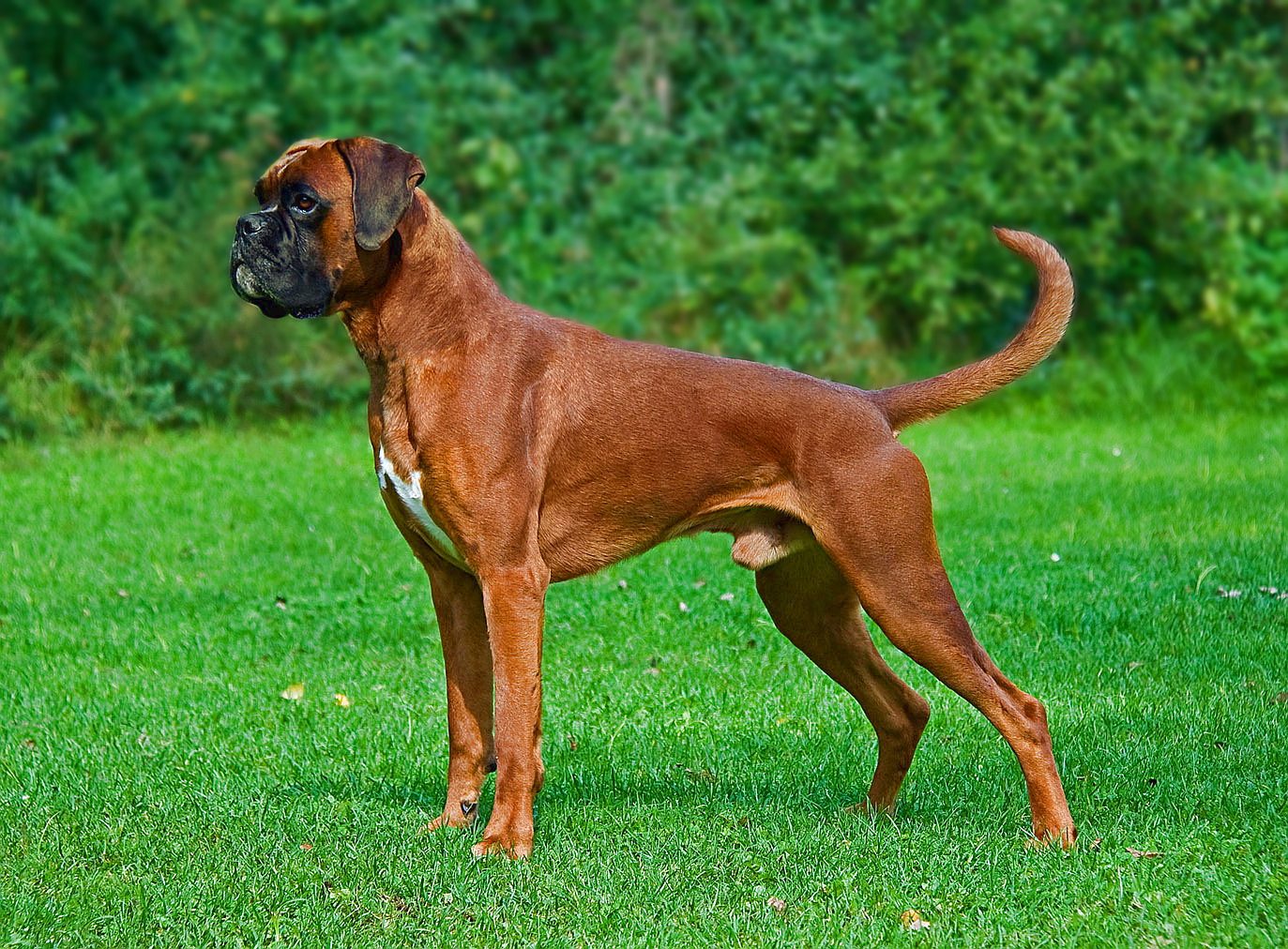
Working group · Germany
Boxer
- SizeMedium
- Height55–64 cm (AKC)
- Weight~23–36 kg (AKC profile)
- GroupWorking
- EnergyHigh
Photo: Mood210, CC BY-SA 3.0, via Wikimedia Commons

Overview
The Boxer is a medium-sized, square-built German working dog with a broad, blunt muzzle, a short, tight coat and well-developed muscle. It descends from the Bullenbeisser, a hunter's dog that seized and held game, and was developed in Munich in the late nineteenth century as a guard, working and companion dog. The AKC standard describes a dog that is playful with family and friends, patient and stoical with children, and wary but fearless with strangers, an instinctive guard dog of real intelligence and loyalty.
History
The Boxer's direct ancestor was the small Brabant Bullenbeisser, or 'bull biter', a dog kept by huntsmen to seize and hold game such as bear, boar and deer until the hunter arrived. Breeders favored a wide jaw and an upturned nose, which let the dog grip and still breathe. The Kennel Club says the Bullenbeisser was probably crossed with the Bulldog to lay the foundation of the modern breed. The Boxer took shape in Munich in the late 1800s, and the first Boxer club was founded there in 1895. In 1904 the Boxer was among the first breeds chosen for police training in Germany, and it later served as a messenger and pack carrier in both world wars. Boxers reached the United States that same year, when the AKC registered its first Boxer.
Type
Both standards describe a medium-sized, square-built dog of good substance, with a short back, strong limbs and clean, hard muscle. The AKC asks for males of 23 to 25 in (58 to 64 cm) and females of 21½ to 23½ in (55 to 60 cm), with no size disqualification; the FCI asks for males of 57 to 63 cm and females of 53 to 59 cm. The FCI suggests that a male of about 60 cm should weigh over 30 kg and a female of about 56 cm about 25 kg. The AKC standard gives no weight, though its breed profile suggests 65 to 80 lb (29 to 36 kg) for males and about 15 lb less for females.
The coat is short, shiny and lies smooth and tight to the body. There are two colors, fawn, from light tan to mahogany, and brindle, from sparse black stripes to stripes so dense that the fawn barely shows through, both usually with a black mask. White markings are allowed but may not cover more than a third of the coat in the AKC standard. The American Boxer Club says 20 to 25 percent of Boxers are born mostly white; these 'white' Boxers are genetically fawn or brindle, can't be shown, and an estimated 18 percent are deaf in one or both ears.
Temperament
The AKC standard puts character and temperament first. It describes an instinctive guard dog whose bearing is alert, dignified and self-assured: playful with family and friends, patient and stoical with children, deliberate and wary with strangers but quick to respond to genuine friendliness, and fearless if threatened. The FCI adds that the Boxer is self-confident, calm and even-tempered, devoted and loyal to its household, harmless with its family but distrustful of strangers, and happy and friendly in play.
Energy
High. The AKC standard says the Boxer's movements denote energy, and the AKC calls it a very playful, high-energy dog that needs ample exercise every day, on a leash or in a securely fenced area. Young Boxers jump and leap a great deal. The AKC also notes that the breed does not tolerate extreme heat or cold well.
Intelligence
Stanley Coren's The Intelligence of Dogs places the Boxer 48th, in his average tier for working and obedience intelligence. The AKC calls it highly intelligent, an excellent problem solver with a mind of its own that can get bored with repetition, and Boxers work as service, therapy, detection and search and rescue dogs.
Intelligence here means typical trainability, guided by Stanley Coren's survey of obedience judges. It is not a verdict on any one dog.
Care
Grooming
The short coat needs very little grooming: the AKC suggests a once-over with a rubber curry brush or hound glove once or twice a week and only an occasional bath. Trim the nails at least monthly and brush the teeth often, daily if possible.
Health notes
The AKC gives a life expectancy of 10 to 12 years. For a CHIC number, the Orthopedic Foundation for Animals requires a hip evaluation (OFA or PennHIP), an autoimmune thyroiditis test, an advanced cardiac exam that includes a Holter monitor, and DNA tests for degenerative myelopathy and arrhythmogenic right ventricular cardiomyopathy (ARVC), all registered with OFA. The American Boxer Club also recommends elbow X-rays, regular thyroid retesting, heart screening for aortic and subaortic stenosis, and a Holter monitor every year. The AKC adds that responsible breeders screen for certain cancers, and it notes that Boxers don't tolerate extreme heat or cold well.
Ordinary care
The AKC says the Boxer should live in the house as a member of the family, and calls early socialization and puppy classes vital for channeling its energy. Give it daily exercise on a leash or in a secure area, go easy in very hot or cold weather, and ask breeders for the parents' heart, hip, thyroid and DNA results.
Facts
- The name 'Boxer' may come from the way the breed uses its front legs when it plays or defends itself, like a sparring prizefighter.
- In 1951 a Boxer named Bang Away of Sirrah Crest won Best in Show at Westminster and became a national celebrity, appearing on magazine covers and winning 121 Best in Show awards. His record stood until 2020, when a fawn female called Wilma passed it.
- About one Boxer in four or five is born mostly white. White Boxers can't be shown, but the American Boxer Club says they are the equal of their colored littermates as obedience, agility, service, therapy and companion dogs.
- There is no such thing as a black Boxer. The American Boxer Club says the breed carries no gene for a black coat; very dark 'reverse' brindles may look black, but the fawn always shows through.
- In 1904 the Boxer was one of the first breeds chosen for police training in Germany.
The Dog Codex is an editorial reference, not veterinary advice. Health notes summarize conditions that appear in breed literature; they do not diagnose an individual dog and do not replace examination by a licensed veterinarian.