Working group · Switzerland
Bernese Mountain Dog
- SizeLarge
- Height58–70 cm (AKC)
- Weight~32–52 kg (AKC profile)
- GroupWorking
- EnergyModerate
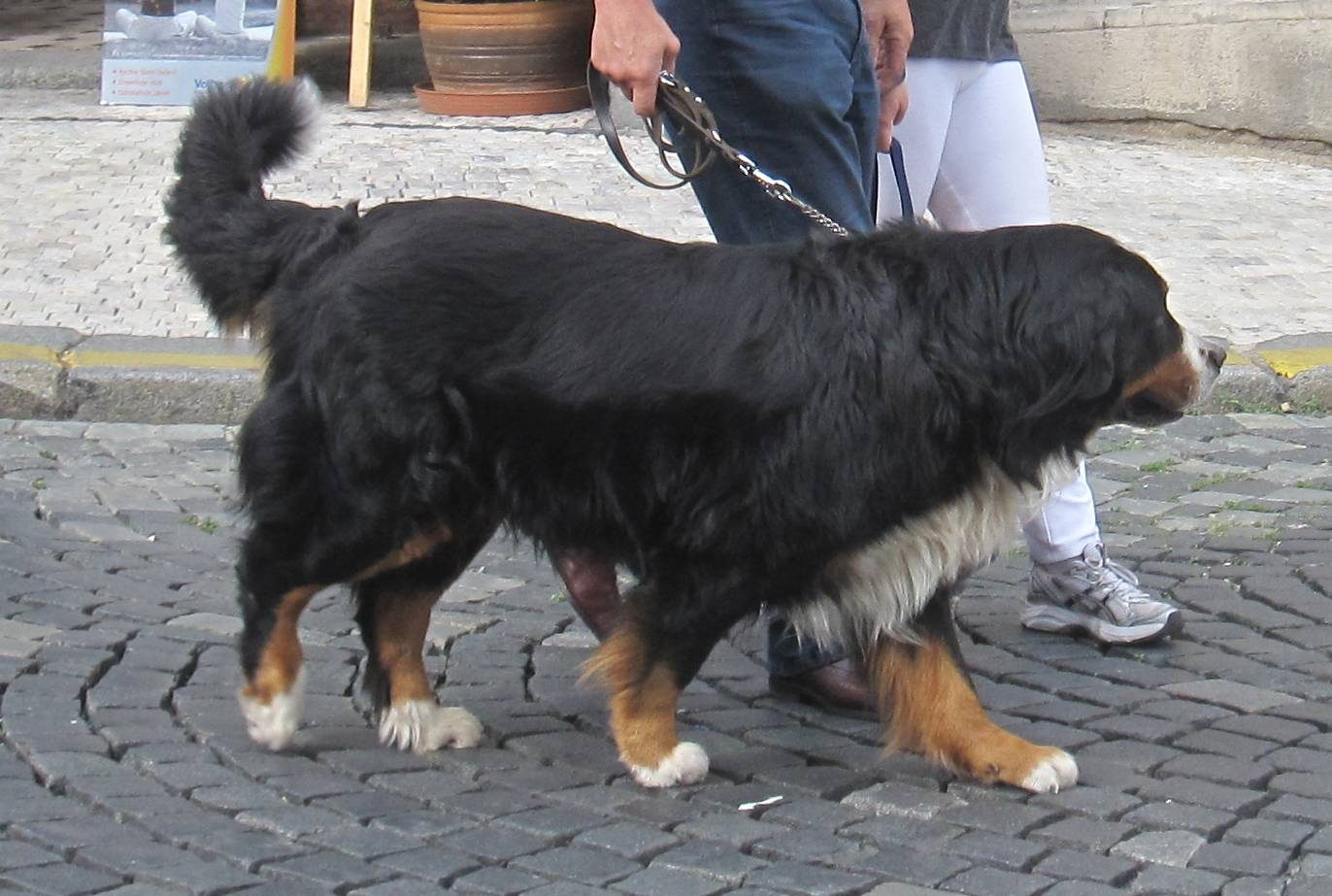
Photo: Bordercolliez, CC BY-SA 3.0, via Wikimedia Commons

Overview
The Bernese Mountain Dog is a big, strong, longhaired farm dog from the Canton of Bern in Switzerland, instantly recognized by its tricolor coat of jet black, rich rust and clear white. Once a guard, draft and cattle dog on Swiss farms, it is the only one of the four Swiss Sennenhund breeds with a long coat. The AKC standard describes a self-confident, alert and good-natured dog, never sharp or shy, and the FCI notes that today it is loved around the world as a family dog.
History
The Bernese is an old farm dog of the prealpine and midland areas around Bern, used to guard farms, pull carts and drive cattle. It was first called the Dürrbächler, after the hamlet and inn of Dürrbach near Riggisberg, where these longhaired tricolor dogs were especially common, and the Kennel Club notes that it pulled carts for the area's weavers and carried milk and cheese. Dogs were shown in 1902, 1904 and 1907, and in 1907 breeders around Burgdorf founded the Schweizerischer Dürrbach-Klub to breed them pure and fix the breed's type. Renamed the Bernese Mountain Dog in line with the other Swiss mountain dogs, the breed quickly became popular across Switzerland and into Germany. In the United States, a Kansas farmer, Isaac Schliess, is believed to have imported the first Berners in 1926, and Glen Shadow of Louisiana brought in a pair in 1936. The AKC recognized the breed in 1937, and the Bernese Mountain Dog Club of America was formed in 1968. The FCI accepted the breed definitively in 1954.
Type
A large, sturdy dog with heavy bone, slightly longer than tall, though it looks square. The FCI and the Kennel Club set height at 64 to 70 cm for males, ideally 66 to 68 cm, and 58 to 66 cm for females, ideally 60 to 63 cm; the AKC's 25 to 27½ in and 23 to 26 in come to almost the same. No standard sets a weight, but the AKC breed profile gives about 36 to 52 kg (80 to 115 lb) for males and 32 to 43 kg (70 to 95 lb) for females.
The coat is thick, moderately long and straight or slightly wavy, with a bright natural sheen, and the AKC shows it natural with no undue trimming. The ground color is always jet black, with rich rust over the eyes, on the cheeks, chest and all four legs, and clear white on the face as a blaze and muzzle band and on the chest, often in the shape of an inverted cross. White feet and a white tail tip are desirable. Any ground color other than black is a disqualification under the AKC, and the FCI disqualifies any coat that isn't tricolor, as well as a short coat.
Temperament
Self-confident, alert and good-natured, never sharp or shy, says the AKC standard; a Bernese should stand steady, though it may stay aloof with strangers. The FCI describes an attentive, vigilant dog, fearless in everyday situations, good-natured and devoted to its own people, self-assured and calm with strangers, of medium temperament and docile. The Kennel Club calls it a kind and devoted family dog that is slow to mature.
Energy
The Bernese is a strong working dog with a calm side: the FCI calls it of medium temperament, the AKC says Berners are generally placid, and its natural working gait is a slow trot, though it is capable of speed and agility. The AKC recommends at least half an hour of moderate exercise every day and says Berners enjoy long walks and hikes, carting and drafting, and sports such as agility, obedience, rally and tracking.
Intelligence
The AKC standard calls the Bernese intelligent, with an intelligent, animated and gentle expression. The AKC says Berners are eager to please and usually easy to train, but sensitive: their feelings are easily hurt, so they don't respond well to harsh corrections.
Intelligence here means typical trainability, guided by Stanley Coren's survey of obedience judges. It is not a verdict on any one dog.
Care
Grooming
Berners have a double coat, a longer outer coat over a woolly undercoat, and shed a fair amount, especially during the twice-yearly shedding seasons. Brush weekly, and daily while the coat is shedding, working out tangles with a slicker brush or metal comb. Trim the nails regularly, check the ears for infection, and brush the teeth often.
Health notes
Berners are a short-lived breed: the AKC gives a life expectancy of 7 to 10 years, and the UK breed club reports an average age at death under 8 years, with cancer behind about two thirds of deaths. Histiocytic sarcoma is the single biggest problem, causing around a quarter of deaths, most often between 5 and 7 years of age. For a CHIC number, the Orthopedic Foundation for Animals requires an AKC DNA profile, a hip evaluation (OFA or PennHIP), an OFA elbow evaluation, an ACVO eye examination, a cardiac exam (a basic exam by a cardiologist, or an advanced exam), DNA results for both degenerative myelopathy mutations (SOD1-A and SOD1-B, or an at-risk result for either), and one elective chosen from a von Willebrand disease DNA test, an autoimmune thyroiditis test or Antagene's histiocytic sarcoma risk test. Other conditions the AKC lists include bloat, subaortic stenosis, autoimmune and skin problems, and eye problems such as entropion, ectropion, cataracts and progressive retinal atrophy.
Ordinary care
Early socialization and training matter all the more in a dog this size, and gentle methods suit this soft-hearted breed. The AKC notes that Berners want to be with their families and can develop unwanted habits if often left alone for long periods. Keep them lean, learn the signs of bloat, and don't let a young Berner pull a loaded cart until its growth plates close at around 2 years. Ask breeders for the parents' hip, elbow, eye, heart and DM results.
Facts
- The breed's first name was Dürrbächler, after the hamlet and inn of Dürrbach near Riggisberg in the Canton of Bern, where these longhaired tricolor farm dogs were especially common.
- At a show in Burgdorf in 1910, local farmers brought along their Dürrbächlers, and 107 of them were shown.
- The Bernese is one of four Swiss Sennenhund breeds, along with the Greater Swiss, the Appenzeller and the Entlebucher, and the only one with a long coat. Some say the white marking on its chest represents the cross on the Swiss flag.
- In Switzerland, Bernese often take part in parades pulling light carts, with their owners in Swiss national costume. In American draft tests, the dogs pull a loaded cart for half a mile in 12 to 15 minutes.
- Two of the first Berners in America proved their worth fast. When a 350-pound buck attacked their owner, Glen Shadow of Louisiana, Felix and Frances, a daughter of his imported female Fridy, grabbed the deer and chased it off. The AKC recognized the breed the next year, on April 13, 1937.
The Dog Codex is an editorial reference, not veterinary advice. Health notes summarize conditions that appear in breed literature; they do not diagnose an individual dog and do not replace examination by a licensed veterinarian.