Article
Why Dalmatians Ran With Fire Engines
Long before sirens, a spotted dog went first: the strange, true career of the coach dog that joined the fire brigade, and why it never quite left.
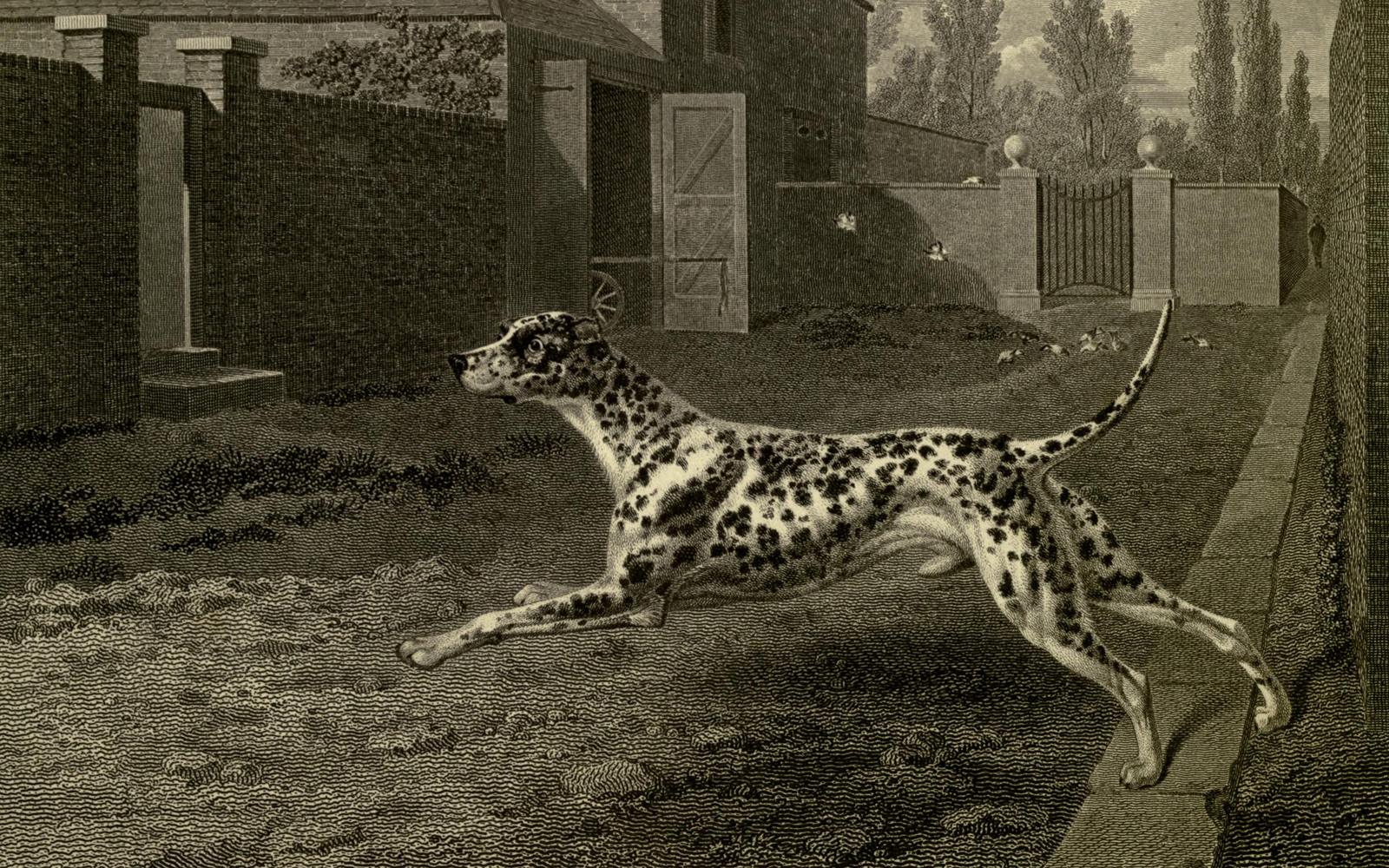
_BHL22490588.jpg)
Picture a city street in the age of horses. A gong clangs inside a firehouse, the doors swing open, and out comes a steam engine hauled by a team of horses at full gallop. Ahead of them, barking at anyone who might wander into the road, runs a white dog covered in black spots.
The American Kennel Club calls these dogs “living sirens” [1]. Fine, but why this dog? How did the Dalmatian end up as the face of the fire service?
The short answer is that it was already doing the job, just for a different employer.
A dog built for the road
In 1790 the English engraver Thomas Bewick published A General History of Quadrupeds. Its entry headed “The Dalmatian or Coach Dog” says the breed was “very common in this country at present; and is frequently kept in genteel houses, as an elegant attendant on a carriage, to which its attention seems to be solely directed” [2].
Bewick wasn’t entirely a fan. He dismissed the dog’s nose, writing of “its incapacity of scenting.” He also complained that ear cropping was so common that he could not remember ever seeing one of these dogs with its ears intact [2]. The modern FCI standard begs to differ on the nose: it credits the breed with “a marked hound instinct” [3]. The two sources never got to argue it out.
The Royal Kennel Club describes the Dalmatian in the Regency period (1795 to 1837) as a status symbol trotting beside horse-drawn carriages, where well-spotted dogs were “highly prized.” That earned it the nickname “the Spotted Coach Dog.” The dogs also guarded the stables at night [4].
The job took skill. A breed history from the AKC’s Complete Dog Book, reprinted by the Dalmatian Club of America, says a coach dog might work under the rear axle, under the front axle, “or, most difficult of all, under the pole between the leaders and the wheelers” [5]. That means trotting between two pairs of moving horses. AKC adds that the dogs were often kenneled in the stables from puppyhood to build the bond with the horses [1].
From the coach house to the firehouse
The fire service came looking for horses, and the dogs came with them. A history published by the Fire Fighters Association of Missouri (FFAM) explains that steam pumpers were too heavy for crews to haul by hand. Once horses moved into the stations, the men moved upstairs, and that move helped give rise to the sliding pole [6].
A dog that already knew horses and could keep pace with a team was, as FFAM puts it, “a natural firehouse addition” [6]. On a run, the sources agree, it did three things:
- They cleared the way. Before sirens, a fire company had a bell and perhaps a steam whistle. FFAM says the dog ran ahead to open a path through crowded streets and kept other dogs from frightening the horses [6]. The Royal Kennel Club agrees [4].
- They kept the horses steady. At a fire, AKC says, the dogs stayed with the horses and kept them calm “in an atmosphere where fear and tension hung in the air just as heavily as smoke and ash” [1].
- They stood guard. Horses were valuable, and so was the equipment. AKC and FFAM both say the dogs made sure nobody walked off with either [1][6].
New York’s firehouse dogs had a chronicler: Alfred M. Downes, secretary of the New York Fire Department, whose Fire Fighters and Their Pets appeared in 1907 [7]. As FFAM summarises him, Downes reported that many dogs “learned to distinguish the signals on which the company rolls,” becoming “good ‘counters’” of the alarm taps. He also described a small metal fire helmet hung from a dog’s collar as a badge of membership [6].
It was dangerous work. Downes described one dog that was run over three times and returned to duty each time after the department’s veterinary surgeon patched it up [6].
One honest footnote: the firehouse dog wasn’t always a Dalmatian. FFAM mentions a St. Louis pointer named Ponto and a Saint Bernard called Prince at FDNY Engine 45, who barked the street clear and then guarded the open firehouse [6]. Its author also says he could not find any reliable count of which breed was most popular in the American fire service [6].
The day the horses retired
On December 20, 1922, Brooklyn’s Engine 205 made what was billed as the last run of New York’s fire horses, a ceremonial dash to Borough Hall, where a motorized engine was waiting to replace them. A Microsoft history piece, citing the Brooklyn Eagle of that day, lists the dignitaries who turned out for the farewell along with “Jiggs, the firehouse’s spotted Dalmatian” [8].
AKC observes, a little drily, that the dogs “no longer had any interest in following the newfangled trucks” [1].
They stayed anyway. FFAM says some dogs rode the new apparatus to calls, others guarded the station, and visiting children now met a dog instead of a horse [6]. By 2011, Live Science could point to Twenty, the Dalmatian at FDNY Ladder 20, who rode in the truck rather than running beside it [9]. The job had changed from escort to mascot.
Mascots, beer wagons and Sparky
Some of the best-known working Dalmatians today ride with horses again. According to Iowa State University’s veterinary college, the Dalmatian joined the Budweiser Clydesdales hitch in 1950 and sits on the wagon beside the driver. A breeder who supplies the dogs explains the fit simply: “Dalmatians were coach dogs in England and transitioned to the horse-drawn fire wagons” [10]. An Anheuser-Busch Q&A printed in 2008 dates the first ride to March 30, 1950, marking the opening of the company’s Newark brewery [11].
Then there’s the fire service’s most famous Dalmatian, who isn’t a real dog at all. The National Fire Protection Association (NFPA) says Sparky the Fire Dog was created by NFPA and the Ad Council on March 18, 1951, to bring fire-safety messages to children [12]. Why a Dalmatian? NFPA is admirably candid: “the exact reasons why are debated.” It lists three theories:
- the dogs were prone to deafness, so sirens didn’t bother them
- their spots made them easy to see
- they had a natural affinity for horses
NFPA adds that the breed has always been linked to the U.S. fire service, especially in the days of horse-drawn engines [12].
Only the last has the coaching record behind it. Deafness does occur in the breed, and the Dalmatian Club of America asks breeders to check the BAER hearing status of breeding dogs and their puppies [13]. But no source here ties it to how firehouse dogs were chosen.
NFPA also runs Fire Prevention Week, which in 2026 falls on October 4 to 10 [14].
And where did the spots come from?
Nobody knows for certain. FCI gives the country of origin as Croatia. It cites a 1600 to 1630 altar painting on the island of Lošinj and 18th-century church chronicles naming “Canis Dalmaticus” [3].
The Royal Kennel Club says there is “little evidence” the breed came from the Dalmatian coast [4]. The AKC Complete Dog Book history opens by saying no breed has “a more disputed heritage” [5]. AKC’s history repeats tales of spotted dogs in ancient Egypt and Greece, calls a Dalmatian-coast origin “probably most unlikely,” and notes that genetically Dalmatians “don’t line up strongly with any established modern breeds” [1].
The firehouse chapter, at least, is easy to explain. A dog bred to run with horses was right there when the horses went to work.
Sources
- American Kennel Club, Denise Flaim, "Dalmatian History: From Carriage Dogs to Firehouse Mascots" (updated 28 Mar 2024) www.akc.org/expert-advice/dog-breeds/dalmatian-history/
- Thomas Bewick and Ralph Beilby, A General History of Quadrupeds (Newcastle upon Tyne, 1790), pp. 293-294, "The Dalmatian or Coach Dog". Full text, Internet Archive archive.org/details/generalhistoryof00beil
- FCI Standard No. 153, Dalmatian (Dalmatinski pas), official valid standard 13 Oct 2010 (English 30 May 2011) fci.be/Nomenclature/Standards/153g06-en.pdf · nomenclature page: fci.be/en/nomenclature/DALMATIAN-153.html
- The Royal Kennel Club, Dalmatian, Breeds A to Z ("About this breed") www.thekennelclub.org.uk/search/breeds-a-to-z/breeds/utility/dalmatian/
- Dalmatian Club of America, "A Short History of the Dalmatian," reprinted from The Complete Dog Book, 18th ed. (AKC, 1992) dalmatianclubofamerica.org/dalmatian-history/
- David Hedrick, "The Dalmatian and Other Firehouse Mascots," Fire Fighters Association of Missouri (FFAM), 23 Sep 2023 (draws on Downes 1907, Treen 1992 and others) www.ffam.org/the-dalmatian-and-other-firehouse-mascots/
- Alfred M. Downes, Fire Fighters and Their Pets (Harper & Brothers, 1907). Bibliographic record (rare-book listing) www.aardvarkrarebooks.com/pages/books/85913/alfred-m-downes/fire-fighters-and-their-pets-with-many-illustrations-reproduced-from-photographs
- Brad Smith and Carol Ann Browne, "The Day the Horse Lost Its Job," Microsoft Today in Technology (cites Brooklyn Eagle, 20 Dec 1922) blogs.microsoft.com/today-in-tech/day-horse-lost-job/
- Remy Melina, "Why Are Dalmatians the Official Firehouse Dogs?" Live Science, 19 May 2011 www.livescience.com/33293-dalmatians-official-firehouse-dogs.html
- Iowa State University College of Veterinary Medicine, "The Clydesdales' Mascots" vetmed.iastate.edu/story/the-clydesdales-mascots/
- "Tidbits about Clydesdales" (Anheuser-Busch Q&A), The Daily Record, 8 Sep 2008 www.the-daily-record.com/story/news/2008/09/08/tidbits-about-clydesdales/19478937007/
- National Fire Protection Association, "About Sparky the Fire Dog" www.nfpa.org/about-nfpa/about-sparky-the-fire-dog
- Dalmatian Club of America, "Position Statement on Dalmatian Deafness" (2020) dalmatianclubofamerica.org/wp-content/uploads/2020/02/Position-Statement-on-Dalmatian-Deafness.pdf · Hearing page: dalmatianclubofamerica.org/hearing/
- National Fire Protection Association, Fire Prevention Week (October 4 to 10, 2026) www.nfpa.org/events/fire-prevention-week
The Dog Codex is an editorial reference, not veterinary advice. Quotations come from the sources listed above; follow the links for the full context.