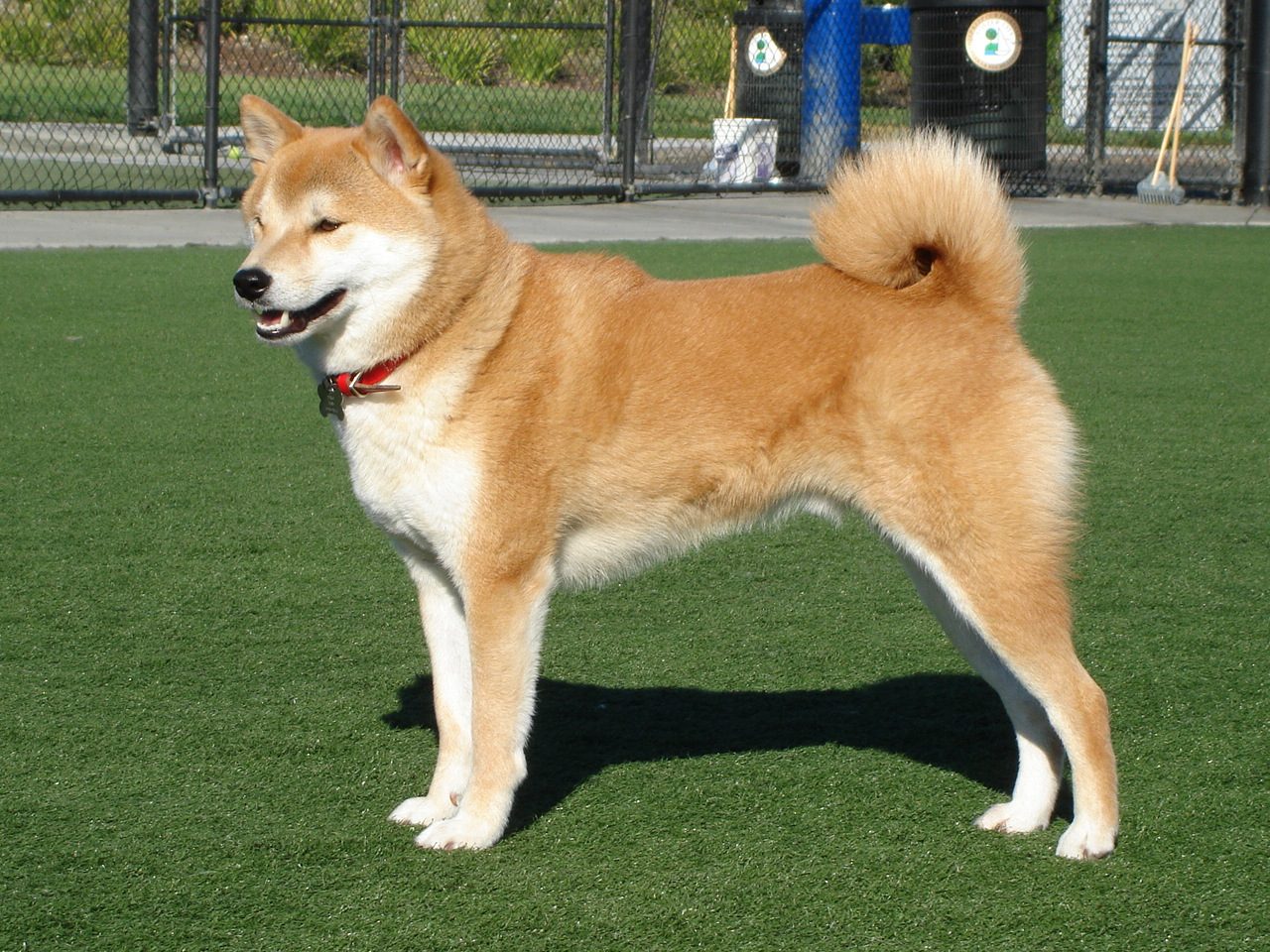
Non-Sporting group · Japan
Shiba Inu
- SizeSmall
- Height35–41 cm
- Weight~7–11 kg
- GroupNon-Sporting
- EnergyModerate
Photo: Takashiba, Public domain, via Wikimedia Commons

Overview
The Shiba Inu is the smallest of Japan's native breeds and the only small one among the six that Japan protects as natural monuments. It was a hunter of birds and small animals, developed to hunt by sight and scent in the dense undergrowth of Japan's mountains. The AKC standard calls it alert and agile with keen senses, and its red, black and tan, or sesame coat always carries the pale urajiro markings that give it a foxlike look.
History
Small hunting dogs of the Shiba type have lived in Japan since ancient times, used on birds and small animals in the mountains facing the Sea of Japan. After English Setters and Pointers arrived in the Meiji era, crossbreeding became so common that pure Shibas were exceedingly scarce by the 1910s and 1920s. Preservation began in earnest around 1928, the year NIPPO was founded, and a unified Japanese dog standard followed in 1934. NIPPO records the Shiba's designation as a natural monument in December 1936. Many dogs were lost in the Second World War, and the NSCA says most survivors then succumbed to distemper. Breeders rebuilt the Shiba from the regional strains that remained, known as the Shinshu, Mino and San'in Shibas. NIPPO traces today's Shibas through the post-war foundation sire Naka back to a dog called Seki, found in Shimane Prefecture in 1936. The AKC recognized the breed in 1992 and places it in the Non-Sporting Group.
Type
FCI and NIPPO: males 39.5 cm and females 36.5 cm, with 1.5 cm allowed either way, so males 38–41 cm and females 35–38 cm. NIPPO gives the weight as about 9–11 kg for males and about 7–9 kg for females; the FCI standard sets no weight. AKC: males 14½–16½ in and females 13½–15½ in, with the middle of each range preferred, and dogs outside those ranges are disqualified. AKC gives an average weight at the preferred size of about 23 lb for males and 17 lb for females. Height to length is 10 to 11, and the AKC adds that females are slightly longer. The FCI lists lack of sexual dimorphism as a fault.
A double coat: the outer coat is harsh, stiff and straight, and the undercoat is soft and dense, with slightly longer hair on the tail. The AKC recognizes three colors, red, black and tan, and sesame, given equal consideration. The FCI lists red, black and tan, sesame, black sesame and red sesame. Both standards require urajiro, the cream to whitish coat on the sides of the muzzle, the cheeks, the underside of the jaw and neck, the chest and belly, the underside of the tail and the inside of the legs, on every color. Under the AKC standard, cream, white, pinto or any other unlisted color is a very serious fault. Under the FCI standard, pinto is a fault. The AKC asks that the Shiba be shown in a natural state, without trimming.
Temperament
The AKC standard describes 'a spirited boldness, a good nature, and an unaffected forthrightness, which together yield dignity and natural beauty.' The Shiba has an independent nature and can be reserved toward strangers, but it is loyal and affectionate to those who earn its respect. The AKC standard also notes that a Shiba may at times be aggressive toward other dogs. The FCI calls the temperament 'faithful, with keenness in sense and high alertness,' and NIPPO describes a dog of spirit and dignity that is also gentle and obedient.
Energy
Moderate. The AKC describes most Shibas as fairly energetic dogs that love to go for walks but are not hyperactive, and says a Shiba owner should be dedicated to exercising the dog. The breed's original work was hunting birds and small animals in mountain undergrowth, and the AKC standard describes its movement as nimble, light and elastic.
Intelligence
NIPPO describes the Shiba as an intelligent dog overall, one that reads its owner's feelings, and praises its independent judgment and quick movement. The AKC standard notes its independent nature.
Intelligence here means typical trainability, guided by Stanley Coren's survey of obedience judges. It is not a verdict on any one dog.
Care
Grooming
The AKC notes that Shibas are often said to shed twice a year. The coat doesn't mat unless the dog has a long coat, so brushing or combing during heavy shedding is what matters most, and a blower can help lift loose hair. Shibas often object to nail trimming, so the AKC advises starting early with puppies. For the show ring, the standard asks for a natural coat, and trimming is severely penalized.
Health notes
The AKC breed page describes the Shiba as a generally healthy breed, with some risk of hip dysplasia, patellar luxation and eye disease, and calls allergies the most common health condition. The National Shiba Club of America's health pages also discuss cataracts and primary glaucoma, which it describes as inherited and not uncommon in Shibas, and GM1 gangliosidosis, a rare, fatal inherited metabolic disease. For a CHIC number from the Orthopedic Foundation for Animals, a Shiba needs a hip evaluation by OFA or PennHIP, an eye exam by a board-certified (ACVO) veterinary ophthalmologist, and a veterinary patellar luxation evaluation, with all results registered with OFA, plus a microchip or tattoo. A CHIC number shows that the tests were done and the results made public, not that every result was normal.
Ordinary care
The AKC's guidance is blunt: a Shiba 'can never, ever be considered reliable off lead unless in a confined area.' Keep it on a lead or in a secure enclosure. Like all breeds, it benefits from early socialization. The AKC also notes that Shiba puppies are unusually quick to housetrain.
Facts
- The meaning of 'Shiba' is debated. The FCI standard says the word originally referred to something small, a 'small dog,' while the AKC links it to brushwood, either the undergrowth where the dogs hunted or their reddish color. The National Shiba Club of America notes that the ideas are often combined into 'little brushwood dog.'
- Every Shiba registered with NIPPO, about 30,000 a year, traces its father's line back to one dog: Seki, found in Shimane Prefecture in 1936.
- Urajiro, the cream to whitish shading on the cheeks, throat, chest, belly and inside of the legs, is required on every Shiba color by both the AKC and FCI standards.
The Dog Codex is an editorial reference, not veterinary advice. Health notes summarize conditions that appear in breed literature; they do not diagnose an individual dog and do not replace examination by a licensed veterinarian.