Herding group · United Kingdom (Shetland Islands)
Shetland Sheepdog
- SizeSmall
- Height33–41 cm (AKC)
- Weight~7–11 kg (AKC profile)
- GroupHerding
- EnergyHigh
Photo: Nick Cowie (nickobec), CC BY-SA 2.0, via Wikimedia Commons

Overview
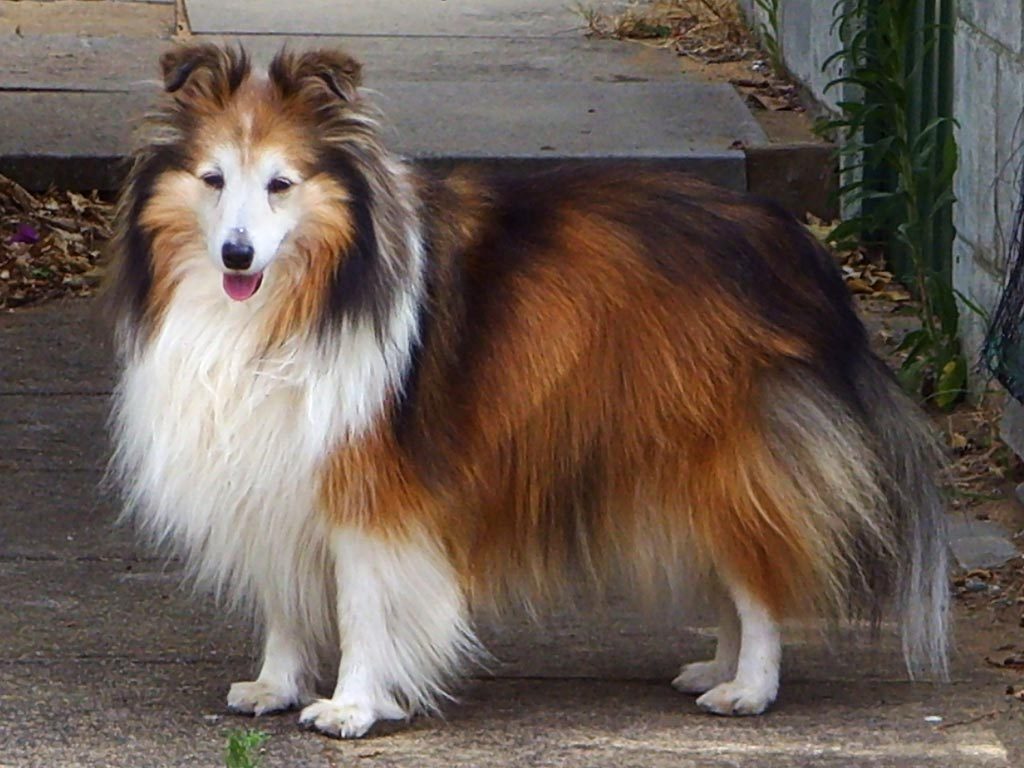
The Shetland Sheepdog, or Sheltie, is a small, long-haired herding dog from Scotland's Shetland Islands. It looks like a Rough Collie in miniature, and the AKC standard says it bears the same relationship to the Collie in size as the Shetland pony does to larger horses. The standards describe an alert, gentle, intelligent, strong and active dog with an abundant coat, mane and frill, a sweet expression and a smooth, effortless trot.
History
On the Shetland Islands, small sheepdogs worked as all-round farm dogs for the crofters, keeping livestock out of the gardens, helping with the twice-yearly sheep round-up and warning of visitors. The AKC standard traces the breed, like the Collie, to Scottish working collies brought to the islands and crossed with small, intelligent long-haired dogs, with Collie crosses added later. The breed was first registered in Lerwick in 1908, and the English Kennel Club recognized it in 1909, first as the Shetland Collie. After objections from Collie fanciers it was renamed the Shetland Sheepdog that same year. The AKC recognized the breed in 1911, and the American Shetland Sheepdog Association was founded in 1929.
Type
A small, sturdy, agile working dog, moderately long in body with a comparatively short back. The AKC asks for 13 to 16 in (33 to 41 cm) at the shoulder and disqualifies dogs outside that range. The FCI and Kennel Club set ideals of 37 cm for males and 35.5 cm for females, and consider more than 2.5 cm above or below highly undesirable. No standard sets a weight; the AKC breed profile gives 15 to 25 lb (about 7 to 11 kg).
The Sheltie has a double coat: a long, straight, harsh outer coat over a short, furry undercoat dense enough to make the whole coat stand off from the body. The mane and frill are abundant, especially in males, the legs are well feathered, and the face, ear tips and feet are smooth. The AKC accepts black, blue merle and sable (golden through mahogany) with white and/or tan markings, and disqualifies brindle. The FCI and Kennel Club list sable, tricolor, blue merle, black and white, and black and tan, and the Kennel Club rejects any other color.
Temperament
The AKC standard calls the Sheltie intensely loyal, affectionate and responsive to its owner. It may be reserved with strangers, but never to the point of fear. The FCI and Kennel Club describe it as alert, gentle, intelligent, strong and active, reserved towards strangers but never nervous. Shyness, snappiness and ill temper are faults.
Energy
High. The standards call the Sheltie a strong, active, agile working dog, and the AKC notes that it is active and athletic and enjoys outings that exercise both mind and body. It excels at obedience, agility, herding and tracking.
Intelligence
Every major standard calls the Sheltie intelligent, and the AKC describes it as extremely intelligent, quick and obedient, very trainable and eager to please. It shines in agility and other dog sports, and the AKC recommends early socialization, puppy classes and at least basic obedience. Shelties can be vocal, so owners should teach a quiet cue.
Intelligence here means typical trainability, guided by Stanley Coren's survey of obedience judges. It is not a verdict on any one dog.
Care
Grooming
The profuse double coat sheds considerably. Brush it at least weekly, and more often in shedding season, checking for mats behind the ears, under the elbows and in the 'pants' under the tail; the Kennel Club suggests grooming every day. Don't shave a Sheltie, since the coat protects against sun and heat as well as cold. Bathe only occasionally and trim the nails regularly.
Health notes
The AKC describes Shelties as generally healthy, with a life expectancy of 12 to 14 years. Conditions breeders screen for include hip dysplasia, thyroid disease, eye diseases, dermatomyositis (Sheltie skin syndrome), von Willebrand's disease, gallbladder mucoceles and epilepsy. For a CHIC number, the Orthopedic Foundation for Animals requires a hip evaluation (OFA or PennHIP), an eye examination (recommended every year until age 5 and every 2 years after that until age 9), a DNA test for BBS2-PRA registered with OFA, and 2 electives chosen from vWD, MDR1, thyroid, collie eye anomaly, elbows and the 3-gene dermatomyositis (DMS) test. Optional CHIC tests include degenerative myelopathy, CNGA1-PRA, patellar luxation, cardiac, dentition and the MCM canine-tooth test. In the UK, the Kennel Club recommends eye testing with litter screening as a minimum.
Ordinary care
Shelties are happiest with regular activity and training that engages their quick minds. Like many herding breeds they like to chase moving things, including cars, so the AKC advises a well-fenced yard and walking on a leash. Keep up with brushing, especially when they shed, and ask breeders for the parents' hip, eye and BBS2-PRA results.
Facts
- The Sheltie is to the Rough Collie what the Shetland pony is to larger horses. The AKC standard makes exactly that comparison, and both animals come from the same small Scottish islands.
- When the Kennel Club first recognized the breed in 1909, it was registered as the Shetland Collie. Collie fanciers objected, and by October of that year the name had been changed to Shetland Sheepdog.
- Before 'Sheltie' caught on, the dogs went by names such as Toonie Dog, Peerie Dog, Fairy Dog, Lilliputian Collie and Miniature Collie.
- The breed's first champion anywhere was American: a black and white dog named Lerwick Rex finished his title in the United States in 1914, just ahead of the first British champion, Clifford Pat.
- On Shetland, Shelties were all-purpose farm helpers: they kept livestock out of the crofters' gardens, helped round up the sheep twice a year and barked to announce visitors.
The Dog Codex is an editorial reference, not veterinary advice. Health notes summarize conditions that appear in breed literature; they do not diagnose an individual dog and do not replace examination by a licensed veterinarian.