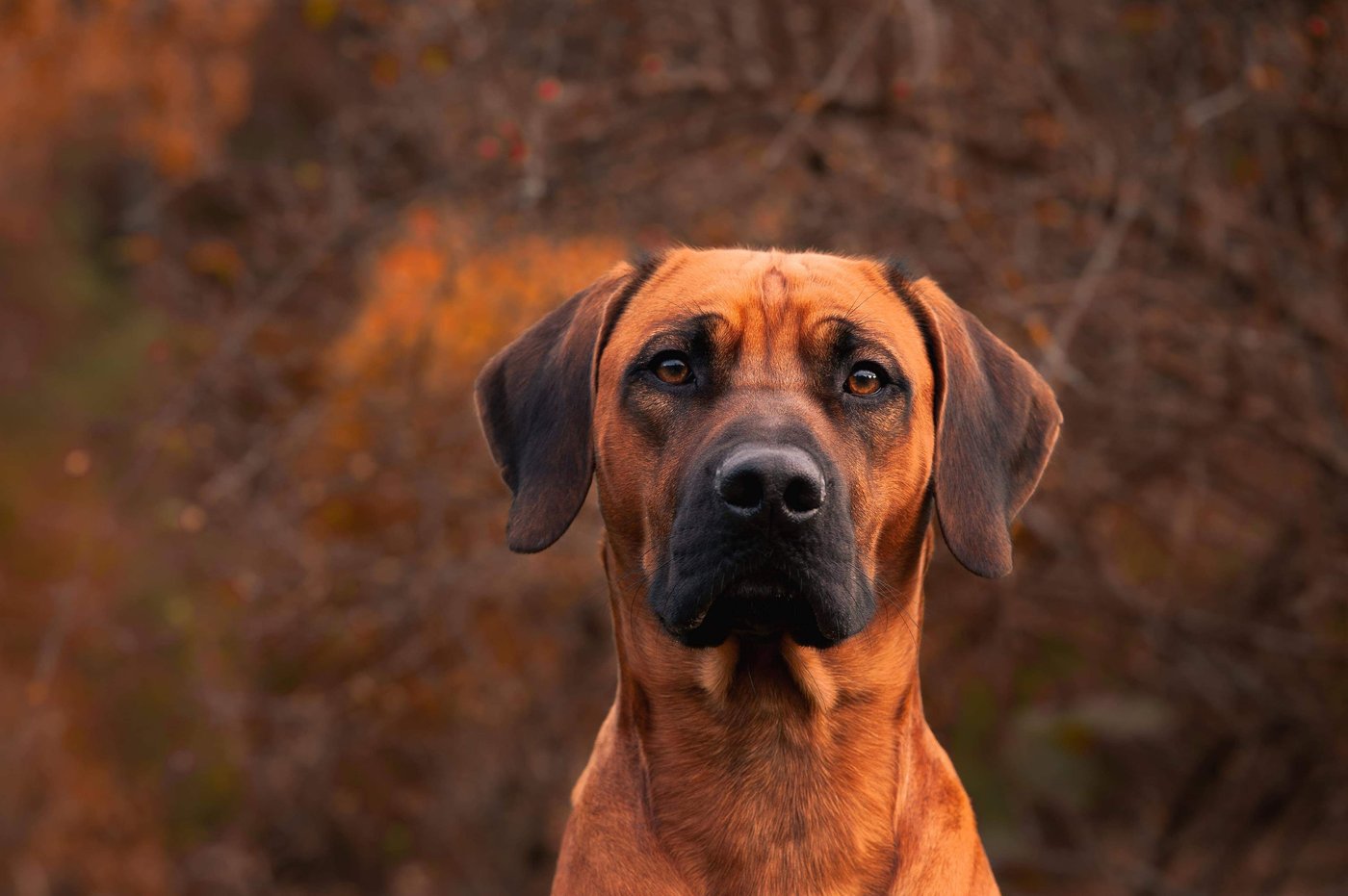
Hound group · Southern Africa (South Africa / Zimbabwe)
Rhodesian Ridgeback
- SizeLarge
- Height61–69 cm (registry- and sex-specific; AKC dogs ~63.5–68.6 cm / bitches ~61.0–66.0 cm; FCI and Royal Kennel Club males 63–69 cm and females 61–66 cm)
- Weight~32–38.6 kg (single desirable figures, not ranges: AKC dogs 85 lb / ~38.6 kg and bitches 70 lb / ~31.8 kg; FCI males 36.5 kg and females 32 kg; Royal Kennel Club gives no weight)
- GroupHound
- EnergyHigh
Photo: Petrwegr, CC BY-SA 4.0, via Wikimedia Commons

Overview
The Rhodesian Ridgeback is a big, athletic, wheaten hound with a signature you can spot from across a park: a ridge of hair running down the spine the wrong way, tapering from just behind the shoulders toward the hips and led by two matching crowns, or whorls. The AKC standard is plain about it — the ridge “must be regarded as the characteristic feature of the breed.” It is worth 20 of 100 points on the AKC scale, more than any other single feature, and a dog without a ridge is disqualified under both AKC and FCI. Beneath the ridge is a strong, muscular, symmetrical hound built for staying power. AKC describes a dog “capable of great endurance with a fair (good) amount of speed,” and FCI asks for “agility, elegance and soundness with no tendency towards massiveness.” The standards agree closely on character, too: dignified, even-tempered or intelligent, devoted to its own people and reserved or aloof with strangers, with FCI and The Royal Kennel Club adding “showing no aggression or shyness.” The breed’s fame rests on its lion-hunting past, and the sources tell that story with care. According to FCI, Ridgebacks worked mainly in groups of two or three to track game, especially lion, and hold it at bay until the hunter arrived. AKC’s breed page stresses that the dogs tracked and bayed lions “but never, ever” killed them. The dogs found and held; the hunter did the rest.
History
The Rhodesian Ridgeback is a breed of southern Africa. FCI’s standard gives its origin as Southern Africa and was supplied jointly by the Kennel Union of Southern Africa and the Zimbabwe Kennel Club; FCI’s nomenclature entry lists South Africa. FCI calls it “presently the only registered breed indigenous to southern Africa,” and the Canadian Kennel Club describes it as the only recognized breed originating in South Africa. Its roots, as the registries tell it, lie in the Cape Colony. AKC’s breed page describes crosses between “the native ridged Khoikhoi dog” and European breeds brought by Dutch colonists, “including Greyhounds and various Terriers”; FCI describes European settlers’ dogs crossing with the semi-domesticated ridged hunting dogs of the Khoikhoi; and The Royal Kennel Club links the breed’s ancestry to the ancient ridged dogs of the Khoikhoi people. CKC says the breed is “said to have descended from native ridged dogs known in South Africa since the 16th century.” The hunting story is told consistently. FCI: “Hunting mainly in groups of two or three, the original function of the Rhodesian Ridgeback, or Lion Dog, was to track game, especially lion, and with great agility, keep it at bay until the arrival of the hunter.” The Royal Kennel Club says the breed was developed in South Africa as a scent hound for a variety of game, then taken to Rhodesia (now Zimbabwe), where it was used largely to track lions and hold them at bay until the hunters arrived. AKC’s breed page credits big-game hunter Cornelius van Rooyen with adding two ridged, Greyhound-like females to his pack of lion dogs in the late 19th century; their ridged offspring excelled at confronting and confounding lions, giving the hunter time to take aim. CKC’s account has van Rooyen acquiring a few ridged dogs in the late 1870s and refining his lion dogs over 35 years with Greyhound, Pointer, Collie, terrier and Great Dane crosses — a different recipe from AKC’s, and each source tells its own version. AKC also credits the ridged dogs with fending off leopards and baboons, keeping pace with mounted riders, coursing antelope for the pot and guarding the homestead. The Royal Kennel Club adds a lovely piece of folklore: a well-marked ridge was said to be a sign of courage. By 1922, AKC says, big-game hunting was fading and the breed was close to extinction, and the dogs gathered at a meeting that year in Bulawayo, Rhodesia, “ranged in size and appearance from Bull Terriers to Great Dane[s].” FCI says F.R. Barnes drafted the original standard there in 1922, basing it on the Dalmatian’s, and that the South African Kennel Union approved it in 1926. FCI accepted the breed on a definitive basis on 21 February 1955; its current standard was published on 15 May 2025. AKC recognized the breed in 1955, and the Rhodesian Ridgeback Club of the United States records recognition in November of that year, with championship points from 1 January 1956. The club itself formed on 10 July 1957, merged with the earlier Rhodesian Ridgeback Club of America in March 1959, and became an AKC member club on 9 March 1971. The current AKC standard was approved on 8 April 2025 and took effect on 1 July 2025.
Type
Large on this site’s size badge. AKC asks for dogs of 25–27 in (about 63.5–68.6 cm) and bitches of 24–26 in (about 61.0–66.0 cm); FCI sets males at 63–69 cm and females at 61–66 cm, and The Royal Kennel Club gives the same figures as desirable minimums and maximums. Weight is expressed differently: rather than a range, AKC gives a single desirable weight of 85 lb (about 38.6 kg) for dogs and 70 lb (about 31.8 kg) for bitches, while FCI gives 36.5 kg for males and 32 kg for females. The Royal Kennel Club gives no weight, and the Canadian Kennel Club’s breed information page suggests somewhat lighter dogs, around 75 lb (34 kg) for males and 65 lb (29.5 kg) for females. In outline, AKC describes a dog “slightly longer than tall but well balanced,” and FCI asks for agility and elegance “with no tendency towards massiveness,” with a brisket reaching to the elbow and a visible forechest. These are conformation descriptions, not a healthy-weight target, and a veterinarian is the right judge of an individual dog’s condition — worth remembering in a breed that AKC calls “notorious counter surfers,” some of them prone to putting on weight.
The coat is short and dense, sleek and glossy, “never woolly nor silky” in AKC’s words (FCI and The Royal Kennel Club say “neither woolly nor silky”). Colour runs from light wheaten to red wheaten across AKC, FCI, The Royal Kennel Club and the Canadian Kennel Club. A little white on the chest and toes is permissible, but excessive white there, on the belly or above the toes is undesirable. Under AKC, clear-faced and masked dogs are equally correct, though the mask must not continue as solid pigment over the eyes; the nose is black or brown/liver, with a black nose going with dark eyes and a brown or liver nose with amber eyes. AKC disqualifies solid black, black and tan, and brown and tan in brown/liver-nosed dogs. FCI permits a dark muzzle and ears and calls excessive black hairs throughout the coat highly undesirable; The Royal Kennel Club asks for a uniform colour on head, body, legs and tail, permits a dark muzzle and ears, and accepts no other colour. Then there is the ridge itself, formed by hair growing against the rest of the coat rather than by a separate coat type. AKC describes it as clearly defined, tapering and symmetrical, starting immediately behind the shoulders and running to a point between the prominences of the hips, with two identical crowns directly opposite each other whose lower edges reach no more than a third of the way down the ridge. Ridgelessness is a disqualification, and one crown or more than two is a serious fault. FCI calls the ridge “the escutcheon of the breed,” requires two identical, opposite crowns, and disqualifies a ridgeless dog; FCI and The Royal Kennel Club both give about 5 cm (2 in) as a good average width.
Temperament
AKC sums up the Ridgeback as “dignified and even tempered” and “reserved with strangers,” and adds that it is “devoted and affectionate to his master.” FCI and The Royal Kennel Club describe a dog that is “dignified, intelligent, aloof with strangers, but showing no aggression or shyness,” and FCI disqualifies aggressive or overly shy dogs. The Canadian Kennel Club’s breed page calls it dignified and even-tempered, possibly reserved with strangers, and “regarded as a strong protector of the home.” The breed’s American parent club is refreshingly frank. Its Life With A Ridgeback page describes hunting dogs with a high prey drive, quite independent, and “not Labradors or Golden Retrievers in short coats.” They can be stubborn, the club says, and need plenty of positive motivation in traditional obedience; AKC’s breed page likewise describes a strong-willed, independent dog that benefits from early socialization and positive-reinforcement puppy classes. On the gentler side, the club says Ridgebacks are generally quiet in the house and discriminating about what they bark at. Breeding, socialization, health and daily life still shape each individual dog.
Energy
High. The standards describe a dog built for sustained work: AKC calls the Ridgeback “capable of great endurance with a fair (good) amount of speed” and says that “at the chase, the Ridgeback demonstrates great coursing ability and endurance,” while FCI calls it “strong, muscular, agile and active” and notes it is still used to hunt game in many parts of the world. The Rhodesian Ridgeback Club of the United States says Ridgebacks “need plenty of exercise to stay happy and healthy,” and the Canadian Kennel Club’s breed page says the dog “needs lots of outdoor exercise.” AKC’s breed page is a little more relaxed, describing a moderate amount of exercise in the form of daily outings such as long walks and play. Lure coursing, tracking, agility, obedience, rally, scent work, racing and endurance trials are all outlets the parent club runs programmes for, and AKC names tracking and agility. Not every dog will take to every sport, and no registry sets a fixed daily exercise figure. Because of the breed’s prey drive, the club and AKC both stress securely fenced or on-leash exercise.
Intelligence
Moderate trainability reflects a clever but independent hound. FCI calls the breed intelligent, yet the parent club describes dogs that are quite independent, can be stubborn and need a lot of positive motivation in traditional obedience, and AKC’s breed page describes a strong-willed, independent temperament. Patient, reward-based training from puppyhood, early socialization and puppy classes are what both recommend, and the club suggests weekly obedience classes with daily practice. Individuals and methods vary; this is a guide to typical trainability, not a ranking of the dog.
Intelligence here means typical trainability, guided by Stanley Coren's survey of obedience judges. It is not a verdict on any one dog.
Care
Grooming
Grooming is low-fuss but not no-fuss. AKC’s breed page says the Ridgeback “does shed somewhat, but overall his grooming needs are minimal”: a weekly brush to lift loose hair and keep the coat glossy, and an occasional bath. The Canadian Kennel Club’s breed page says a stiff brush or a rubdown with a hound mitt will do. Nails need more attention. AKC advises trimming them often if they don’t wear down naturally, and notes that many Ridgebacks object to clippers and do better with a grinder.
Health notes
Only conditions and screening routes named by the parent club, AKC, OFA/CHIC, a kennel-club health programme or peer-reviewed genetics are listed here, and no prevalence, lifespan or diagnosis is implied. Screening reduces uncertainty; it cannot guarantee an individual dog’s future health. OFA’s current CHIC requirements for the Rhodesian Ridgeback, set with the parent club, are a hip evaluation (OFA radiographs or PennHIP, minimum age 12 months for PennHIP), an OFA elbow evaluation, an ACVO eye examination with annual exams until 9 years of age registered with OFA, and an autoimmune thyroiditis evaluation from an OFA-approved laboratory or a board-certified endocrinologist or pathologist, with thyroid testing recommended at ages 2, 3, 4, 5, 6 and 8. Cardiac evaluation and BAER hearing testing are optional. Like every CHIC breed, the dog must also be permanently identified by microchip or tattoo. The Rhodesian Ridgeback Club of the United States’ health statement (dated 7 October 2023 and hosted by AKC) requires member breeders to use dogs screened clear of hip and elbow dysplasia — preliminary OFA screenings for dogs bred under 24 months, final OFA certifications over 24 months, with a PennHIP distraction index of 0.30 or below also accepted for hips. It strongly encourages a complete thyroid panel, cardiac certification and an annual OFA eye (CAER) examination, and encourages DNA tests for degenerative myelopathy (DM), juvenile myoclonic epilepsy (JME) and early onset adult deafness (EOAD); the club says carriers may be bred to clear dogs but never to other carriers, and describes a Brucella test as prudent before breeding. The club’s health-screening page calls hypothyroidism caused by autoimmune thyroiditis “the most common disease found in Rhodesian Ridgebacks,” and very heritable, recommending yearly Free T4 by dialysis, TSH and thyroglobulin autoantibody (TgAA) testing for breeding stock from ages 1 to 6, with a final check at 8; a dog with elevated TgAA should be considered affected and not bred. The same page says Ridgebacks generally have very healthy eyes but notes a small juvenile cataract that occurs with some frequency, and says deafness occurs but is not widespread, is inherited as an autosomal recessive trait and, unlike Dalmatian deafness, is not linked to colour. AKC’s Hound Group health-testing page lists hip and elbow evaluations as the club’s recommended tests. AKC’s breed page also describes dermoid sinus as “a tube-like opening in the skin that is occasionally present at birth,” which an experienced breeder can feel for. Research published in Nature Genetics in 2007 (Salmon Hillbertz and colleagues) found that the ridge is caused by a dominant duplication involving the FGF3, FGF4 and FGF19 genes and ORAOV1, and that the same mutation predisposes dogs to dermoid sinus — only occasionally in dogs with one copy, much more often in dogs with two. In other words, the breed’s hallmark and its best-known congenital defect share a genetic root. In the UK, The Royal Kennel Club lists a JME DNA test and the BVA/KC hip and elbow schemes as Good Practice, and a DM DNA test as Best Practice. OFA notes that a CHIC number shows the required tests were completed and made public, not that every result was normal, so ask to see the actual results and their dates, and review the dog’s own health with a veterinarian.
Ordinary care
Care should follow the dog the standards describe: a large, athletic, independent hound bred to cover ground and think for itself, and devoted to its own people. Build everyday life around regular, age-appropriate exercise with room to stretch out safely, plus training and company. AKC’s breed page says the Ridgeback “needs to live indoors with his human family,” and the parent club warns that a bored Ridgeback can become destructive. Start patient, reward-based training early. The club and AKC both recommend early socialization and puppy classes, and the club suggests weekly obedience classes with daily practice and early work on loose-lead walking. Given the strong prey drive both describe, save off-leash running for securely fenced areas; the club notes that a motivated adult can clear a five-foot fence and that introductions to cats need care. Keep nails short, brush weekly and guard the kitchen: AKC calls Ridgebacks “notorious counter surfers,” some of them prone to weight gain, and the club calls them “master counter-surfers.” For a puppy or breeding prospect, ask for the parents’ actual OFA hip and elbow results (or PennHIP), thyroid results, a current eye exam and, where done, DNA results for DM, JME and EOAD. It is also reasonable to ask whether the litter was checked for dermoid sinus, which AKC says an experienced breeder can feel for. Records beat a general assurance that the parents are healthy.
Facts
- The ridge is worth 20 points on AKC’s 100-point scale, more than the head (15), the legs and feet (15) or the gait (10).
- Two crowns, opposite each other: AKC and FCI both require exactly two identical, opposite whorls, and AKC calls one crown or more than two a serious fault.
- FCI and The Royal Kennel Club give about 5 cm (2 in) as a good average ridge width.
- Built from a Dalmatian template: FCI says F.R. Barnes based the 1922 Bulawayo standard on the Dalmatian’s.
- AKC says the dogs at the 1922 Bulawayo meeting ranged from Bull Terrier to Great Dane in type before the standard pulled them together.
- Found and held, never killed: AKC stresses that Ridgebacks tracked and bayed lions “but never, ever” killed them, and FCI describes keeping game at bay until the hunter arrived.
- The Royal Kennel Club notes that a well-marked ridge was once said to be a sign of courage.
- The ridge has a genetic address: a 2007 Nature Genetics study traced it to a duplication involving three FGF genes and ORAOV1, the same change that predisposes to dermoid sinus.
- Nose and eyes match: AKC and FCI pair a black nose with dark eyes and a brown or liver nose with amber eyes.
- The current AKC standard is brand new, approved on 8 April 2025 and in effect from 1 July 2025.
The Dog Codex is an editorial reference, not veterinary advice. Health notes summarize conditions that appear in breed literature; they do not diagnose an individual dog and do not replace examination by a licensed veterinarian.