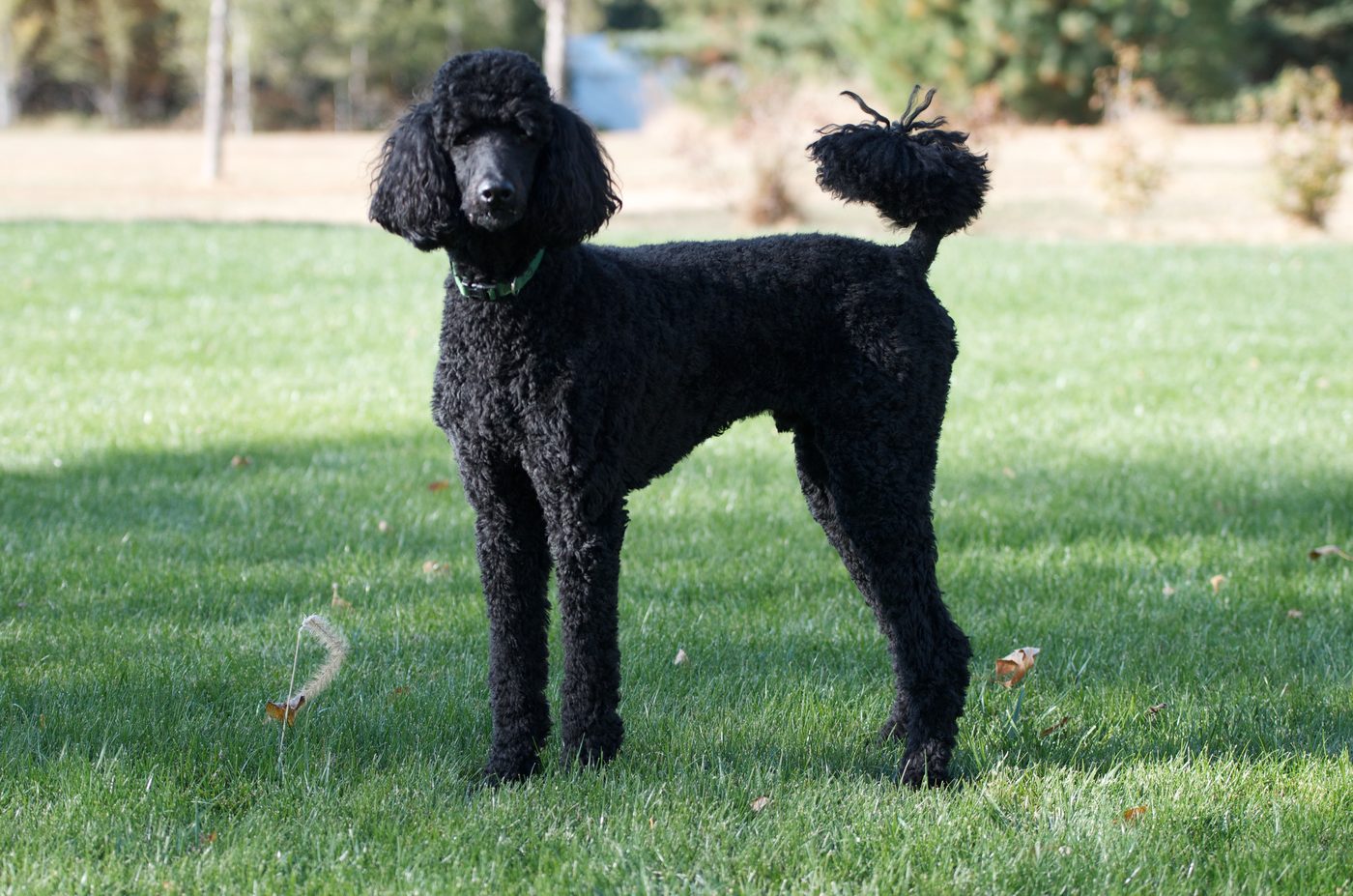
Non-Sporting group · Germany / France
Poodle
- SizeLarge
- Heightover 38 cm (AKC Std)
- Weight~18–32 kg (AKC profile)
- GroupNon-Sporting
- EnergyHigh
Photo: Wikidocsptm, CC BY-SA 4.0, via Wikimedia Commons

Overview
Beneath the famous clip, the Poodle is an athletic water retriever, and the AKC calls it extremely intelligent and easily trained. The AKC standard asks for a very active, intelligent and elegant dog, squarely built and carrying itself proudly, with an air of distinction and dignity. The breed comes in three sizes in the United States and four under the FCI, all sharing the same build; the Standard is the largest, and the AKC notes that many historians believe it came first. The coat is curly or corded, and the AKC describes it as relatively non-shedding.
History
The Poodle (Caniche; Pudel in German usage) developed from a continental European water-dog tradition, but its remote origin remains disputed. The Kennel Club describes German water-retriever origins, while the FCI assigns France as the country of origin and describes a Barbet-linked French history; AKC and PCA accounts preserve a broader Germany, France, and Russia debate. Registry dates remain separate: the Poodle Council of Great Britain says 1874; AKC says 1887 (older PCA archival wording says 1886); CKC says 1916; and FCI definitive acceptance was 1 January 1955.
No single fetched kennel-club account settles the Poodle's remote origin. The Kennel Club says the breed originates in Germany, where it was bred as a water retriever for duck hunters, and places its ancestors among various European water dogs. The FCI nomenclature and standard give France as the country of origin and describe descent from the Barbet. AKC says the origin disappears in antiquity and names Germany, France, and Russia; the Poodle Club of America archive likewise records France's national-dog association alongside claims of German or earlier origins. These are competing attributed origin accounts rather than one uncontested ancient pedigree.
The most defensible early context is a larger, curly-coated European water dog used in waterfowling. The FCI standard says the dog was originally used for wildfowling and descended from the Barbet, retaining many of its characteristics. CKC says the breed probably dates to the late Roman period and that the Standard type was established across Europe by the sixteenth century. AKC discusses Poodle-like dogs in ancient art and manuscripts. Such sources preserve type and function narratives; they do not establish a continuous modern pedigree from Roman dogs, a precise Barbet cross, or a closed breed before nineteenth-century registration.
The name has more than one attributed explanation. The FCI standard says French caniche comes from cane, its word for a female duck, linking French nomenclature to wildfowling. It associates names in other countries with splashing in water, while AKC and CKC connect English “Poodle” to German pudeln or puddeln, “to splash in water.” These etymologies reinforce the water association but do not date the modern breed or settle which language supplied the earliest name.
The FCI account gives a French historical and standardization narrative without supplying a documented mating list. It says that in 1743 caniche, the female of the Barbet in French, was in use before Barbet and Caniche gradually separated. The Kennel Club's German-origin wording remains part of the record, so the French country-of-origin field should not erase the German account, nor should the German account erase the FCI's French designation. The Barbet relationship is a kennel-standard historical statement, not a genetically demonstrated single-founder pedigree.
Waterfowl retrieval and wildfowling are the safest foundation functions across the official sources. The Kennel Club describes duck hunters using the Poodle as a water retriever; the FCI describes wildfowling; and CKC calls waterfowl retrieval the first job of the Standard. Later uses should remain distinct: CKC says Poodles were used in France to scent truffles and became popular as circus dogs by the end of the eighteenth century, while AKC describes companion, circus, and show visibility. Those developments do not mean every size shared one historical job or that all modern Poodles retain field use.
The coat's traditional outline also has a practical water-work explanation. The Kennel Club says clipping the hindquarters aided propulsion in swimming, while bands of hair remained on the joints and tail tip for protection from cold. AKC gives a similar account, describing hair retained over the chest, hips, and leg joints while other areas were trimmed for easier swimming. The lion-style outline therefore has a documented function-linked rationale before its later show symbolism, although the sources do not date the first clip or establish one universal trim.
Current standards recognize both curly and corded coats. The FCI defines dense characteristic cords at least 20 cm long; the AKC/Poodle Club of America standard and CKC standard also recognize corded and curly qualities. CKC breed pages say an ungroomed coat will cord and that a Poodle may be shown corded, though few are presented that way. These standards establish recognized coat forms and regulated presentation, not a reliable historical prevalence timeline for corded coats.
Grooming rules are registry-specific. The Kennel Club says earlier standards recommended the traditional lion trim in the show ring and that other trims later became acceptable. The AKC/PCA standard specifies Puppy, English Saddle, Continental, and Sporting clips; CKC specifies Puppy, English Saddle, and Continental clips and permits corded coat; FCI describes Lion, Modern, English, Puppy, and Scandinavian/Terrier clips. These rules preserve a water-dog rationale while defining modern show presentation.
The larger type appears first in the fetched club narratives. The Kennel Club says its Standard, Miniature, and Toy varieties share one standard, with smaller forms presenting the same features at reduced scale. CKC calls Standard the oldest of the three and places Miniature and Toy development in the following two hundred years or so. AKC says Standard and Miniature were recognized as separate breeds in 1887, and PCA later treated Toy as the third variety in 1943. These are development and registry narratives rather than a complete breeding record.
The current UK Kennel Club system defines three varieties: Standard over 38 cm (15 in), Miniature under 38 cm but not under 28 cm (11 in), and Toy under 28 cm. The KC says all three share the same standard. These are United Kingdom rules, not a universal Poodle size system.
The AKC standard hosted by the Poodle Club of America defines Standard as over 15 inches, Miniature as 15 inches or under and over 10 inches, and Toy as 10 inches or under, measured at the highest point of the shoulders. A dog outside the relevant limits is disqualified from that variety under the cited standard. The American boundaries resemble the UK cuts in broad outline but use their own wording and thresholds.
The Canadian Kennel Club defines Standard as over 38 cm (15 in), Miniature as 38 cm or under and over 25.5 cm (10 in), and Toy as 25.5 cm or under, measured at the shoulder. Its official standards describe three varieties for show purposes and label Miniature and Standard, as well as Toy, recognized in 1916. The later Toy-development prose does not establish a separate earlier Toy-recognition year.
The FCI system has four registry-defined varieties: Standard over 45–60 cm with a 2 cm tolerance, Medium over 35–45 cm, Miniature over 28–35 cm, and Toy over 24–28 cm with a 1 cm lower tolerance and an ideal of 25 cm. Its standard excludes signs of dwarfism and treats heights above 62 cm in Standards or below 23 cm in Toys as severe faults. Medium is therefore a fourth FCI variety, not a fourth variety in the AKC, KC, or CKC systems cited here.
British registration chronology needs careful labels. The Poodle Council of Great Britain says the first Poodle was registered with The Kennel Club in 1874. The Royal Kennel Club's history confirms that its first Stud Book was published in 1874 and its first monthly register of dog names appeared in 1880, but that page does not state a Poodle-specific recognition event. The Poodle Council's claim and the KC's registry infrastructure are related but not identical evidence.
The current AKC Breeds by Year Recognized list says the Poodle first became registrable with AKC in 1887. An older AKC-hosted PCA archival guide says the breed was acknowledged by AKC in 1886. The current list supplies the safer official date while the archival wording remains a relevant historical discrepancy. Neither year is the breed's origin date.
The Poodle Club of America formed in 1931, held its first specialty in June 1932, and approved a new breed standard that AKC published in 1932. The PCA archive says an early club majority associated with an Anglo-French rather than German type, while British imports supplied foundation stock for serious American programs. This records American club preference and standard development, not a separate breed or a complete American pedigree.
AKC's breed history says Standard and Miniature were recognized as separate breeds in 1887, that Toy was first bred in the United States in the early twentieth century, and that PCA recognized Toy as the third variety in 1943. The PCA archive likewise describes the 1943 change as renaming Toys a variety rather than maintaining a separate breed. These American milestones are not universal dates for Toy development worldwide.
The CKC official standards label Miniature, Standard, and Toy recognized in 1916. The Poodle Club of Canada's history says its organization began on 16 June 1957 as the Poodle Advancement Association, while its home page describes dedication to Canadian Poodles since 1963. The registry date and parent-club dates describe different institutions and remain separate.
The FCI nomenclature lists Poodle/Caniche No. 172 as definitively accepted on 1 January 1955, with France as country of origin, French as the official authentic language, Group 9 Section 2, and no working trial. The current valid standard is dated 20 March 2024, with English publication dated 4 May 2024. These FCI labels sit alongside, rather than replace, the UK, AKC, and CKC chronology.
Colour history is registry-specific. The FCI standard says breeders worked to obtain original subjects and its 2014 wording referred to uniform colour; the current FCI standard lists solid and multiple colour patterns. KC and CKC standards emphasize solid colours, while the AKC/PCA standard disqualifies parti-coloured dogs. The KC's January 2020 policy says merle is not historically established in Poodles and will not register merle dogs under that policy. These sources support changing registry boundaries, not a complete chronology of every accepted colour.
Modern standards preserve elements of the water-dog foundation while changing institutional roles. The FCI classifies the Poodle as a companion dog without a working trial, yet retains wildfowling and Barbet-linked history. KC standards emphasize fitness for function and sound, free movement; CKC says its standard should ensure that the dog can carry out its original purpose; and PCA purposes include breeding, training, field trials, and obedience trials. Standardization preserved a water-dog outline, coat, movement, and trainability while Poodles also became companion, show, obedience, and performance dogs.
Parent clubs provide additional institutional continuity without forming one global chain. The Poodle Council says it was founded at a meeting on 24 November 1963, with KC permission granted on 28 January 1964, to give clubs in England, Scotland, and Wales a united voice. PCA lists local specialty clubs and sanctioned specialty, field, and obedience events among its purposes. The Poodle Club of Canada describes a national role across all three Canadian varieties. These histories document national and regional stewardship rather than one worldwide parent club.
Sources
- The Kennel Club — Poodle (Standard) breed page
- The Kennel Club — Poodle (Miniature) breed page
- The Kennel Club — Poodle (Toy) breed page
- The Kennel Club — Poodle (Standard) breed standard, updated April 2025
- The Kennel Club — Poodle (Miniature) breed standard, updated April 2025
- The Kennel Club — Poodle (Toy) breed standard, updated April 2025
- The Royal Kennel Club — History of The Kennel Club
- The Poodle Council of Great Britain — Home/history
- The Poodle Council of Great Britain — History of Poodles
- Fédération Cynologique Internationale — Poodle nomenclature No. 172
- Fédération Cynologique Internationale — Poodle Standard No. 172, valid from 1 August 2024, published 20 March 2024
- Fédération Cynologique Internationale — Poodle Standard No. 172, 2014 version
- American Kennel Club — “Poodle History: From Water Retriever to Versatile Companion”
- American Kennel Club — Breeds by Year Recognized, updated 1 January 2026
- Poodle Club of America — AKC Breed Standard
- American Kennel Club Archives — Poodle Club of America collection, AKD 6.13
- Poodle Club of America — About the PCA
- Canadian Kennel Club — Poodle (Standard) breed page
- Canadian Kennel Club — Poodle (Miniature) breed page
- Canadian Kennel Club — Poodle (Toy) breed page
- Canadian Kennel Club — Poodle (Miniature & Standard) official standard, recognized 1916, effective January 2005
- Canadian Kennel Club — Poodle (Toy) official standard, recognized 1916, effective January 2005
- Poodle Club of Canada — About the Club
- The Kennel Club — Registration of dogs of merle colouring, January 2020
Type
The AKC recognizes three varieties built to one standard and separated by height at the shoulder: the Standard is over 15 in (38 cm), the Miniature is 15 in or under but over 10 in (25 cm), and the Toy is 10 in or under. Neither standard sets a weight; the AKC breed profile suggests about 60 to 70 lb (27 to 32 kg) for Standard males and 40 to 50 lb (18 to 23 kg) for females. The FCI recognizes four sizes: Standard, over 45 up to 60 cm with a 2 cm tolerance; Medium, over 35 up to 45 cm; Miniature, over 28 up to 35 cm; and Toy, over 24 up to 28 cm, with 25 cm the ideal. Both standards ask for a squarely built dog whose body length roughly equals its height.
The coat is either curly, dense and of naturally harsh texture, or corded, hanging in tight, even cords. The AKC requires an even, solid color at the skin, naming blue, gray, silver, brown, café-au-lait, apricot, cream, black and white, and disqualifies parti-colored dogs. The FCI standard of 2024 is broader: alongside solid black, white, brown, gray and fawn (from pale fawn to apricot or red), it accepts parti-colors with white, black or brown with fawn markings, tricolor, brindle and brindle and white.
Temperament
The AKC standard describes a proud, very active and intelligent dog and treats shyness or sharpness as a major fault. The FCI calls the Poodle renowned for its loyalty and able to learn and be trained, which makes it a particularly pleasant companion, and says it became popular for its friendly, joyful and loyal character. The AKC adds that Poodles are very people-oriented and quick to please when training is fun, positive and consistent.
Energy
High. The AKC describes Poodles of every size as very active dogs that need good exercise every day. Most love the water, and swimming, retrieving games, jogs and long walks all suit them; the AKC notes that, bred as hunting dogs, they have a strong urge to retrieve.
Intelligence
The AKC calls Poodles extremely intelligent and easily trained, and notes that they excel at agility, obedience and tracking, compete in dock diving and retriever hunt tests, and have worked in the circus since the eighteenth century.
Intelligence here means typical trainability, guided by Stanley Coren's survey of obedience judges. It is not a verdict on any one dog.
Care
Grooming
A Poodle in full coat must be brushed and combed right down to the skin, ideally daily, or the hair mats near the roots and has to be shaved off. The AKC notes that most pet owners keep a shorter trim, either clipping it themselves or visiting a professional groomer every four to six weeks. In AKC conformation, adults in the regular classes must be shown in the English Saddle or Continental clip; the simpler Sporting clip, which follows the outline of the dog with a short blanket of coat, is permitted only in the Stud Dog and Brood Bitch classes and the Parade of Champions. Dogs under a year may be shown in the Puppy clip.
Health notes
The AKC says most Poodles live long, healthy lives and puts life expectancy at 10 to 18 years. Hip dysplasia, eye disorders including progressive retinal atrophy and cataracts, idiopathic epilepsy, sebaceous adenitis, von Willebrand disease and immune-mediated disorders have been seen in all three sizes. Legg-Calvé-Perthes disease and luxating patellas are more likely in Toys and Miniatures, while Standards are more at risk of bloat and sebaceous adenitis. The Poodle Club of America also names Addison's disease, atrial septal defects, chronic active hepatitis and Cushing's disease. The club's December 2024 health statement asks Standard Poodle breeders to test for hip dysplasia, eyes, autoimmune thyroiditis, and the DNA conditions NEwS (neonatal encephalopathy with seizures) and von Willebrand disease type I, with heart and sebaceous adenitis tests optional. Miniatures should have a prcd-PRA DNA test, annual eye exams, a patella check and hip evaluation, and Toys the same without the hips.
Ordinary care
Poodles do best with daily exercise and something to think about; the AKC suggests swimming and retrieving games, and notes that they enjoy keeping busy. The coat needs a regular routine of brushing or clipping to stay free of mats. As with any dog, the AKC advises watching weight and keeping treats moderate.
Facts
- The show clip began as a working trim: hunters left hair over the chest, hips and leg joints to protect the dog in cold water and trimmed the legs, neck and tail so it could swim freely.
- A Standard Poodle called Duxbury My Ten Cents, known as Dime, became the first Poodle to earn the AKC's Master National Hunter title.
- The English name comes from the German pudeln, to splash in water, while the French name, caniche, comes from cane, a female duck.
The Dog Codex is an editorial reference, not veterinary advice. Health notes summarize conditions that appear in breed literature; they do not diagnose an individual dog and do not replace examination by a licensed veterinarian.