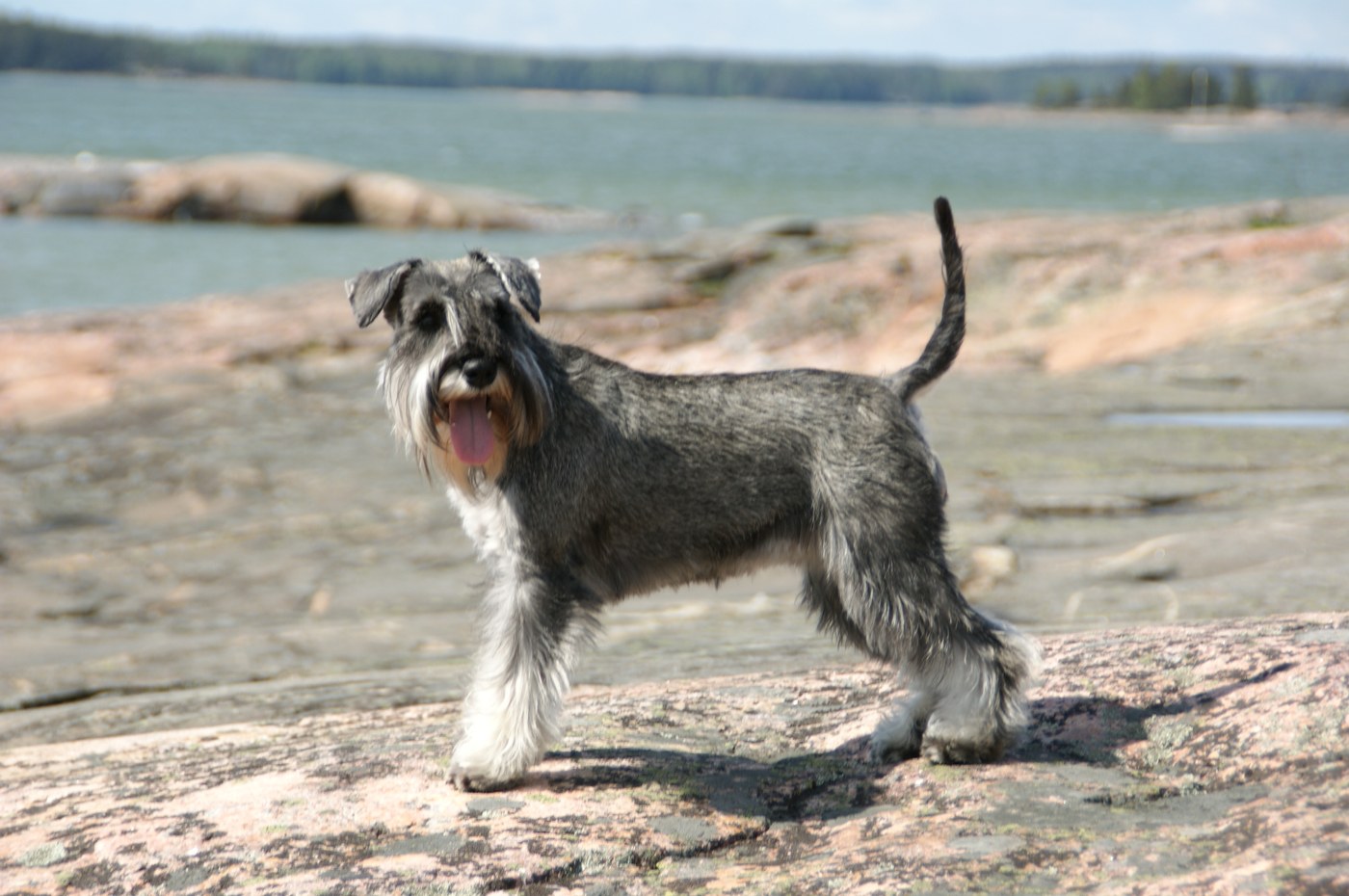
Terrier group · Germany
Miniature Schnauzer
- SizeSmall
- Height30–36 cm (AKC)
- Weight~4–8 kg (FCI)
- GroupTerrier
- EnergyModerate
Photo: Canarian, CC BY-SA 3.0, via Wikimedia Commons

Overview
The Miniature Schnauzer is the smallest of the three Schnauzers, a sturdy, square, wire-coated dog from Germany, bred down from the Standard Schnauzer to catch rats and mice on farms and in houses. Its bushy eyebrows and beard give it a famously expressive face. The AKC standard describes a robust, active dog of terrier type, alert and spirited yet obedient, friendly, intelligent and willing to please. Today it is above all a companion; in the United States it is shown in the Terrier Group, while the Standard and Giant Schnauzers are working dogs.
History
Bearded Schnauzer-type farm dogs appear in German art from around 1500, and the Kennel Club dates the original Schnauzer in Germany to at least the fourteenth century. These medium-sized farm dogs herded, guarded and caught rats, and in the late nineteenth century farmers bred smaller versions for ratting in house and barn. The AKC says small Standard Schnauzers were crossed with Miniature Pinschers, Affenpinschers and Miniature Poodles; the Kennel Club and the American club both credit the Affenpinscher with bringing the size down. The FCI says the dwarf Schnauzer came from around Frankfurt am Main and was at first described as a rough-haired Miniature Pinscher. The first Miniature Schnauzer registered in Germany was a black female named Findel, born in 1888, and the breed was shown in its own right by 1899. Miniatures reached the United States in the 1920s, the AKC recognized the breed in 1926, and the American Miniature Schnauzer Club was founded in 1933. The FCI accepted it on a definitive basis in 1955.
Type
The Miniature Schnauzer is small, sturdy and nearly square, as long as it is tall, with plenty of bone. Both standards insist that it look like a reduced Standard Schnauzer, never toyish or dwarfed. The AKC calls for 12 to 14 in (30 to 36 cm) and disqualifies dogs outside that range; the FCI asks for 30 to 35 cm and a weight of about 4 to 8 kg. The AKC standard gives no weight, though its breed profile suggests 11 to 20 lb (5 to 9 kg).
The coat is double: a hard, wiry outer coat over a close undercoat, with fairly thick but not silky furnishings, the typical beard and bushy eyebrows. For the show ring the head, neck, ears, chest, tail and body coat are hand-plucked. The AKC allows three colors, salt and pepper, black and silver, and solid black, and requires a solid black nose. The FCI and the Kennel Club also accept pure white with a white undercoat, a color the American club does not recognize for showing.
Temperament
The AKC standard describes the typical Miniature Schnauzer as alert and spirited, yet obedient to command; friendly, intelligent and willing to please; and never overaggressive or timid. The FCI credits it with the intelligence, fearlessness, endurance and alertness of its larger relative, which make it an agreeable house dog and a good watch and companion dog, one that can live happily even in a small apartment.
Energy
Moderate. The AKC describes an alert, lively dog with a medium energy level that needs regular daily exercise and loves doing things with its family. It has a strong prey drive, so the AKC advises keeping it on a leash outside a fenced area. Miniatures still make good ratters and take part in Barn Hunt and Earthdog trials as well as agility, obedience and rally.
Intelligence
The AKC standard calls the Miniature Schnauzer intelligent, willing to please and obedient to command. The AKC adds that it learns quickly, but its intelligence means training should stay fun and varied, since it can get bored with repetition.
Intelligence here means typical trainability, guided by Stanley Coren's survey of obedience judges. It is not a verdict on any one dog.
Care
Grooming
The wiry coat needs regular brushing and combing, especially the beard and leg furnishings. Show dogs keep their harsh topcoat by hand stripping or rolling. Most pet owners have the coat clipped by a groomer every five to eight weeks, which keeps the same outline but softens the coat, since the wiry topcoat disappears with clipping. The AKC suggests a bath about once a month, monthly nail trims and weekly ear checks.
Health notes
The AKC calls the Miniature Schnauzer a generally healthy breed and gives a life expectancy of 12 to 15 years. It lists cataracts, hyperlipidemia (high blood fats), pancreatitis, liver shunts and urinary stones among the conditions the breed can be prone to. For a CHIC number, the Orthopedic Foundation for Animals requires an ACVO eye examination and a cardiac exam (a basic exam by a cardiologist, or an advanced exam); optional CHIC tests are DNA tests for myotonia congenita, Mycobacterium avium complex (MAC) and progressive retinal atrophy type B (HIVEP3). The American club recommends repeating the eye exam every year. In Britain, the Kennel Club asks breeders to DNA test for MAC and to eye test, including litter screening.
Ordinary care
Plan for regular grooming, whether stripping or clipping, along with daily exercise and training that keeps things interesting. Socialize early; the AKC recommends puppy classes. Because of its prey drive, keep it leashed outside a fenced area, and choose a breeder whose dogs have current eye and heart exams.
Facts
- Most terriers come from the British Isles, but the Miniature Schnauzer has no British ancestry at all. It descends from German farm Schnauzers.
- In the United States, the Miniature and Standard Schnauzers both competed in the Terrier Group until 1945, when the Standard moved to the Working Group. The Miniature stayed a terrier, while across most of the world all three Schnauzers are grouped with working breeds.
- The name comes from the German Schnauze, meaning muzzle, a nod to the breed's bearded face.
- White Miniature Schnauzers are accepted by the FCI and the Kennel Club in Britain, but the AKC allows only salt and pepper, black and silver, and solid black, so white dogs can't be shown in American conformation.
- The first Miniature Schnauzer entered in a German stud book was a black female named Findel, born in 1888.
The Dog Codex is an editorial reference, not veterinary advice. Health notes summarize conditions that appear in breed literature; they do not diagnose an individual dog and do not replace examination by a licensed veterinarian.