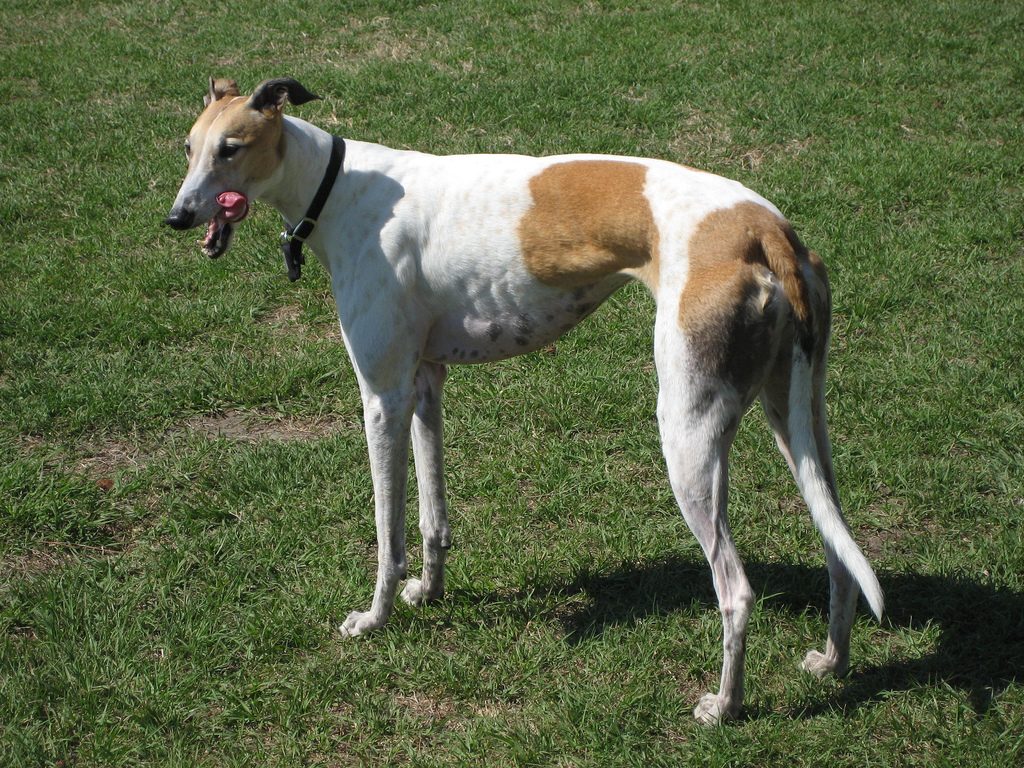
Hound group · United Kingdom
Greyhound
- SizeLarge
- Height68–76 cm
- Weight27–40 kg
- GroupHound
- EnergyModerate
Photo: Neurodoc, CC BY-SA 3.0, via Wikimedia Commons

Overview
The Greyhound is an ancient sighthound: a deep-chested sprinter built to course hare by vision and speed, not by scent. Despite the racetrack stereotype, adult Greyhounds are often quiet house dogs that save their fire for a short, spectacular run.
History
Sighthounds of Greyhound type appear in art and law from Egypt, the classical world, and medieval Europe. The name's etymology is disputed (possibly from Old English 'grighund'). British coursing and, from the twentieth century, track racing refined a specialist sprinter. The AKC recognized the breed in 1885. As commercial racing has contracted, adoption of retired racers has become a major path into companion homes.
Type
Males often 71–76 cm and 29–40 kg; females somewhat smaller. Racing lines may be lighter than show lines. The silhouette is unmistakable: deep brisket, tucked loin, long legs, and a long fine tail.
Short, smooth, and fine. Any color or pattern is acceptable: black, white, brindle, fawn, red, blue, and various particolors. There is almost no undercoat; they chill easily.
Temperament
Gentle, sensitive, and typically reserved with strangers rather than exuberant. Many Greyhounds are cat-safe if introduced carefully; others retain a fierce chase instinct toward small running animals. They are not marathon joggers by preference and often bond quietly to a sofa and one or two people.
Energy
Moderate overall, with brief spikes of very high speed. A daily walk plus a chance to gallop in a safely fenced area satisfies most adults. Puppies and recently retired racers need more managed exercise. They are sprinters, not endurance trotters.
Intelligence
Sighthounds are typically gentle and independent: they learn household routines, but formal obedience is not the breed's job.
Intelligence here means typical trainability, guided by Stanley Coren's survey of obedience judges. It is not a verdict on any one dog.
Care
Grooming
A hound glove and the occasional bath. Thin skin tears more readily than in coated breeds—check for kennel or play scrapes. Provide coats in cold weather. Dental care matters; many racers arrive with neglected teeth.
Health notes
Osteosarcoma is a significant risk in the breed, as in other giant-legged sighthounds. Gastric dilatation-volvulus can occur. Greyhounds have unique bloodwork normals (higher red-cell counts, lower thyroid values) that veterinarians must interpret with breed context. Anesthesia sensitivity is often overstated but their lean mass and low body fat do change drug dosing. Corns on the feet afflict some dogs.
Ordinary care
Soft bedding prevents sores on bony prominences. Never use a flexi-lead for a dog that can hit 70 km/h. Muzzle culture from the track is normal and not a sign of aggression. They often live peacefully in pairs. Watch stairs and slippery floors with older dogs.
Facts
- A fit Greyhound can exceed 70 km/h in a few strides—the fastest of all dog breeds over a short course.
- Despite the speed, many retired racers are nicknamed '45-mph couch potatoes.'
- Greyhound racing used a mechanical lure; coursing used live hare, a practice now restricted or banned in much of the world.
The Dog Codex is an editorial reference, not veterinary advice. Health notes summarize conditions that appear in breed literature; they do not diagnose an individual dog and do not replace examination by a licensed veterinarian.