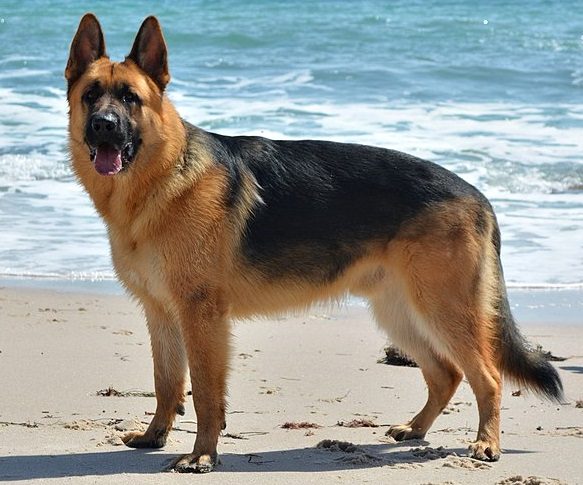
Herding group · Germany
German Shepherd Dog
- SizeMedium
- Height55–65 cm (FCI)
- Weight22–40 kg (FCI)
- GroupHerding
- EnergyHigh
Photo: Jakub Hałun, CC BY-SA 4.0, via Wikimedia Commons

Overview
The German Shepherd Dog was created in Germany at the end of the nineteenth century from the herding dogs of central and southern Germany, with one aim: a working dog capable of great things. The FCI standard calls it a versatile working, herding and service dog, and the AKC standard asks that it be fit to serve as companion, watchdog, blind leader, herding dog or guardian. It is a strong, agile, well-muscled dog, alert and full of life, slightly longer than tall, and built to trot. Its character is meant to be self-assured and steady, with a certain aloofness toward strangers.
History
Max von Stephanitz and the Verein für Deutsche Schäferhunde (SV), founded in 1899, standardized herding dogs of Germany around a foundation dog, Horand von Grafrath. The goal was utility. The First World War spread the breed and led to wartime renaming (Shepherd Dog in the United States, Alsatian in Britain). The AKC recognized it in 1908. Working type and show type now sometimes look like different dogs; they are not official kennel-club varieties.
Herding dogs of Germany were brought toward one working type after methodical breeding began in 1899. The FCI translation of the SV standard says the work started from central German and southern German herding dogs, “with the ultimate objective of creating a working dog inclined to high achievements.” On 22 April 1899, on the edge of a dog show in Karlsruhe, Max Emil Friedrich von Stephanitz founded the Verein für Deutsche Schäferhunde (SV) e.V. with thirteen further working-dog enthusiasts. That same day, the SV’s 2024 chronicle records, he presented Hektor, renamed Horand von Grafrath. The FCI’s country of origin for the standardized breed is Germany.
Horand von Grafrath is SZ 1, the first stud-book entry and Stammvater: a 61 cm male, bought for 200 Mark, number one in a book that has since registered more than two million German Shepherds. The SV chronicle places SZ-Nr. 1 under 1900, when the stud book was newly laid, and says the book opened about five months after founding. The German Shepherd Dog Club of America and Denise Flaim’s AKC history record that before the rename the dog was Hektor Linksrhein. Flaim writes that von Stephanitz spotted him in April 1899 with Artur Meyer and formed a club “within a month”; that clashes with the SV’s same-day founding. The SV date of 22 April 1899 is preferred.
The FCI records the first General Meeting and first standard at Frankfurt am Main on 20 September 1899, according to suggestions by A. Meyer and Max von Stephanitz. The GSDCA names Artur Meyer among the 1899 founding members and reprints the original SV standard as adopted that day. Primary consideration was capability and usefulness as a working dog. The GSDCA motto wording is “Utility and intelligence.” The SV motto is “Schäferhundezucht ist Gebrauchshundezucht”: shepherd breeding is working-dog breeding. The SV says crossbreeding with other breeds was out of the question for von Stephanitz.
The American Kennel Club’s breeds-by-year list records the German Shepherd Dog in 1908. The GSDCA chronology names the first AKC-registered dog as Queen of Switzerland, owned by Adolph Vogt, in 1908. Mira von Offingen was shown in America in 1907 and in Westminster’s Miscellaneous class in 1908. First championships, the GSDCA says, came in 1913. The Canadian Kennel Club recognised the breed in 1912.
The German Shepherd Dog Club of America was formed in 1913 by Benjamin Throop and Anne Tracy, with 26 charter members. An organizing meeting was held at the 1913 Westminster show. The first specialty was at Greenwich, Connecticut, in 1915. The club was incorporated on 7 February 1916.
In the First World War the SV records about 7,000 German Shepherds killed as telephone-cable layers, messengers, or medical-service dogs, and a 2024 timeline of over 20,000 used as messenger, patrol, and medical dogs — used in large numbers; the two figures are not the same claim. The GSDCA records the German army war dog; returning United States servicemen and the films of Rin Tin Tin and Strongheart sent popularity sky-high, after which puppy factories sold poor-quality “German police dogs.” GSDCA records Mrs Harrison Eustis and The Seeing Eye in 1929. In 1917, the GSDCA says, the AKC changed the breed name to Shepherd Dog and the parent club became the Shepherd Dog Club of America; in England the name was changed to the Alsatian. Members voted on 19 May 1930 to restore the United States club name to German Shepherd Dog Club of America.
In Britain in 1924 the breed was officially classified as the “Alsatian Wolf Dog.” The German Shepherd Dog League of Great Britain, the oldest Kennel Club–registered German Shepherd club, was established in 1919. In May 1927 the first championship Working Trial recognised by the Club was held by the Alsatian League and Club of Great Britain at Castle Bromwich. On 12 October 2010 the Kennel Club General Committee removed “Alsatian” from the Club’s formal breed name (21 clubs for, 4 against); clubs were not required to drop Alsatian from their own titles. A 2008 archive of the Kennel Club standard was still titled German Shepherd Dog (Alsatian).
In 1933 the SV records that independent clubs were forced into a Reichsverband, and that the breed was abused for propaganda. Many thousand were used in the Second World War as messenger, gas-detection, and munition-carrier dogs. The SV’s 2024 chronicle gives 30,000 confiscated for army and front service — confiscations, not a death toll. The GSDCA records use by Allied and Axis forces and, in America, Dogs for Defense. After 1945 the SV split with Germany. On 20 April 1990 the entire GDR SV membership joined the federal German SV. The GSDCA also describes American (Pfeffer and Odin) versus post-war German breeding paths. Those are breeding histories, not official kennel-club varieties.
The FCI lists the Deutscher Schäferhund as Standard No. 166, origin Germany, Group 1, with a working trial. Definitive FCI acceptance is 1 January 1955; the official valid standard is 11 August 2010. The SV, domicile Augsburg, is the founding club.
The FCI standard recognises two coat varieties, each with CACIB: (a) double coat; (b) long and harsh outer coat. Both have undercoat; white is not allowed. From 2008 the SV likewise records two varieties, Stockhaar and Langstockhaar with undercoat. The Kennel Club treats two separate varieties of coat, and the long-haired variety is now in the standard. The AKC (1978/1994) and Canadian Kennel Club (2004) standards call for a medium-length double coat; a too-long outer coat is a fault, not a variety.
White is not this AKC or FCI German Shepherd. The AKC and Canadian Kennel Club disqualify white dogs. FCI 166 does not allow the colour white. The Kennel Club treats whites as highly undesirable (White is NBS). The GSDCA accepts small white markings on chest, tail tip, or toes; conformation whites are disqualified. The White Swiss Shepherd Dog (Berger Blanc Suisse) is a separate FCI breed, No. 347, origin Switzerland. FCI 347 names Lobo, whelped 5 March 1966, as progenitor in Switzerland, with a Swiss stud-book appendix from June 1991. The Kennel Club recognised the White Swiss Shepherd from 1 October 2017. A white dog is not the AKC German Shepherd, and White Swiss is not a German Shepherd variety.
The Kennel Club notes a marked division of breed type. Its standard says working ability must never be sacrificed for mere beauty, and that over-angulation of the hindquarters is highly undesirable. FCI 166 likewise records that over-angulation reduces stability, stamina, and working ability. A 2016 Kennel Club German Shepherd Dog Review Group reported conformation and temperament concerns. Parent clubs discuss type; they do not register working and show as separate breeds.
Sources
- SV Geschichte
- SV History (EN)
- SV Struktur
- SV Chronik 2024 (PDF)
- FCI Standard N° 166
- FCI nomenclature 166
- FCI Standard N° 347 White Swiss
- KC German Shepherd Dog
- KC GSD standard
- KC archive 12 Oct 2010 Alsatian
- KC 70 years of membership
- KC working trials
- KC GSD Review Group
- KC White Swiss Shepherd Dog
- KC new breed White Swiss Shepherd
- German Shepherd Dog League
- GSDL history
- AKC Flaim GSD history
- AKC Breeds by Year Recognized
- AKC Official Standard PDF
- GSDCA Breed History
- GSDCA About
- GSDCA Original 1899 Standard
- GSDCA Color
- CKC standard PDF
- KC 2008 archive GSD (Alsatian) standard
Type
The FCI standard asks for males of 60 to 65 cm weighing 30 to 40 kg and females of 55 to 60 cm weighing 22 to 32 kg, and disqualifies dogs more than 1 cm over or under. The AKC standard gives a desired height of 24 to 26 in (61 to 66 cm) for males and 22 to 24 in (56 to 61 cm) for bitches, and no weight. Both describe a dog longer than tall, the FCI by about 10 to 17 percent and the AKC in a ratio of 10 to 8½. The FCI warns that any tendency toward over-angulation of the hindquarters reduces stability, stamina and working ability.
The coat is double, with a dense, straight, harsh outer coat lying close to the body over an undercoat. The FCI recognizes two varieties, the double coat and the long double coat, both with undercoat; the AKC standard has one medium-length coat and counts a soft, silky or too-long outer coat as a fault. The FCI lists black with reddish-brown, brown or yellow to light gray markings, solid black, and gray with darker shading, black saddle and mask. The AKC permits most colors but prefers strong, rich ones and treats pale, washed-out colors, blues and livers as serious faults. Both standards disqualify white.
Temperament
The AKC standard gives the German Shepherd a distinct personality: a direct and fearless but not hostile expression, self-confidence, and a certain aloofness that does not make immediate or indiscriminate friends. It should be approachable, quietly standing its ground and meeting overtures without making them, and it treats timidity or nervousness as a very serious fault. The FCI asks for a dog with strong nerves, self-assured and natural, good-natured unless provoked, attentive and willing to please. The AKC describes the breed as extremely bonded to its people.
Energy
High. The AKC describes a very active and athletic breed that needs plenty of exercise for body and mind, and suggests agility, herding, tracking and dock diving as outlets. Puppies can start with short daily walks and play in a safely fenced area, and the AKC advises against letting even a well-trained dog off the leash.
Intelligence
The AKC calls the German Shepherd a highly intelligent companion and an extraordinary worker, and the SV credits its learning ability, strength and stamina with turning it into an all-rounder. The Kennel Club notes its work as a guide dog for the blind, a tracking dog and in obedience.
Intelligence here means typical trainability, guided by Stanley Coren's survey of obedience judges. It is not a verdict on any one dog.
Care
Grooming
The AKC calls the breed easy to maintain: a quick brushing every few days removes loose hair, with more frequent brushing during the heavier sheds that come once or twice a year. An occasional bath is enough, and nails should be trimmed or ground monthly if they do not wear down naturally.
Health notes
The AKC describes most German Shepherds as healthy and asks responsible breeders to screen for hip and elbow dysplasia and for degenerative myelopathy, a gradual, painless degeneration of the spinal cord that usually begins between 8 and 14 years of age and for which a DNA test exists. German Shepherds can suffer bloat, a sudden and life-threatening swelling of the stomach, and owners should know its signs. For a CHIC number from the Orthopedic Foundation for Animals, a German Shepherd needs hip and elbow evaluations from OFA or the German SV, plus a pass on the German Shepherd Dog Club of America's temperament test, and a microchip or tattoo. Heart, thyroid, eye and degenerative myelopathy testing are optional extras. A CHIC number shows that the tests were done and the results made public, not that every result was normal.
Ordinary care
The AKC calls early socialization and puppy classes vital, with obedience training continued into adulthood, and it recommends consistent, positive, reward-based methods. It also suggests raising the dog in the household, where it can take part in family life. The German Shepherd Dog Club of America publishes detailed training advice for owners.
Facts
- After the First World War, the film stars Rin Tin Tin and Strongheart, both war veterans, helped send the breed's popularity soaring around the world.
- Max von Stephanitz's guiding principle for the breed was 'shepherd breeding is working dog breeding.'
- Unusually, the German Shepherd's CHIC certificate requires a character test: dogs must pass the German Shepherd Dog Club of America's temperament test as well as hip and elbow screening.
The Dog Codex is an editorial reference, not veterinary advice. Health notes summarize conditions that appear in breed literature; they do not diagnose an individual dog and do not replace examination by a licensed veterinarian.