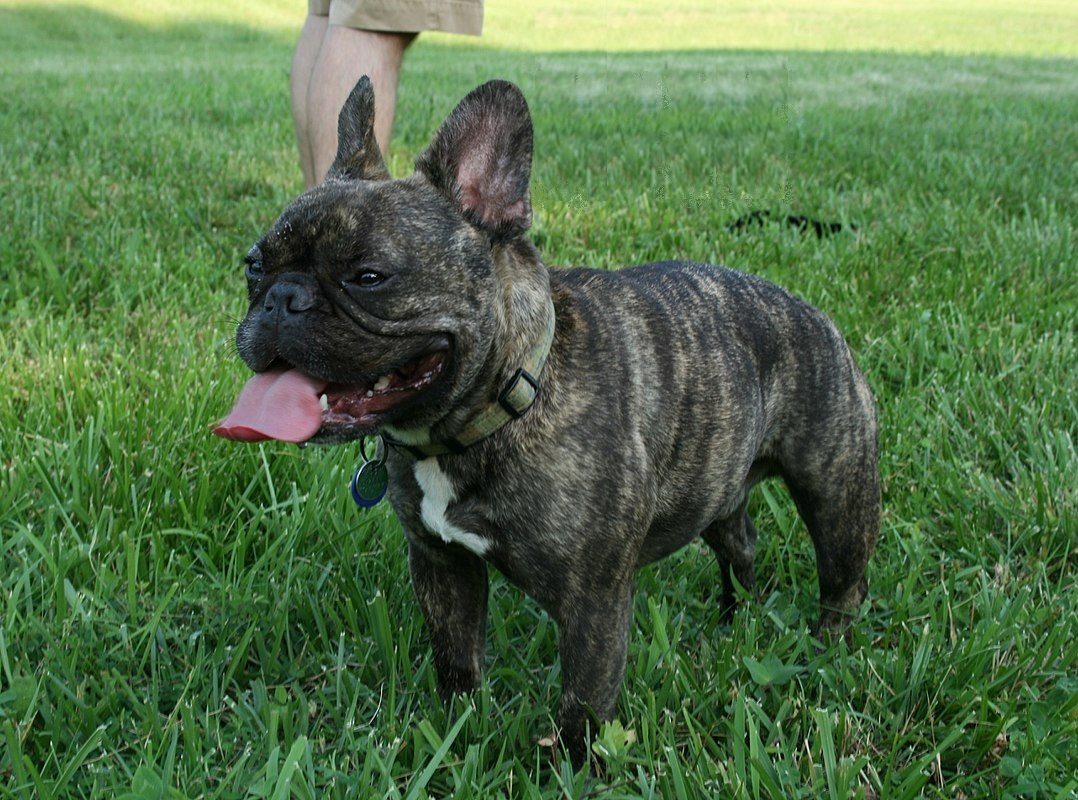
Non-Sporting group · France / United Kingdom
French Bulldog
- SizeSmall
- Height24–35 cm (FCI)
- Weight8–14 kg (FCI)
- GroupNon-Sporting
- EnergyModerate
Photo: Ildar Sagdejev (Specious), CC BY-SA 4.0, via Wikimedia Commons

Overview
The French Bulldog is a small, sturdy companion with a square head, a short face and the upright bat ears that are its trademark. Its roots lie in the toy bulldogs of nineteenth-century England, but it was in Paris that the breed took shape, and American fanciers later wrote the bat ear into its standard. The AKC standard describes a well-behaved, adaptable and affectionate dog, alert and playful without being unduly boisterous. Its short face comes at a cost: the AKC notes that Frenchies breathe less efficiently than long-nosed breeds and cope poorly with heat.
History
The French Bulldog (Bouledogue Français) was standardized in France from a nineteenth-century English Toy Bulldog foundation. Kennel clubs attribute the Channel crossing in part to lace workers who took small Bulldogs to northern France; Parisian breeders then shaped the compact companion type. France is the FCI country of origin. Recognition dates differ by registry: 1898 (SCC/France and AKC), 1906 (The Kennel Club), 1907 (CKC), and definitive FCI acceptance in 1954.
Part of the breed’s ancestry sits in Great Britain in the 1850s, when a dwarf Bulldog type known as the Toy Bulldog was popular. The Kennel Club, the AKC, and the French Bull Dog Club of America describe a smaller, lighter companion development from the English Bulldog—rounded forehead, short underjaw, rose or upright ears—as a foundation type and population, not a single named founder or a modern registry variety. The AKC connects the broader Bulldog’s shift from bull-baiting to show classes after animal combat was banned in England in the 1830s.
Kennel clubs attribute the Channel crossing to Nottingham and Midlands lace workers who emigrated to northern France (often Normandy) with their small Bulldogs. The Canadian Kennel Club says the dogs were eventually crossed with local breeds. That is the standard kennel-club narrative of population movement; it does not identify every migrant, breeder, mating, or local breed involved.
The FCI standard, drawing on French parent-club and Société Centrale Canine history, says the Bouledogue Français known today came from different crossings by breeders in popular Paris neighbourhoods in the 1880s. Dogs were kept among market porters, butchers, and coachmen around Les Halles, then won over high society and the artistic world. The FBDCA says French breeders made type more uniform—compact, straight-legged, without the English Bulldog’s extreme underjaw. Primary kennel-club sources used here do not settle a Pug, terrier, or ratter recipe; those remain theories outside the official histories.
In France the dogs were called Bouledogues Français. The FCI uses Bouledogue Français as the official French name. FBDCA and AKC histories place Frenchies in late nineteenth- and early twentieth-century Parisian art, cafés, and nightlife, including Toulouse-Lautrec’s depictions of Bouboule. Those accounts show public visibility, not a breeding record or proof that artists created the breed.
French chronology in the FCI and Club du Bouledogue Français is consistent: first breed club in Paris in 1880, first registration record in 1885, first exhibition in 1887, and first standard in 1898, the year the Société Centrale Canine recognized the breed. The FCI summary records later standard revisions in 1931–1932, 1948, 1986, 1994, and 2012. Those are French/FCI standard dates, not every national recognition year.
Club-foundation claims refer to different organizations or definitions of “first.” FCI and CBF historical paragraphs say a Paris breed club was founded in 1880. The current Club du Bouledogue Français describes itself as founded in 1898 and affiliated with the SCC. The FBDCA calls itself the first club anywhere dedicated exclusively to the French Bulldog, founded in the United States in 1897.
The French Bull Dog Club of America dates its founding to 5 April 1897, after American fanciers objected when English judge George Raper placed rose-eared Frenchies at February Westminster. The new American standard required the upright bat ear. When Westminster 1898 planned both ear types, the FBDCA withdrew and held its first specialty on 12 February 1898 at the Waldorf-Astoria Sun Parlor for bat-eared dogs only; FBDCA names the brindle Dimboolaa as winner. The episode is a documented conflict over type, not evidence that Americans created the breed from scratch.
The Kennel Club says the French-developed dog returned to Britain in the last years of the nineteenth century. The French Bulldog Club of England was founded in 1902 as the UK parent club. The Kennel Club’s current breed page dates official recognition to 1906. The club’s foundation year and KC recognition are separate events.
Recognition years need their registry labels: France/SCC 1898 (also first French standard); AKC 1898 on the official breeds-by-year list (FBDCA’s 1897 founding and 1898 specialty are not AKC recognition); The Kennel Club 1906; CKC 1907; FCI definitive acceptance 30 November 1954, with country of origin France, Group 9 Small Molossian type, and no working trial. The current official FCI valid standard is dated 10 August 2023.
Early French-developed dogs could show rose or bat ears. FBDCA history says the American club made bat ears the only acceptable ear in its 1897 standard, and that the bat ear later became a defining international feature. Current FCI, KC, and CKC descriptions require or identify erect bat ears. The sources do not support saying every early French dog already had bat ears, or that the ear question was settled in France before 1897.
Modern standards describe a compact small Molossian—short, stocky, smooth-coated, solid bone, erect ears, naturally short tail—while rejecting exaggeration that harms harmony, movement, or breathing. The FCI requires nostrils that permit normal nasal breathing and lists respiratory distress among disqualifications. The Kennel Club stresses that no point should be exaggerated and that respiratory distress or excessive respiratory noise is unacceptable. FBDCA conformation guidance treats brachycephaly as characteristic but warns that an excessively short back can worsen vertebral, chest, and respiratory compromises.
Attributed modern corrective work includes the Kennel Club’s 2021 standard amendments (muzzle clearly viewable in profile; nostrils visibly open), developed with breed clubs, veterinary and academic experts, welfare organizations, and the Brachycephalic Working Group, and linked to the Respiratory Function Grading Scheme launched with the University of Cambridge in 2019. FCI educational commentary attributed to E. Waget says successive revisions removed “hypertype” allowances and notes concern about excess muzzle, folds, and very short tails. These are official and club positions about desired type, not a measured global demographic trend.
Colour rules differ by registry. The current FCI standard permits brindle, fawn, and brindle/fawn with white spotting, and admits all-white subjects with black pigment but says they are not bred for because of deafness risk. The Kennel Club recognizes brindle, fawn, and pied and rejects other colours or combinations. FBDCA show history notes white, pied, and fawn classes from 1931 and rising cream/fawn success in American showing from the 1950s—an American show narrative, not proof that every registry changed that year.
Popularity figures are registry-specific. FBDCA’s historian describes pre–World War I fashionability, mid-century rarity (100 AKC registrations in 1940; 106 in 1960), and a late-twentieth-century American revival (170 registrations in 1980; 632 in 1990; more than 5,500 in 2006). The Kennel Club separately reports a tenfold British registration increase from 2009 to 2015 and a large rise since 2010 in its 2021 health announcement. Those series are not a single worldwide population count.
Sources
- The Kennel Club — French Bulldog
- The Kennel Club — French Bulldog breed standard
- The Kennel Club — French Bulldog Breed Standard amended (2021)
- The Kennel Club — Respiratory Function Grading Scheme (2019)
- FCI Standard No. 101 — Bouledogue Français (PDF)
- FCI nomenclature — French Bulldog (101)
- FCI education — French Bulldog standard and comments (PDF)
- Canadian Kennel Club — French Bulldog
- Canadian Kennel Club — French Bulldog standard (PDF)
- AKC — French Bulldog History (Denise Flaim)
- AKC — How the French Bulldog Became the Most Popular Dog
- AKC — Breeds by Year Recognized
- FBDCA — History of the French Bulldog Breed (Jim Grebe)
- FBDCA — History of the FBDCA (Jim Grebe)
- French Bulldog Club of England
- Club du Bouledogue Français — standard/history
- Club du Bouledogue Français — identity
Type
The FCI standard asks for males of 27 to 35 cm weighing 9 to 14 kg, and females of 24 to 32 cm weighing 8 to 13 kg, with 1 cm of leeway either way on height and an extra 500 g allowed for a typical dog. The AKC standard sets no height at all, only a ceiling: a French Bulldog over 28 lb (12.7 kg) is disqualified. Both describe a compact, muscular dog of heavy bone, and the FCI adds that no single feature should be so exaggerated that it spoils the dog's overall harmony.
The coat is short, smooth and brilliant, lying over soft, loose skin that forms wrinkles at the head and shoulders. The AKC accepts white, cream and fawn, from light fawn to red fawn, alone or in combination, with brindle, piebald, black masks, black shadings and white markings. The FCI accepts fawn, brindled or not, with or without white spotting. Both standards disqualify colors outside their lists: the AKC names solid black, black and tan, black and white, blue, blue fawn, liver and merle among them, and the FCI names black, black and tan, and all dilutions of black. The FCI admits all-white dogs with black eye rims and nose but says they are not bred for because of a risk of deafness.
Temperament
The AKC standard describes French Bulldogs as well-behaved, adaptable companions with an affectionate nature and an even disposition, generally active, alert and playful but never unduly boisterous. The FCI paints much the same picture in fewer words: sociable, lively, playful, possessive and keen. The AKC adds that Frenchies can be stubborn but are people pleasers at heart, and that food and a sense of play are the surest ways to win their cooperation in training.
Energy
Moderate. The AKC standard calls the French Bulldog generally active and playful, and the AKC suggests that a short daily walk or play session keeps one in shape. Many Frenchies enjoy obedience, agility and rally. Because of the short face, the AKC advises never letting them exert themselves in hot or humid weather.
Intelligence
The AKC standard describes an active, intelligent dog, and the AKC calls Frenchies easy to train once motivated, with food and games working better than repetition.
Intelligence here means typical trainability, guided by Stanley Coren's survey of obedience judges. It is not a verdict on any one dog.
Care
Grooming
Grooming is simple. The AKC recommends a weekly brushing with a medium-bristle brush, a rubber grooming mitt or a hound glove to lift loose hair and spread the skin's oils. The facial folds need to be kept clean and dry, and the nails trimmed regularly, since overly long nails can be painful.
Health notes
As a short-faced breed, the French Bulldog breathes less efficiently than long-nosed dogs, and the AKC advises having the airway checked for pinched nostrils or an elongated soft palate if a dog overheats easily or breathes noisily. The FCI standard now disqualifies dogs with respiratory distress or completely closed nostrils. Like other dwarf breeds, Frenchies can have abnormal vertebrae and early degeneration of the spinal discs, and the AKC notes that most back trouble comes from disc disease. Cherry eye, juvenile cataracts, entropion, skin allergies and autoimmune skin disorders are also known, and anesthesia carries more risk than in long-nosed dogs. For a CHIC number from the Orthopedic Foundation for Animals, a Frenchie needs a hip evaluation by OFA or PennHIP, an eye exam registered with the Companion Animal Eye Registry, a patellar luxation evaluation and a cardiac exam, plus a microchip or tattoo. A CHIC number shows that the tests were done and the results made public, not that every result was normal.
Ordinary care
Keep a Frenchie cool, lean and supervised around water. The AKC warns that their front-heavy build means Frenchies cannot swim and should never be left unattended near a tub, pool or open water, and that they do poorly in hot or humid weather. It also stresses weight control, since obesity strains their build and raises the risk of the breed's health problems. Early socialization and puppy classes are recommended.
Facts
- The bat ear was settled by an argument. After an English judge at the 1897 Westminster show rewarded only rose-eared Frenchies, American owners founded the French Bull Dog Club of America that April and wrote a standard allowing nothing but the upright bat ear. Today the AKC disqualifies any other ear.
- Henri de Toulouse-Lautrec painted a Frenchie named Bouboule, who belonged to Madame Palmyre, owner of the Paris café La Souris.
- By 1940 the French Bulldog had become a rarity in America, with only about 100 registered with the AKC that year. In 2025 it was the country's most popular breed.
The Dog Codex is an editorial reference, not veterinary advice. Health notes summarize conditions that appear in breed literature; they do not diagnose an individual dog and do not replace examination by a licensed veterinarian.