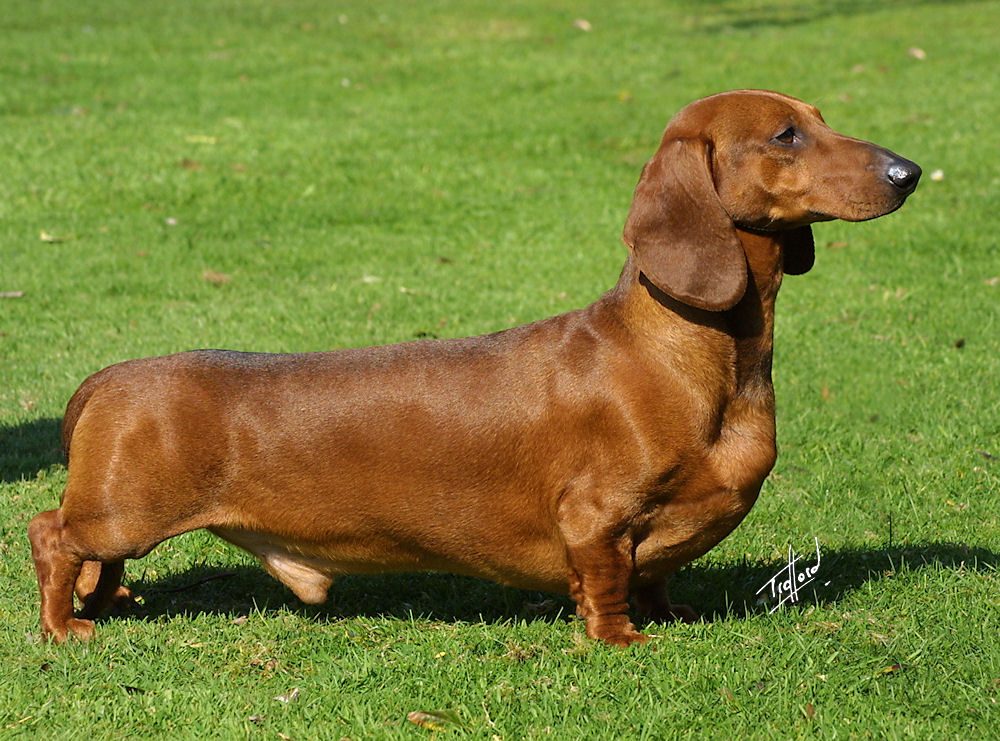
Hound group · Germany
Dachshund
- SizeSmall
- Height~13–23 cm (AKC profile)
- Weight≤5–14.5 kg (AKC)
- GroupHound
- EnergyModerate
Photo: Katemil94, CC BY-SA 4.0, via Wikimedia Commons
_(Dachshund_(Short)).jpg)
Overview
Low to the ground, long in the body and short of leg, the Dachshund was bred in Germany to hunt above and below ground. The AKC standard credits it with a hunting spirit, a good nose and a loud voice, and describes it as clever, lively and courageous to the point of rashness. The FCI adds that it should be friendly by nature, neither fearful nor aggressive. It comes in three coats, smooth, wirehaired and longhaired, and in two sizes under the AKC or three under the FCI.
History
The FCI standard says the Dachshund, also called the Dackel or Teckel, has been known since the Middle Ages, developed from short-legged hounds of the Bracke type that suited hunting below ground. According to the Dachshund Club of America, the word 'Dachshund' was at first a general term for dogs that hunted vermin above and below ground, and a dog resembling the modern breed was first described around 1700. By 1879 the breed was very popular in Germany and had its first list of desirable points, and in 1888 German breeders founded the Deutscher Teckelklub, the oldest club devoted to the breed. The AKC recognized the Dachshund in 1885 and the Dachshund Club of America was founded in 1895. The First World War brought hard times: anti-German feeling led many American kennels to stop breeding, and the breed was known as the 'Badger Dog' until 1923, when only 23 Dachshunds were registered with the AKC. By the end of the 1930s registrations had climbed to more than 3,000 a year.
Type
Neither the AKC nor the FCI standard gives a height for the Dachshund. The AKC shows two sizes: the standard, which usually weighs between 16 and 32 lb (about 7 to 14.5 kg), and the miniature, which is not a separate variety but competes in a class for dogs of 11 lb (about 5 kg) and under at 12 months or older. The FCI recognizes three sizes, the Teckel (standard), Miniature Teckel and Rabbit Teckel, and tells them apart by chest circumference measured at 15 months or older: over 37 up to 47 cm for standard males and over 35 up to 45 cm for females; over 32 up to 37 cm for miniature males and over 30 up to 35 cm for females; and 27 up to 32 cm for rabbit males and 25 up to 30 cm for females. The FCI asks for ground clearance of about a third of the height at the withers and a body length of about 1.7 to 1.8 times that height.
There are three coats: smooth, short and shining; wirehaired, a tight, harsh outer coat over an undercoat with a beard and bushy eyebrows; and longhaired, sleek and slightly wavy with longer hair under the neck, on the ears and behind the legs. The AKC accepts one-colored red and cream; two-colored black, chocolate, wild boar, gray (blue) and fawn (Isabella), each with tan or cream points; and the dapple (merle), brindle, piebald and sable patterns. The FCI list is shorter: red, black or brown with tan, wild boar in the wirehair, and the dapple and brindle patterns, and it disqualifies any color it does not list. Both standards allow blue or partly blue eyes only in dapples. The Dachshund Club of America warns that breeding two dapples together can produce double dapples, which are more likely to be deaf or to have small or missing eyes, and the double-dapple pattern is no longer accepted in the AKC standard.
Temperament
The AKC standard describes the Dachshund as clever, lively and courageous to the point of rashness, persevering in work above and below ground, with all its senses well developed, and treats any shyness as a serious fault. The FCI asks for an even temperament, friendly and neither fearful nor aggressive, and a passionate, persistent and fast hunting dog with an excellent nose. The AKC adds that Dachshunds are affectionate and sensitive, respond best to positive, reward-based training, and do not react well to harsh commands or punishment.
Energy
Moderate. The AKC notes that Dachshunds need more than running around the house: regular exercise keeps them fit and builds the muscle that supports the back, and two walks a day of moderate length should be enough. To avoid injury, the AKC advises against letting them run up and down stairs or jump on and off furniture.
Intelligence
The AKC calls Dachshunds very intelligent but independent and often stubborn, and so a challenge to train. Bred to stay on a trail without distraction, they may not pay attention if something more interesting has their focus; patience and consistency are the keys.
Intelligence here means typical trainability, guided by Stanley Coren's survey of obedience judges. It is not a verdict on any one dog.
Care
Grooming
Grooming depends on the coat. The AKC says a smooth needs little more than a wipe with a towel or hound glove, a longhair may need more frequent brushing depending on how thick the coat is, and a wirehair can be plucked or hand-stripped several times a year, with occasional trimming of the beard and eyebrows and a brush or comb once or twice a week. All Dachshunds need their nails trimmed every month, and like most drop-eared dogs they can get ear infections if their ears are not kept clean.
Health notes
The Dachshund Club of America calls the breed generally healthy, with a life expectancy of 12 to 16 years, but its long back makes it prone to back problems. Intervertebral disc disease is the main concern: a Veterinary Partner article linked from the club's health page estimates that about a quarter of Dachshunds have at least one episode of Type I disc disease in their lifetime. Both the AKC and the club stress keeping Dachshunds lean, since extra weight strains the back and brings the same problems it does in people. The club's health page also lists hemangiosarcoma and mitral valve disease. For a CHIC number from the Orthopedic Foundation for Animals, a Dachshund needs an eye exam by a board-certified veterinary ophthalmologist and a patella evaluation at 12 months or older; a heart exam is optional. Double dapples have a raised risk of deafness and eye defects (see coat).
Ordinary care
The AKC's advice centers on the back: keep the dog lean, feed measured meals with few table scraps, avoid stairs and jumping on or off furniture, and give regular walks to build supporting muscle. The Dachshund Club of America recommends feeding on a schedule rather than leaving food out, since the breed's appetite makes weight gain easy, and building up a puppy's exercise gradually until it is about a year old. The AKC adds that Dachshunds are very social and want to live with their people rather than outdoors.
Facts
- Dachshund means 'badger dog' in German, and during the First World War American owners used the English name to avoid hostility; 'Badger Dog' stuck until 1923.
- Waldi, a striped, multicolored dachshund, was the first official mascot of the Olympic Summer Games, created for Munich 1972; the IOC says the marathon route traced his outline.
- The FCI does not size Dachshunds by height or weight at all. Its three sizes, standard, miniature and rabbit, are set by chest circumference, measured once the dog is at least 15 months old.
The Dog Codex is an editorial reference, not veterinary advice. Health notes summarize conditions that appear in breed literature; they do not diagnose an individual dog and do not replace examination by a licensed veterinarian.