Herding group · United Kingdom (Scotland / Northern England)
Collie
- SizeLarge
- Height51–66 cm (registry- and sex-specific; AKC dogs 61.0–66.0 cm / bitches 55.9–61.0 cm; FCI and Royal Kennel Club, Rough and Smooth, males 56–61 cm and females 51–56 cm)
- Weight18–34 kg (registry- and sex-specific; AKC dogs 27.2–34.0 kg / bitches 22.7–29.5 kg; FCI and Royal Kennel Club Smooth males 20.5–29.5 kg and females 18–25 kg; FCI and Royal Kennel Club Rough standards give height only)
- GroupHerding
- EnergyHigh
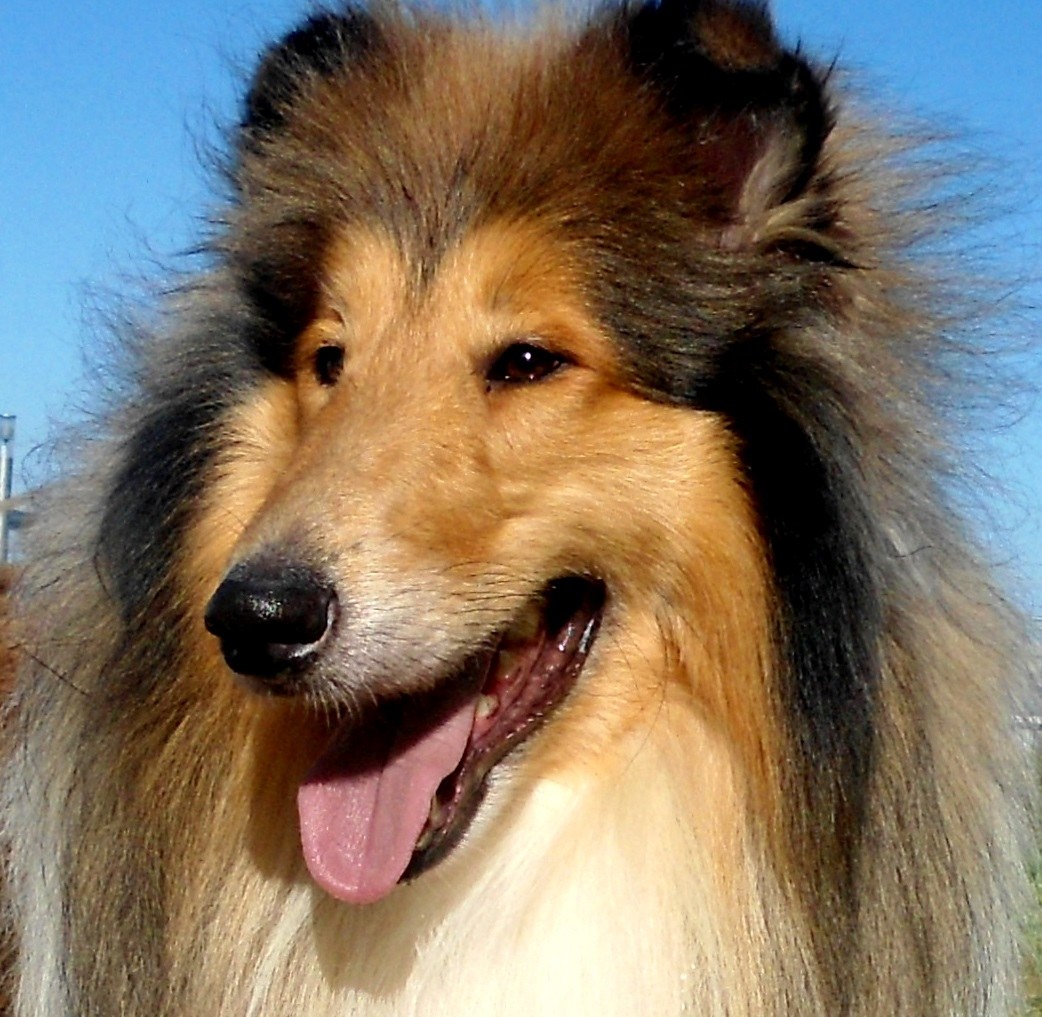
Photo: WisewynD, CC BY-SA 3.0, via Wikimedia Commons

Overview
The Collie is the tall, elegant Scottish sheepdog most people picture when they hear “Lassie,” but the breed is older and more interesting than any one film star. In the American Kennel Club’s system it is a single breed in two coats. The Rough Collie wears the famous long, harsh outer coat over a dense undercoat, with a showy mane and frill; the Smooth Collie is judged by the same standard except for coat, and carries a short, hard, dense, flat coat with plenty of undercoat underneath. Same wedge-shaped head, same almond eyes, same semi-erect tipping ears, same size bands — just a different wardrobe. FCI, The Royal Kennel Club and the Canadian Kennel Club go further and register Rough and Smooth as two separate breeds. Either way, the Collie is its own dog and not a Border Collie, which AKC recognized as a distinct breed in 1995, 110 years after it recognized the Collie in 1885. The AKC standard asks for a lithe, strong, responsive, active dog that “presents an impressive, proud picture of true balance,” and it gives unusual weight to expression: the sweet, intelligent look that comes from the wedge head, dark almond eyes and tipping ears. FCI’s history of the Rough puts the other half of the story plainly — for all his beauty, the Collie is a worker. Refined herding dog and devoted household companion: the standards and club writing support both.
History
The Collie comes from the working sheepdogs of Scotland and northern England. FCI lists Great Britain as the country of origin for both Rough and Smooth, and The Royal Kennel Club says the two share their origins in Scottish sheepdogs. AKC history writing places long-haired Collies with the flocks of the Scottish Highlands and a short-haired type working as drovers’ dogs in the harsh lowlands of northern England. The word itself is old: AKC’s history article, citing Gayle R. Kaye’s The Collie in America, points to “Ran Colle oure dogge” in Chaucer’s Canterbury Tales (c. 1387–1400), while noting there is no agreement on where the word comes from. FCI’s summary suggests the breed may descend from dogs brought to Scotland by the Romans and crossed with native types, a traditional theory rather than a documented pedigree. FCI also says Rough and Smooth derived very recently from the same stock and still share lines, with the Rough being “the somewhat refined version of the original working collie of the Scottish shepherd.” Fashion arrived in the 1860s, when Queen Victoria’s enthusiasm for the Collies she met at Balmoral helped lift them from hillside to show ring; she later brought Collies from Balmoral to her other estates. The Royal Kennel Club records separate classes for “Sheepdogs Rough” and “Sheepdogs Smooth” from around 1870 and credits its founder, S.E. Shirley, with promoting the Rough. AKC history writing names Shirley’s Trefoil, registered in 1873, as a foundational sire, and describes J.P. Morgan importing British stock and founding Cragston Kennels on the Hudson in 1888. In the UK the two coats could be interbred until 1994, so Rough and Smooth puppies could turn up in the same litter; the Smooth gained challenge certificates as a separate breed in 1979. AKC recognized the Collie in 1885, and its breed page dates the Collie Club of America to 1886. The current AKC standard was approved on 10 May 1977. FCI accepted the Rough on a definitive basis on 13 April 1955 and the Smooth on 18 December 1974. Albert Payson Terhune’s Sunnybank stories, Eric Knight’s Lassie Come-Home and the films and television series that followed made the Collie famous around the world — cultural history rather than a guide to the breed standard.
Type
Large on this site’s size badge, following the AKC Collie’s bands: dogs 24–26 in (about 61–66 cm) and 60–75 lb (about 27.2–34.0 kg), bitches 22–24 in (about 55.9–61 cm) and 50–65 lb (about 22.7–29.5 kg). AKC penalizes undersize or oversize according to how far the dog departs from those bands. FCI and The Royal Kennel Club set somewhat lower heights for both coats — males 56–61 cm, females 51–56 cm — so an AKC bitch at the bottom of her range stands close to the top of the FCI and RKC male range. For weight, FCI and RKC publish figures only for the Smooth (males 20.5–29.5 kg, females 18–25 kg); their Rough standards give height alone. Every one of these standards describes a body that is a trifle long compared with its height rather than square. A Rough in full mane and frill can look heavier than a Smooth on the same frame, but that is coat, not a second size class. These are conformation descriptions, not a healthy-weight target; a veterinarian should judge an individual dog’s body condition hands-on.
Under AKC rules there are two coat varieties of one breed; under FCI, Royal Kennel Club and Canadian Kennel Club naming, two breeds. The Rough’s well-fitting, proper-textured coat is, in the AKC standard’s words, “the crowning glory.” It is abundant everywhere except the head and legs, with a straight, harsh outer coat (a soft, open or curly outer coat is penalized) over an undercoat so soft, furry and dense that it is hard to see the skin when the hair is parted. The mane and frill are very abundant, the face is smooth, the forelegs are feathered, the tail is very profuse and the hips are long and bushy; feathering below the hocks is removed for the show ring. FCI and RKC Rough language is closely aligned. The Smooth, per AKC, has a short, hard, dense, flat coat of good texture with an abundance of undercoat; FCI and RKC describe a short, flat, harsh top coat over a very dense undercoat, not trimmed or clipped. Colour is where the registries part ways. AKC recognizes four colours with no preference: sable and white, tri-color, blue merle, and white — predominantly white, preferably with sable, tri-color or blue merle markings. FCI and The Royal Kennel Club recognize sable, tricolour and blue merle with typical white Collie markings, and consider all-white or predominantly white dogs highly undesirable; for the Smooth they add that white markings should not extend behind the withers or above the hock. FCI and RKC also consider light straw or cream sable highly undesirable. Blue merles may have blue or blue-flecked eyes under AKC, FCI and RKC.
Temperament
The AKC standard wants a lithe, strong, responsive, active dog, and it names the things that spoil a Collie: timidity, frailness, sullenness, viciousness, lack of animation and a cumbersome appearance. Expression — sweet and intelligent, never sullen — is called one of the most important points of the breed. FCI’s Rough standard describes a friendly disposition with no trace of nervousness or aggressiveness, and adds that the Collie is “a great companion dog, friendly, happy and active, good with children and other dogs”; The Royal Kennel Club’s Rough standard uses the same fuller wording, while the FCI and RKC Smooth standards keep the friendly, no-nervousness, no-aggression line. The Collie Club of America’s new-owner guide describes sensitive, responsive dogs bred to work cooperatively with a human leader. They thrive on interaction, the club says, can pick up annoying habits when bored and lonely, and respond best to gentle, loving training, ideally including a basic obedience course. Barking is noted as a herding-dog trait that proper attention helps manage. Breeding, health, training and daily life still shape each individual dog, and no standard predicts how a particular Collie will behave with strangers, stock, other dogs or a given household.
Energy
High, in line with this site’s other herding plates. FCI lists the utilization of both Rough and Smooth as Sheepdog, and its history of the Rough notes that many Collies can still work if given the chance. The AKC standard describes a gait that “suggests effortless speed combined with the dog’s herding heritage,” including the ability to change direction almost instantly. The Royal Kennel Club places both coats in its Pastoral group. Good outlets include herding trials and instinct tests where available, obedience, rally, agility, tracking and canine freestyle, which AKC history writing highlights; the Collie Club of America lists obedience, herding, tracking and agility among the activities its owners enjoy. Not every Collie will excel at every sport, and no registry sets a fixed daily exercise figure — age, conditioning, weather, health and the individual dog shape the right amount.
Intelligence
High trainability fits the standards’ emphasis on a responsive, active dog with an intelligent expression, and the Collie Club of America’s description of a sensitive breed developed to work cooperatively with a human leader. The club recommends gentle, loving training and a basic obedience course, especially in the first year. Herding, obedience, rally, agility and tracking all give that cooperative streak somewhere to go. Individuals and methods still vary; this is a guide to typical trainability, not a published ranking.
Intelligence here means typical trainability, guided by Stanley Coren's survey of obedience judges. It is not a verdict on any one dog.
Care
Grooming
The Collie Club of America’s new-owner guide gently punctures the idea that a Collie needs daily brushing or frequent baths. How much grooming a dog needs depends on how much coat it is carrying and the season: a Rough in full coat does well with brushing about once a week or every two weeks, a dog out of coat or in summer coat needs less, and Smooths need less brushing and upkeep than Roughs. Both varieties shed. The club describes spayed females and males as shedding about once a year, and intact females in step with their heat cycle. It also calls the Collie a clean breed, often without a strong doggy odour, and folds in the ordinary routines: exercise, teeth, nails, permanent identification and a healthy weight. For the show ring, AKC calls for removing the Rough’s feathering below the hocks. Many companion owners keep a Rough in a shorter pet trim for easier upkeep; that is a household choice, not a third variety.
Health notes
Only conditions and screening routes named by the Collie Club of America, the Collie Health Foundation, AKC, OFA/CHIC or a kennel-club health programme are listed here, and no prevalence, lifespan or diagnosis is implied. Screening reduces uncertainty but cannot guarantee an individual dog’s future health. The Collie Club of America’s health statement (approved 12 October 2022 and hosted by AKC) links breeding ethics to written disclosure of known defects, a health guarantee and an eye examination by a veterinarian trained in ophthalmology or a certified ophthalmologist. It highly recommends testing, or clearance by parentage where appropriate, for MDR1 (multi-drug sensitivity), PRA-rcd2 (progressive retinal atrophy, rod-cone dysplasia 2), DMS (dermatomyositis) and Collie Eye Anomaly (CEA). According to the Collie Health Foundation, a Collie earns a CHIC number when results for three DNA tests — MDR1, PRA-rcd2 and DMS — are submitted to OFA along with permanent identification; CEA testing and eye exams are strongly recommended but sit outside that trio. AKC’s Herding Group health-testing page lists the club’s recommended DNA tests as PRA-rcd2, MDR1, DMS and CEA. MDR1 is a mutation that changes how certain drugs are kept out of the brain, and dogs carrying it can suffer serious neurological reactions to some common medications. On ivermectin specifically, the Collie Health Foundation, drawing on work from Washington State University (whose lab identified the canine mutation), says the manufacturer’s heartworm-prevention dose is generally safe even for dogs with the mutation; the danger lies in much higher doses, such as those used in some mange treatments. Because other medications are affected too, CHF and WSU recommend knowing each dog’s MDR1 status, recording it with the veterinarian and checking WSU’s current problem-drug list before treatment. CEA is present at birth and affects structures at the back of the eye; the club says most affected dogs do not have vision problems, that severity varies, and that an examination by a board-certified veterinary ophthalmologist, often at about five to eight weeks, is still needed even when a DNA test has been done. The club describes PRA-rcd2 as an early-onset condition, with night blindness often apparent by about six weeks and, in most affected dogs, blindness by about a year; a DNA test identifies normal, carrier and affected dogs. DMS is an inflammatory autoimmune disease of skin and/or muscle, and DNA risk typing helps breeders choose lower-risk pairings. The Royal Kennel Club’s schemes include BVA/KC/ISDS eye testing and hip scoring, plus DNA tests for CEA/CH, DM, MDR1 and PRA-rcd2, with details differing between Rough and Smooth. OFA notes that a CHIC number shows the required tests were completed and made public, not that every result was normal, so ask to see the actual results and dates, and review the dog’s own health with a veterinarian.
Ordinary care
Care should fit the dog the standards describe: a large, lithe herding companion that wants people around and enough purposeful activity to stay content. Build everyday life around regular, age-appropriate exercise, training and company. Herding, obedience, rally, agility, tracking and freestyle all use what the breed was made for, and the Collie Club of America warns that a bored Collie can become noisy and unhappy. Calm, reward-based training for manners, recall, impulse control and quiet suits a sensitive breed; the club recommends a basic obedience course, especially in the first year, and advises against keeping a Collie chained or as a full-time backyard dog. Secure fencing or leashed walks make sense for a dog whose gait standard still talks about near-instant changes of direction. Keep coat, ears, eyes, nails and teeth on a routine that suits the dog’s coat and the season. Know the dog’s MDR1 status before sedation, anaesthesia or antiparasitic treatment, and keep a current WSU or CHF problem-drug list with the veterinarian. For a puppy or breeding prospect, ask for the actual records — an ophthalmologist’s eye exam and MDR1, PRA-rcd2, DMS and CEA DNA results as applicable — rather than a general assurance that the parents are healthy.
Facts
- One breed or two? AKC judges Rough and Smooth as varieties of a single Collie; FCI, The Royal Kennel Club and the Canadian Kennel Club register them as separate breeds that share almost everything but coat.
- Same stock, different wardrobe: FCI’s history says Rough and Smooth derived very recently from the same stock and still share lines.
- In the UK, Rough and Smooth could be interbred until 1994, so both coats could appear in one litter (Royal Kennel Club).
- Expression is a judging point: the AKC standard says a Collie cannot be judged properly until its expression has been carefully evaluated.
- White is a recognized Collie colour under AKC; FCI and The Royal Kennel Club consider all-white or predominantly white dogs highly undesirable.
- “Collie” predates the show ring by centuries: AKC history writing points to Chaucer’s “Ran Colle oure dogge.”
- Club and AKC histories credit Queen Victoria’s Balmoral-era enthusiasm with making Collies fashionable.
- AKC history writing calls Sewallis E. Shirley’s Trefoil, registered in 1873, a foundational sire of the modern Collie.
- Albert Payson Terhune’s Sunnybank, the New Jersey home behind his Collie stories, survives as a memorial park where visitors can see his dogs’ graves (AKC history writing).
- A Collie’s CHIC number rests on three DNA tests — MDR1, PRA-rcd2 and DMS — and records that the tests were submitted, not that every result was normal (Collie Health Foundation).
The Dog Codex is an editorial reference, not veterinary advice. Health notes summarize conditions that appear in breed literature; they do not diagnose an individual dog and do not replace examination by a licensed veterinarian.