Non-Sporting group · United Kingdom
Bulldog
- SizeMedium
- Height~36–38 cm (AKC profile)
- Weight~18–23 kg (AKC)
- GroupNon-Sporting
- EnergyLow
Photo: Canarian, CC BY-SA 4.0, via Wikimedia Commons

Overview
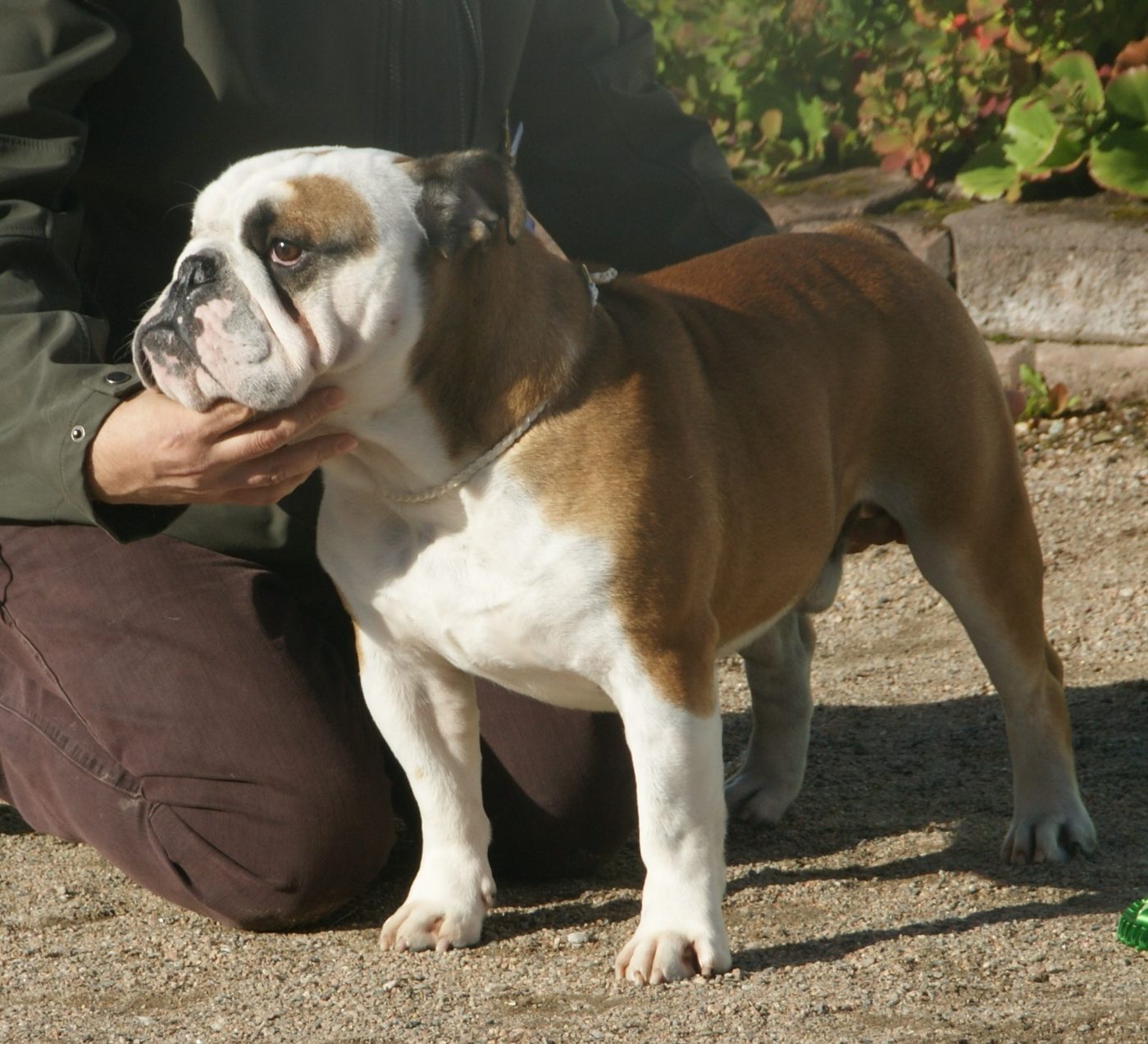
The Bulldog is a medium-sized, smooth-coated dog with a heavy, thick-set, low-slung body, a massive short-faced head, wide shoulders and sturdy limbs. Once used for bull-baiting, it has long been a companion, and the FCI calls it the national dog of Great Britain, a symbol of British determination. The AKC standard asks for a disposition that is equable and kind, resolute and courageous but not vicious or aggressive, with a peaceful, dignified bearing. Its short muzzle makes breathing difficult in heat and humidity, so the AKC urges owners to guard against overheating.
History
The Kennel Club says bull-baiting reached Britain with the Normans in the twelfth century and was a popular entertainment by the sixteenth, when the leggier mastiff types used for it gave way to smaller, thick-set dogs with strong heads and powerful jaws, the ancestors of the modern Bulldog. The FCI dates the name Bulldog to the 1630s and adds that the dogs also fought in the pits. Bull-baiting was made illegal in 1835, and the breed, now without a job, survived through dogs kept as companions. According to the FCI it then began to develop into the shorter-faced, squatter dog of today, entering the show ring in 1860 and changing greatly in temperament in the years that followed. The Kennel Club recognized the Bulldog in 1873 and the AKC in 1886. The Kennel Club notes that since the start of the twenty-first century breeders have worked to improve the breed's health by reducing exaggeration, and that its standard now leans firmly toward health and welfare.
Type
Neither standard gives a height. The AKC standard asks for about 50 lb (23 kg) in mature dogs and about 40 lb (18 kg) in bitches, and the FCI for 25 kg in males and 23 kg in females; the AKC breed profile suggests a height of about 14 to 15 in (36 to 38 cm). The AKC asks that the circumference of the skull in front of the ears be at least the dog's height at the shoulder. The FCI wants a dog in hard condition with no tendency toward obesity, and warns that no feature should be so exaggerated as to make the dog look deformed or interfere with its movement.
The coat is straight, short, flat, close, fine, smooth and glossy, with no fringe, feathering or curl. The skin is soft and loose, especially at the head, neck and shoulders, with heavy wrinkles on the head and face and two loose folds forming the dewlap. The AKC accepts red, white, fawn and fallow or any combination of them, with brindle, piebald, ticking, black masks, black tipping and a little solid black in piebalds; all other colors and the merle pattern are disqualified. The FCI accepts whole colors and pied, prefers brilliant, pure colors, and calls black, black and tan, and a liver nose (dudley) highly undesirable. The Kennel Club does not register merle Bulldogs, citing the health concerns linked to the merle gene.
Temperament
The AKC standard asks for an equable, kind, resolute and courageous dog, never vicious or aggressive, with a peaceful and dignified manner. The FCI describes a dog that is alert, bold, loyal, dependable and courageous, fierce in appearance but affectionate by nature. The AKC adds that Bulldogs are sweet, devoted and easygoing and want to please their owners.
Energy
Low. The AKC calls Bulldogs mellow, happy to relax at their owner's feet, but they enjoy an occasional romp and brisk walks, and regular moderate exercise helps keep them trim. The Kennel Club rates their exercise needs as low, a couple of short, gentle walks a day. On very warm days both advise keeping activity down, since the short muzzle makes breathing hard in heat and humidity.
Intelligence
The AKC finds Bulldogs eager to please and recommends early socialization and puppy classes. The Kennel Club says they can be strong-willed and are not among the quickest breeds to train, and that short, positive sessions with patience and consistency work best.
Intelligence here means typical trainability, guided by Stanley Coren's survey of obedience judges. It is not a verdict on any one dog.
Care
Grooming
The AKC suggests ten minutes of brushing with a soft brush two or three times a week, starting with a rubber curry brush in heavier sheds. The facial wrinkles need regular checks to keep them clean and dry, since trapped food or moisture can cause irritation or infection, and the ears and the area under the tail should be kept clean. Nails need trimming every two weeks or so.
Health notes
The AKC gives a life expectancy of 8 to 10 years. Because of their short-nosed build, Bulldogs often have breathing difficulties, commonly from an elongated soft palate that blocks the airway and can be corrected surgically, and the FCI standard calls respiratory distress highly undesirable. They overheat easily: the AKC warns that a Bulldog breathing too hard may show an unusually long, bluish tongue, and that cooling with water and ice can help. Cherry eye and skin-fold infections are also reported. The Bulldog Club of America recommends a heart exam, a patella evaluation and an X-ray for tracheal hypoplasia (a narrow windpipe), and those three tests earn a CHIC number from the Orthopedic Foundation for Animals. Optional CHIC tests include a respiratory function grade for brachycephalic airway syndrome (BOAS), eye, hip, elbow and thyroid exams, a hearing test and a DNA test for hyperuricosuria.
Ordinary care
The AKC advises never leaving a Bulldog in the hot sun without shade and water, or in a closed car in even mildly warm weather, and keeping very hot days indoors in air-conditioning. It also lists stairs and pools as major hazards: Bulldogs enjoy wading in very shallow water but should not be in water deeper than their elbows unless closely supervised. Measured meals help keep them trim, and the AKC recommends teaching puppies early to release toys on command and to accept people near their food bowl.
Facts
- Yale's Handsome Dan, a bulldog bought in 1889 from a New Haven blacksmith for five dollars, began what Yale calls the first live animal mascot tradition at an American college. The University of Georgia's Uga, a line of pure white English Bulldogs, has been on the sidelines since 1956.
- The FCI says the name Bulldog was first used for the breed in the 1630s, though similar dogs were known earlier as bandogs.
- The AKC standard describes the Bulldog's walk as a loose-jointed, shuffling, sideways motion that gives it a characteristic roll, though the action must still be free and vigorous.
The Dog Codex is an editorial reference, not veterinary advice. Health notes summarize conditions that appear in breed literature; they do not diagnose an individual dog and do not replace examination by a licensed veterinarian.