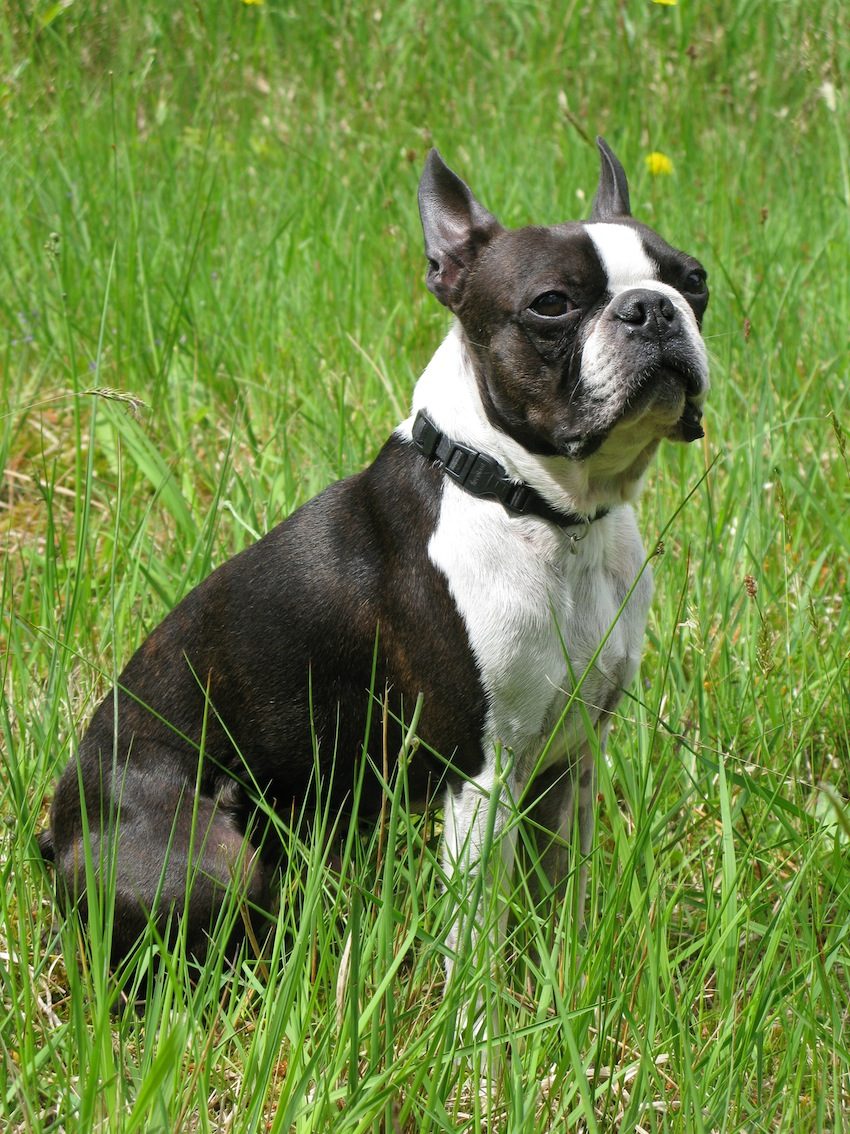
Non-Sporting group · United States
Boston Terrier
- SizeSmall
- Height~25–30 cm (AKC profile)
- Weightup to 11.3 kg (AKC/FCI)
- GroupNon-Sporting
- EnergyModerate
Photo: Jean-Pierre Dagneaux, CC BY-SA 3.0, via Wikimedia Commons

Overview
The Boston Terrier is a lively, highly intelligent little American dog with a smooth coat, a short square head, a short tail and a striking tuxedo of white markings on brindle, seal or black. Its standard calls it 'a most dapper and charming American original', and its manners have earned it the nickname 'the American Gentleman.' Despite the name, it isn't a terrier: the AKC places it in the Non-Sporting Group and the FCI among the small Molossian companion dogs. It is friendly, lively and good-natured, which the standards say makes it an incomparable companion.
History
The Boston Terrier was developed in and around Boston, Massachusetts. Its patriarch was Hooper's Judge, a stocky, dark brindle dog of Bulldog and terrier type that William O'Brien brought from England and sold to Robert C. Hooper around 1870; the AKC describes him as a cross between an English Bulldog and the now-extinct White English Terrier. Judge was bred to Burnett's Gyp, a small white bitch, and their son, Well's Eph, became a foundation sire of the breed. Early breeders showed the dogs as 'Round Heads' or American Bull Terriers, and the breed was later named after its home city. The Boston Terrier Club of America was formed in 1891, and the AKC registered its first Boston Terrier in 1893. When the AKC created its Non-Sporting Group in 1923, the Boston was its first member, and the breed ranked among America's ten most popular for six decades, from 1910 to 1970.
Type
A compact, sturdy little dog with a strikingly square outline, never spindly or coarse. The standards set no height and divide the breed instead into three weight classes: under 15 lb (6.8 kg), 15 to under 20 lb (6.8 to 9 kg), and 20 lb up to a maximum of 25 lb (9 to 11.3 kg). The AKC breed profile gives a height of about 10 to 12 in (25 to 30 cm).
The coat is short, smooth, bright and fine. Bostons come in brindle, seal or black, always with white markings; seal looks black but shows a red cast in sunlight. A white muzzle band, a white blaze between the eyes and a white forechest are required, and a white collar and white on the legs are desirable. Solid colors without the required white are disqualified, and the FCI also disqualifies gray and liver.
Temperament
Friendly and lively, with an excellent disposition and a high degree of intelligence, says the AKC standard; its expression should be alert and kind. The Kennel Club describes the Boston as lively, intelligent, determined and strong willed. The AKC notes that many Bostons are quite sensitive and respond best when gentle corrections are followed by warmth and praise.
Energy
Moderate. The standard asks for a dog that conveys determination, strength and activity, and the AKC says exercise needs vary: for some Bostons a brisk walk once or twice a day is enough, while others need more time to run and play. Games of fetch and sports such as agility, obedience, flyball and rally are good outlets. As a flat-faced breed, the Boston needs protection from heat and humidity.
Intelligence
Stanley Coren's The Intelligence of Dogs places the Boston 54th, at the foot of his average tier, even though its standard calls it 'highly intelligent'. The AKC recommends early socialization and puppy classes and notes that treats make a great training incentive.
Intelligence here means typical trainability, guided by Stanley Coren's survey of obedience judges. It is not a verdict on any one dog.
Care
Grooming
The sleek, fine coat sheds a little. A weekly brushing with a soft-bristle brush, rubber mitt or hound glove removes loose hair and spreads the skin's oils, and baths are needed only occasionally. Check the large, prominent eyes daily for redness or irritation, and keep the nails trimmed.
Health notes
The AKC gives a life expectancy of 11 to 13 years. The Boston's large, prominent eyes are easily hurt, and as a flat-faced breed it can struggle to breathe in heat or humidity. For a CHIC number, the Orthopedic Foundation for Animals requires an ACVO eye exam, a veterinary evaluation for patellar luxation, and a BAER hearing test (or a GDC evaluation based on a BAER test), all registered with OFA. The Boston Terrier Club of America also recommends a DNA test for early-onset hereditary juvenile cataracts (HSF4). In the UK, the Kennel Club recommends eye testing and the HSF4 test, and from 2027, breathing tests for BOAS (brachycephalic obstructive airway syndrome).
Ordinary care
Bostons need shade and cool conditions in hot weather and, says the AKC, a sweater or coat in the cold. Their eyes are easily injured, so check them daily and see a vet promptly for any injury. Early socialization, puppy classes and gentle, praise-based training suit this sensitive breed. Ask breeders for the parents' eye, kneecap and BAER results, and HSF4 DNA results.
Facts
- The Boston Terrier's nickname, 'the American Gentleman', comes from its dapper tuxedo coat and its impeccable manners.
- Despite the name, the Boston isn't in the Terrier Group. When the AKC created its Non-Sporting Group in 1923, the Boston Terrier was the first breed in it.
- In 1979 the Massachusetts legislature named the Boston Terrier the official state dog, and the breed has been Boston University's mascot for nearly 100 years.
- Sergeant Stubby, the most decorated dog in American military history, was a stray brindle found in Connecticut in 1917, described by the AKC as a Boston Terrier or bull terrier type. He served with the 102nd Infantry in France, warned soldiers of gas attacks, and earned two Purple Hearts.
- Tige, the dog in the Buster Brown shoe comic strips, was a Boston Terrier.
The Dog Codex is an editorial reference, not veterinary advice. Health notes summarize conditions that appear in breed literature; they do not diagnose an individual dog and do not replace examination by a licensed veterinarian.