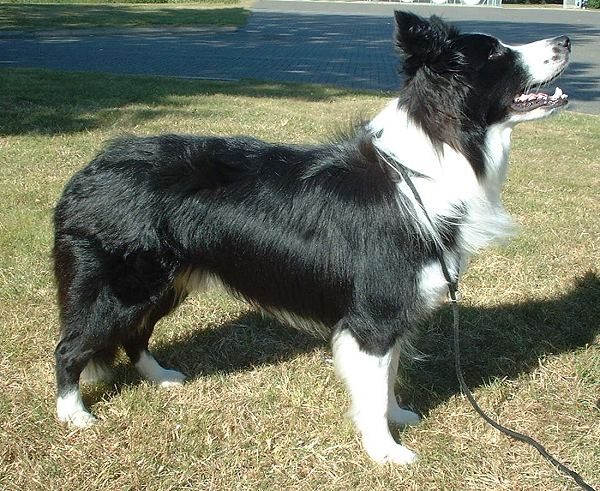
Herding group · United Kingdom
Border Collie
- SizeMedium
- Height46–56 cm (AKC)
- Weight~14–25 kg (AKC profile)
- GroupHerding
- EnergyVery high
Photo: sannse, CC BY-SA 3.0, via Wikimedia Commons

Overview
The Border Collie is the sheepdog of the hill country where England meets Scotland and Wales, a medium-sized, athletic herder bred for stamina, speed and a quick mind. The AKC standard describes it as extremely intelligent and asks that it remain 'a natural and unspoiled true working sheep dog.' Its signature is the intense, stalking gaze known as 'eye', which it uses to move livestock, and the Kennel Club notes that it is still seen working sheep and cattle today.
History
The Border Collie belongs to the working sheepdogs of Great Britain, with its history rooted in the border country of England and Scotland and a wider Welsh trial tradition. FCI gives Great Britain as the country of origin; kennel-club accounts describe a dog shaped by sheep work, terrain, stamina, and control rather than by one neatly documented founding pedigree.
Long before a registry fixed the name, shepherds in Britain depended on dogs that could gather and move stock across difficult ground. The Royal Kennel Club places the Border Collie's working history in the border regions of England, Scotland, and Wales, while the AKC reaches back to a 1557 description of shepherds' dogs and their work. Those references establish an old working setting, not an unbroken pedigree from medieval farm dogs to the modern breed.
The border country between Scotland and England became especially important in the usual kennel-club account. The AKC connects the development of working collies with differences in terrain, climate, livestock, and the wool trade, and says early shepherds selected chiefly for the ability to handle stock rather than for looks. That is a persuasive account of environmental and functional selection, though not a precise recipe of foundation crosses.
The geography is worth keeping in proportion. Scotland, England, Wales, and the Borders appear in sources for different reasons: FCI records Great Britain as the country of origin, The Kennel Club describes the regions where the dog worked, and the AKC emphasizes the Scotland–England border. A useful description is therefore a British sheepdog of the English–Scottish border country, with Welsh working-trial context—not a set of interchangeable registry fields.
The modern name arrived through a history that is less tidy than a single date suggests. The AKC explains Border Collie as a name associated with the working collie of the border country and reports a Gaelic rural sense of collie meaning something useful. The Border Collie Museum attributes the later distinction from the show Collie to ISDS secretary James A. Reid after the First World War. Since the surviving accounts refer to different uses of the name, from print to championship descriptions and registration papers, no one date safely settles its first appearance.
Sheepdog trials gave this working population a public stage. The International Sheep Dog Society and the AKC place the first recorded formal trial at Bala in North Wales in 1873. The Border Collie Museum reproduces a more detailed account attributed to James A. Reid, including 9 October 1873. That day is best retained as Reid's attributed detail, while Bala, Wales, in 1873 is the broader point on which the institutional histories agree.
English and Scottish sheep-men formed the International Sheep Dog Society in 1906. Its purpose was to register working sheepdogs in a stud book and support trials, and the Society says pedigrees for many dogs can be traced back more than a century. The AKC notes that the first official ISDS trial came later, in 1922. ISDS registration and trial history developed on their own track, separate from The Kennel Club's show-breed chronology.
Old Hemp occupies a central place in the breed's retrospective story, but the language around him matters. The Border Collie Club of South Australia says Adam Telfer's 1893 mating produced a dog who might be regarded as a foundation sire, with about 200 puppies before his death in 1901. The Border Collie Museum calls him a progenitor, and the AKC calls a dog born in 1893 the breed's granddaddy. These are accounts of exceptional influence, not evidence that one dog single-handedly created the breed or that every modern dog descends from him as settled fact.
Old Hemp also predates the ISDS by several years. The Museum explicitly places him too early for the National and International trials and describes his importance retrospectively through descendants and working reputation. That timeline makes him a useful window into the older sheepdog population, not an ISDS champion or a legal founder created by a later stud-book entry.
Working dogs travelled wherever sheep farming needed them. The AKC describes Border Collies exported from British ports to farms and ranches around the world, including the United States. The South Australian club gives Hindhope Jed's 1901 arrival as Australia's first recorded import and then follows the country's later show and standard history. That is an Australian club chronology, valuable in its setting but not a universal first-export date.
The United Kingdom's later show history runs alongside, rather than replacing, the ISDS tradition. The Border Collie Club of Great Britain says a group formed in 1972 after The Kennel Club would register one member's dog only as a working sheepdog. Its account records the club title's registration with The Kennel Club in October 1976, an interim Australian standard in February 1977, and a fuller standard process afterward. This is the club's account of a transition, not proof that the two institutions had always used one definition.
A cautious label is safest for the often-cited UK milestone: 1976 belongs to the BCCGB's club chronology, including its October registration with The Kennel Club. The current Royal Kennel Club breed page does not itself publish a recognition year, so it is better not to turn that club date into an independently verified KC recognition entry. The distinction preserves what the source actually says without erasing the importance of the period.
The modern British show system still makes room for the original work. The Royal Kennel Club requires a Border Collie that reaches Show Champion status in the breed ring to pass a herding test before receiving the full Champion title. That is a present-day safeguard for working function; it does not make every KC-registered dog an ISDS dog, nor does one test equal an ISDS trial.
In the United States, the AKC places the Border Collie in its Miscellaneous class in 1955 and gives 1995 as the year of full recognition. The current AKC list describes 1995 as the first year the breed was registrable with AKC. Those milestones belong to AKC status: the earlier Miscellaneous placement was not full recognition, and neither date marks the beginning of American working-dog history.
American organizations then took different institutional paths. The Border Collie Society of America describes a loose group beginning in Louisville in fall 1990, incorporation in 1993, and selection as the AKC parent club in August 1996 after the AKC decision announced in December 1994. The American Border Collie Association, founded in 1983, describes a separate working registry built to keep records of working bloodlines and support reliable stockdogs and trials. BCSA's parent-club role and ABCA's working-registry role should not be merged.
The disagreement between those institutions is real, but it is chiefly a disagreement about registry purpose and selection priorities. ABCA says breeding for conformation rather than working ability is detrimental, does not accept registration based on AKC, UK KC, or FCI registries, and excludes dogs awarded a conformation championship. BCSA describes a mission that preserves working attributes while supporting herding, conformation, companion, and performance activities. Those published positions do not establish a clean biological boundary between show and working dogs; some dogs and owners move among activities and registries.
Canada adds another layer of registry vocabulary. The current Canadian Kennel Club standard is marked “RECOGNIZED: N/A,” even though it provides a judging standard effective January 2015. CKC's 2023 guidance says a Border Collie can be registered through another Canadian registry under the Animal Pedigree Act and can enter CKC events with an Event Registration Number. The standard date is therefore not a CKC recognition year, and CKC event eligibility is not the same thing as CKC breed-register recognition.
The Canadian Border Collie Association describes itself as the country's purebred Border Collie registry and maintains A and B registries. Its rules place ISDS, ABCA, and certain working registries in Section A, while UK KC, AKC, and Australian KC pedigrees appear in Section B, with reclassification possible after proof of herding ability. That is CBCA policy, not a universal hierarchy of Border Collies and not evidence that CBCA and CKC are interchangeable.
FCI supplies a separate international milestone. Its nomenclature lists Border Collie No. 297 under Great Britain, in Group 1, Section 1 Sheepdogs, with a working trial; definitive acceptance is dated 27 September 1977, and publication of the official valid standard is dated 24 June 1987. Those FCI dates sit beside, rather than replace, the ISDS, UK club, and AKC timelines.
Even coat terminology reflects the registry-specific nature of modern standards. The Royal Kennel Club, FCI, and CKC describe moderately long and smooth varieties. The AKC uses rough and smooth, calls both weather-resistant double coats, and gives neither preference. “Rough” is accurate in the AKC's vocabulary; “moderately long” is the term used by the other standards, and neither should be silently treated as a universal historical category.
Across those standards, the desired outline still answers to work. FCI describes a tenacious, tractable sheepdog with free, smooth, tireless movement suggesting stealth and speed. The Royal Kennel Club calls fitness for function central and notes that the breed is still seen working sheep and cattle. The AKC gives intensity, trainability, and working ability equal importance with size and appearance, while its standard permits the marks of honest work. These are ideals preserved in modern documents, not a measured history proving that every contemporary dog matches every earlier one.
The Border Collie's history is consequently a story of working populations becoming legible to several institutions at different times. British regional practice, Welsh trials, the ISDS stud book, The Kennel Club's later show framework, FCI's international definition, and the separate American and Canadian registries each preserve part of the record. The most durable thread is not a single founder or a perfectly dated naming event, but a sheepdog selected for judgment, stamina, and controlled movement—and repeatedly debated when registration began to define what that work should look like.
Sources
- The Royal Kennel Club — Border Collie breed page
- The Royal Kennel Club — Border Collie breed standard
- American Kennel Club — Border Collie History: From Pastures to Today
- American Kennel Club — Official Standard of the Border Collie
- American Kennel Club — Breeds by Year Recognized
- International Sheep Dog Society — official home page
- Fédération Cynologique Internationale — Border Collie nomenclature No. 297
- Fédération Cynologique Internationale — Border Collie Standard No. 297
- Border Collie Club of Great Britain — The Early History of the Border Collie Club of Gt. Britain
- Border Collie Society of America — About BCSA
- American Border Collie Association — History of the ABCA
- American Border Collie Association — Registration Requirements
- Canadian Kennel Club — Border Collie official standard, Group VII
- Canadian Kennel Club — Border Collie registration guidance
- Canadian Border Collie Association — Registration and Transfer of Ownership
- Border Collie Club of South Australia — Border Collie History
- BC Museum — AULDHEMP
- BC Museum — Sheepdog Trials in Britain & Ireland
- The Royal Kennel Club — Certificate types
- American Kennel Club — So You Think You Can Live With the World's Smartest Dog?
Type
A well-balanced, medium-sized, athletic dog, slightly longer than tall at a ratio of about 10 to 9. The AKC standard gives 48 to 56 cm (19 to 22 in) for males and 46 to 53 cm (18 to 21 in) for females, while the FCI and Kennel Club set an ideal of 53 cm for males, with females slightly less. Medium bone is correct, and the AKC says overall balance matters more than any single measurement. No standard sets a weight; the AKC breed profile gives 30 to 55 lb (about 14 to 25 kg).
There are two varieties, both with a dense, weather-resistant double coat: a moderately long coat (the AKC calls it rough) that forms a mane, breeching and brush, and a short, smooth coat. The standards allow a wide variety of colors. The AKC judges solid, bicolor, tricolor, merle and sable equally, and the FCI and Kennel Club say only that white should never predominate.
Temperament
The AKC standard describes the Border Collie as energetic, intelligent, keen, alert and responsive, an intense worker of great tractability that is affectionate with friends but may be sensibly reserved with strangers. It should stand its ground when approached and never show fear, dullness or resentment. The FCI and Kennel Club call it a tenacious, hard-working sheepdog, neither nervous nor aggressive.
Energy
Very high. The AKC standard calls the Border Collie energetic and built for 'endless endurance', and the Kennel Club recommends more than two hours of exercise a day. The AKC describes it as an extremely energetic, high-drive breed that needs vigorous daily exercise beyond a walk around the block, and Border Collies excel at herding, obedience, agility, flyball and flying disc.
Intelligence
The AKC standard calls the Border Collie extremely intelligent, and its keen, alert expression is a hallmark of the breed. The AKC describes it as highly trainable and says ongoing obedience training gives it the mental stimulation it needs. The Kennel Club credits its intelligence, speed and versatility for its success in obedience and agility and as a sniffer dog detecting explosives and drugs.
Intelligence here means typical trainability, guided by Stanley Coren's survey of obedience judges. It is not a verdict on any one dog.
Care
Grooming
Both coat types are groomed the same way: go over the dog with a pin brush once or twice a week to keep the coat free of mats and debris, and brush daily during shedding season. Trim the nails regularly, check the ears for signs of infection, and brush the teeth often.
Health notes
The AKC calls the Border Collie a generally hardy and healthy breed with a life expectancy of 12 to 15 years. It lists hip dysplasia, progressive retinal atrophy, deafness, epilepsy, collie eye anomaly, neuronal ceroid lipofuscinosis and trapped neutrophil syndrome among the conditions breeders screen for. For a CHIC number, the Orthopedic Foundation for Animals requires a hip evaluation (OFA or PennHIP), ACVO eye examinations every year until 7 years (84 months) of age with results registered with OFA, and participation in the OFA/CHIC DNA Repository. Optional CHIC tests include elbows, shoulders, autoimmune thyroiditis, BAER hearing, cardiac, and DNA tests for collie eye anomaly, neuronal ceroid lipofuscinosis and trapped neutrophil syndrome. In the UK, the Kennel Club recommends eye testing with gonioscopy as a minimum, plus hip, elbow and hearing tests and DNA tests that include MDR1 drug sensitivity.
Ordinary care
Border Collies need daily vigorous exercise and regular mental work, whether herding, training or dog sports. The AKC stresses early socialization, with plenty of positive experiences with people and places from puppyhood through about seven months, and obedience training that continues throughout life. Keep the nails trimmed and the coat brushed, and ask breeders for the parents' hip and eye results.
Facts
- Old Hemp, born in 1893 on Adam Telfer's farm in Otterburn, is widely regarded as the foundation sire of the Border Collie. He is said to have sired about 200 puppies before he died in 1901, and he lived too early to compete in the International Sheep Dog Society's trials.
- A Border Collie named Chaser learned the names of 1,022 toys in a study published in 2011, and in monthly tests she picked out more than 95 percent of them correctly by name.
- In the UK, a Border Collie that wins its Show Champion title in the breed ring must also pass a herding test before it can become a full Champion.
- According to the AKC, 'collie' was an old rural word for anything useful, so a collie dog was simply a useful dog.
- The breed's familiar white markings may have a practical origin: the AKC says white on the neck, chest, legs and tail tip helped shepherds see and direct their dogs when working at night.
The Dog Codex is an editorial reference, not veterinary advice. Health notes summarize conditions that appear in breed literature; they do not diagnose an individual dog and do not replace examination by a licensed veterinarian.