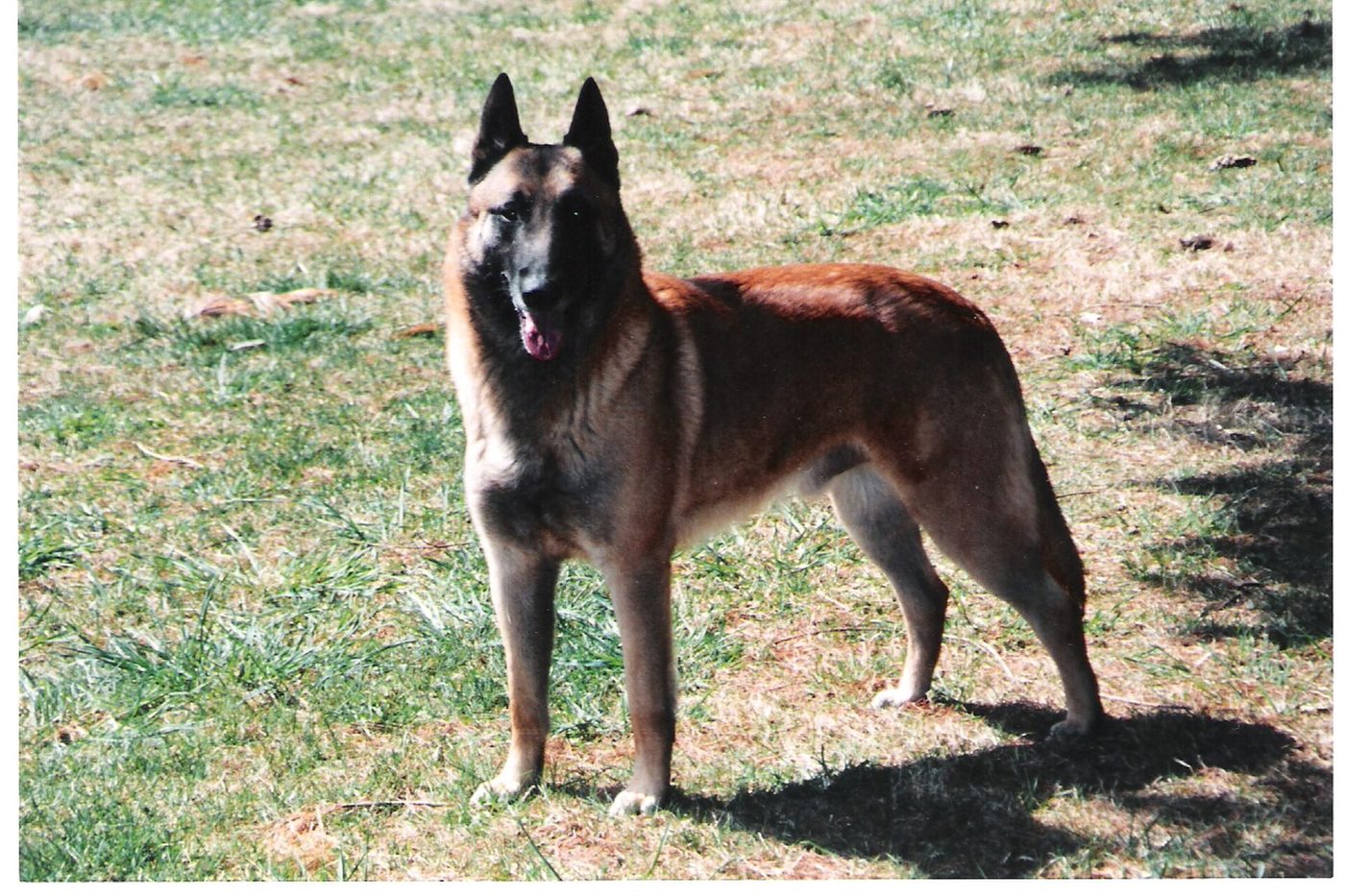
Herding group · Belgium
Belgian Malinois
- SizeMedium
- Height56–66 cm (AKC/FCI)
- Weight20–30 kg (FCI)
- GroupHerding
- EnergyVery high
Photo: Flickr user intrepidmalinois "MALINUTS", CC BY 2.0, via Wikimedia Commons

Overview
The Belgian Malinois is a square, elegant herding dog from Belgium: strong, agile, well-muscled, alert and full of life, with an exceptionally proud carriage of head and neck. Its short coat is a rich fawn to mahogany with black-tipped hairs, a black mask and black ears. The FCI says it was originally a sheepdog and is now a working and all-purpose service dog as well as a family dog. In most of the world, the Malinois is the short-haired variety of a single breed, the Belgian Shepherd Dog; the AKC has recognized it as a breed of its own since 1959.
History
At the end of the nineteenth century Belgium had many herding dogs of varied type and very different coats. In 1891 a group of enthusiasts founded the Belgian Shepherd Dog Club in Brussels and turned to Professor Adolphe Reul of the Cureghem veterinary school, whom the FCI calls the real founder of the breed. That November Reul gathered 117 dogs at Cureghem to choose the best, and by April 1892 the club had a first standard for a single breed with several coat varieties. The varieties came to be named for the places where they were developed, the short-haired fawn Malinois for the area around Malines (Mechelen). The first Belgian Shepherds entered the Saint-Hubert stud book in 1901, and the FCI says type and temperament were settled by about 1910. Two Malinois reached the United States in 1911, registered by the AKC at first as German Shepherds with the prefix 'Belgian'. Imports continued until the Second World War, after which numbers fell. In 1959 the AKC split the Belgian varieties into separate breeds; the Malinois became eligible for championships in 1965 and moved to the new Herding Group in 1983. The FCI, the Kennel Club and the Canadian Kennel Club still treat the Malinois as one variety of the Belgian Shepherd Dog.
Type
The FCI describes the Belgian Shepherd as a dog of medium size, combining elegance and power. Its ideal height is about 62 cm for males and 58 cm for females, with 2 cm allowed below and 4 cm above, and it suggests weights of about 25 to 30 kg for males and 20 to 25 kg for females. The AKC asks for males of 24 to 26 in (61 to 66 cm) and females of 22 to 24 in (56 to 61 cm), disqualifies males under 23 or over 27 in and females under 21 or over 25 in, and sets no weight; its breed profile suggests 60 to 80 lb (27 to 36 kg) for males and 40 to 60 lb (18 to 27 kg) for females. Both standards ask for a square dog, as long as it is tall, with depth and solidity but no bulk.
The coat is comparatively short, straight and hard enough to resist weather, over a dense undercoat. It is very short on the head, ears and lower legs and longer around the neck, where it forms a collarette, and on the tail and the backs of the thighs. The color is a rich fawn to mahogany in the AKC's words, or fawn in the FCI's, with black-tipped hairs giving an overlay that must not be patched or brindled, and a pronounced black mask. White is limited to the tips of the toes and a small spot on the chest. The AKC disqualifies any color not described in its standard, and the FCI allows only fawn with black overlay and black mask.
Temperament
The AKC standard calls correct temperament essential to the Malinois's working character. It describes a dog that is alert, intelligent, inquisitive and confident, showing neither fear nor aggression; energetic and ready for action, yet highly responsive to its owner. It is an exceptional watchdog, firmly loyal to those it loves but sometimes indifferent to strangers. The FCI describes a watchful, active dog bursting with energy and always ready to leap into action, a natural guardian of flock and property and a keen protector of its owner, and it disqualifies aggressive or timid dogs.
Energy
Very high. The FCI describes a dog bursting with energy and always ready to leap into action, and the American Belgian Malinois Club credits the breed with inexhaustible energy, which let it work long hours in harsh weather. The AKC says daily walks are not enough: the Malinois needs plenty of exercise, ideally alongside its owner, and excels at agility, tracking, herding, obedience and protection sports.
Intelligence
Stanley Coren's The Intelligence of Dogs ranks the Malinois 22nd, but it is widely regarded as one of the most trainable working breeds, which is why police and military units rely on it. The AKC standard calls it alert, intelligent and inquisitive, and the AKC describes it as a world-class worker. Like most herding breeds it has a strong prey drive, which the AKC advises channeling through early socialization and obedience training.
Intelligence here means typical trainability, guided by Stanley Coren's survey of obedience judges. It is not a verdict on any one dog.
Care
Grooming
The AKC standard calls the Malinois a natural breed with no need for excessive grooming. Occasional brushing with a medium-bristle brush, rubber mitt or hound glove keeps the coat in order; the Malinois sheds twice a year, when a daily going-over with a slicker brush helps. Nails should be trimmed regularly, ears checked and teeth brushed often.
Health notes
The AKC calls the Malinois generally healthy and gives a life expectancy of 14 to 16 years; the American Belgian Malinois Club suggests 12 years or more. For a CHIC number, the Orthopedic Foundation for Animals requires a hip evaluation (OFA or PennHIP), an OFA elbow evaluation and an ACVO eye examination, all registered with OFA. The eye exam can reveal inherited problems such as cataracts and progressive retinal atrophy. The club also suggests asking breeders about any history of epilepsy, cancer (hemangiosarcoma), thyroid and heart problems, and temperament.
Ordinary care
The AKC calls early socialization and obedience training musts, and says the Malinois needs to be actively engaged with its owner, both mentally and physically. The American Belgian Malinois Club notes that behavior problems can arise when a Malinois is underemployed or neglected, and that dogs bred for protection work have been selected for higher energy and a sharper character.
Facts
- The Malinois takes its name from the area around Malines, the French name for the Belgian city of Mechelen, where the short-haired fawn variety was developed.
- To the FCI and most kennel clubs outside the United States, the Malinois, Groenendael, Tervueren and Laekenois are one breed, the Belgian Shepherd Dog, told apart only by coat. The AKC recognizes them as four separate breeds.
- The breed's founder, Professor Adolphe Reul, began by gathering 117 Belgian herding dogs at Cureghem on 15 November 1891 to pick out the best.
- The first Malinois registered in the United States, in 1911, went into the AKC stud book as German Shepherds, with 'Belgian' added to their names.
- In the First World War, Malinois carried messages, served as ambulance dogs and even pulled machine guns, according to the American Belgian Malinois Club. The FCI still classifies the breed with a working trial.
The Dog Codex is an editorial reference, not veterinary advice. Health notes summarize conditions that appear in breed literature; they do not diagnose an individual dog and do not replace examination by a licensed veterinarian.