Hound group · United Kingdom
Beagle
- SizeSmall
- Height33–40 cm (FCI)
- Weight<9–13.5 kg (AKC profile)
- GroupHound
- EnergyHigh
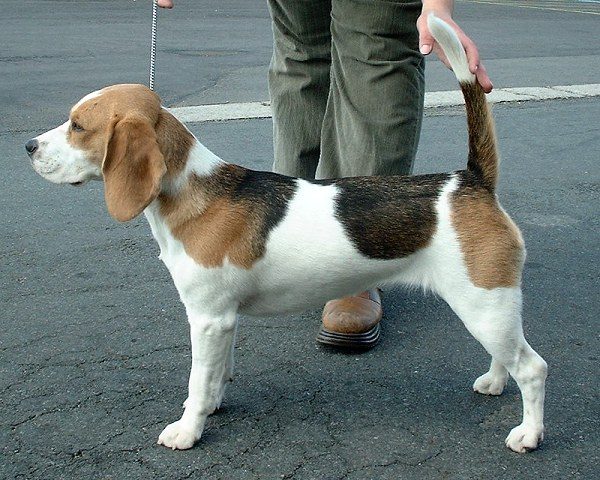
Photo: Tobycat, CC BY-SA 3.0, via Wikimedia Commons

Overview
The Beagle is a sturdy, compact scent hound bred to hunt hare in packs, with followers on foot. The FCI describes a merry hound, bold and full of activity, stamina and determination, and calls it a bustling, eager little dog ever ready for anything that involves it. The AKC adds that its fanciers call it merry and that, bred to hunt in packs, it enjoys company and is generally easygoing.
History
The modern Beagle is a small English pack hound standardized in Great Britain. Kennel clubs and the UK parent club place its working history with scent-driven packs hunting small game—especially hare—followed on foot. Older Greek, Roman, Norman, and medieval small-hound stories appear in club narratives as speculative antecedents, not a continuous pedigree. Registry dates differ: AKC first registrable 1885, CKC recognized 1889, FCI definitive acceptance 26 April 1955.
The Beagle Club places the breed’s remote background among small hounds used for hunting small game in southern Europe and points to Xenophon’s description of small hounds hunting hare and rabbit on foot. Its history then gives an attributed Roman-to-Britain narrative, with Saxon, Norman, medieval, and Tudor references. The club says the origin is obscure and that it is not certain whether Britain already had native hare-hunting hounds. That ancestry remains speculative parent-club narrative, not a documented pedigree.
The Beagle Club dates the name Beagle in English writing to around 1475 and links earlier small-hound context with Chaucer’s “smale houndes.” The AKC likewise dates the first appearance of the name in English literature to 1475 and notes a later Shakespeare reference. Those citations show the word and literary visibility; they do not prove a modern registry-defined Beagle already existed in the fifteenth century.
Tudor sources describe miniature packs. The Beagle Club attributes “Singing Beagles” to Queen Elizabeth I, named for their cry, and repeats the tradition that they were small enough to fit in a lady’s gauntlet. The Kennel Club says Elizabeth kept miniature Beagles reputedly small enough for a saddle pannier or pocket. The AKC calls these “pocket beagles,” places them among historical variations, and gives an approximate nine-inch figure. That is a historically described miniature type, not a current registry variety named Pocket Beagle.
The Kennel Club describes the Beagle as the smallest of the British pack hounds, bred to hunt small game and followed on foot rather than horseback, with stamina, voice, and scenting ability prized. Its current standard identifies the essential function as hunting primarily hare by following a scent. The Beagle Club says Beagles were hunted in packs after hare and followed on foot and horseback. Working history centers on small-game hunting, especially hare; rabbit-only origin stories are not universal across the sources.
Club and kennel narratives about possible antecedents differ. The Canadian Kennel Club mentions fifteenth-century written references, a possible link to small Greek hunting hounds as early as 400 BC, and descent from dogs brought from France at the Norman Conquest in 1066. The Beagle Club gives a related Roman-transmission story. The AKC discusses Xenophon, Talbot Hounds, and a possible Irish Kerry Beagle contribution. Those accounts are attributed theories, not an established cross recipe.
What can safely be said about English development is narrower. The Beagle Club says development as a recognizable English sporting hound occurred in Britain, with remote origin obscure. The Kennel Club says the breed was established in England by the fifteenth century. The AKC says Beagle-like dogs appeared in America before the Civil War but were not firmly established there until the 1880s. No single founder kennel, planned cross, or precise “first Beagle” date is established by the fetched sources. Familiar Southern Hound, North Country Beagle, Harrier, Talbot, Kerry Beagle, or Foxhound recipes are not documented as settled foundation fact on those pages.
The Beagle Club says Beagles were not exhibited at British shows until the late nineteenth century and lacked an organization for sport and show. It dates The Beagle Club to 1890 and the Association of Masters of Harriers and Beagles to 1891. Those are club-foundation dates, not Kennel Club recognition dates.
The Beagle Club published its Standard of Points in 1895 and says that document formed the basis of The Kennel Club’s breed standard, which the club characterizes as largely unchanged. The club’s first show followed in 1896. Safest UK chronology from those pages: club 1890, hunting association 1891, Standard of Points 1895, first club show 1896. Current Kennel Club pages do not state a Beagle recognition year, so 1895 should not be treated as a confirmed KC recognition date.
The Kennel Club’s first Stud Book appeared in 1874, listing show and field-trial results since 1859, and its 1880 monthly register became a pedigree source. Those dates describe registry infrastructure, not a Beagle-specific recognition event. The fetched sources do not identify a first KC-registered Beagle.
British popularity figures from the Beagle Club are UK registrations: 154 in 1954, 1,092 in 1959, 2,047 in 1961, and a peak of 3,979 in 1969, when the club says the Beagle became Britain’s most popular dog. Its 1990 centenary show attracted 340 Beagles. Those are UK club figures, not a worldwide census.
In America, the AKC says Beagle-like dogs were present before the Civil War, with firm establishment in the 1880s after 1860s imports of well-bred English lines. AKC Archives materials associated with Wilbur E. “Red” Henry include a development timeline beginning with General Richard Rowett in the early 1870s—an archival and club-history thread, not proof of a sole American founder.
The AKC’s Breeds by Year Recognized list makes the Beagle first registrable in 1885. AKC history names Blunder as the first Beagle registered by AKC that year—a first-registration note, not a foundation-sire claim. CKC recognized the Beagle in 1889. FCI definitive acceptance is 26 April 1955, with country of origin Great Britain, Group 6 Section 1.3 Small-sized Hounds, English as authentic language, and a working trial; the official valid FCI standard is dated 13 October 2010.
National Beagle Club organization dates need separate labels. AKC field-trials history records the National Beagle Club of America’s first field trial at Hyannis, Massachusetts, on 4 November 1890 (eighteen entries), and a May 1891 merger with the American Beagle Club (formerly the American English Beagle Club) that made the new National Beagle Club the parent club. A current AKC-hosted National Beagle Club health document says “Founded 1887.” Report both chronologies; the sources do not reconcile them.
American field-trial history frames U.S. and Canadian sport around following wild rabbit or hare, with formal packs at the 1896 National meet, later “single” hounds, and twentieth-century pack, brace, small-pack, large-pack, and gun-dog formats. Parent-club work included proposing conformation and performance standards; in 1936 field-trial administration shifted to an AKC Beagle Advisory Committee. That is performance history, not proof every Beagle was bred to one trial style. Quarry wording differs by jurisdiction: UK KC primarily hare; CKC rabbit as chief quarry; AKC trials rabbit or hare.
The current AKC standard describes the Beagle as a “miniature Foxhound,” solid and substantial for its height and able to last in the chase, with a close hard hound coat, large open nostrils, long low-set ears, a level jaw, strong running gear, and a tail with a brush. A separate pack section evaluates uniformity, individual merit, manners, and appointments. CKC likewise calls the Beagle a miniature Foxhound and says its standard is intended to ensure the dog can carry out its original purpose.
Size rules are registry-specific. AKC and CKC define two varieties: Thirteen Inch (not exceeding 13 inches) and Fifteen Inch (over 13 but not exceeding 15 inches), with over 15 inches a disqualification under AKC. The UK Kennel Club standard gives one desirable range of 33–40 cm (13–16 inches). Those rules are not a universal two-variety system. “Pocket Beagle” remains a historical or common label for miniature type; neither the KC nor AKC pages establish a current AKC registry variety formally named Pocket Beagle.
Modern standards preserve function and outline: UK KC emphasizes activity, stamina, determination, a level back, firm hocks, and free long-reaching movement for scent hunting; AKC keeps a chase-ready miniature-Foxhound construction. Standardization formalized a compact, durable pack hound; it does not prove that every show line and every working line are identical. The Beagle Club notes that in 2023 it ceased its working section for reduced interest and promoted other activities—a UK club note, not evidence that hunting function disappeared everywhere.
Cultural and working visibility notes from AKC history include Norman Rockwell imagery, Snoopy’s 1950 debut and an honorary “Beagle-1” registration, and the USDA Beagle Brigade from 1984. Those are modern visibility and working-use items, not origin or pedigree evidence.
Sources
- The Kennel Club — Beagle
- The Kennel Club — Beagle breed standard
- The Kennel Club — History of The Kennel Club
- The Beagle Club (UK) — A History Of The Beagle Club
- The Beagle Club (UK) — Breed History
- The Beagle Club (UK) — The Beagle
- The Beagle Club (UK) — Breed Standard
- AKC — Beagle History
- AKC — Breeds by Year Recognized
- AKC — Beagle Field Trials: History
- AKC — Official Standard for the Beagle (PDF)
- AKC — 10 Most Popular Dog Breeds of the 1880s
- AKC Archives — Wilbur E. “Red” Henry Beagle collection
- AKC — National Beagle Club health statement
- FCI nomenclature — Beagle (161)
- FCI Standard No. 161 — Beagle (PDF)
- Canadian Kennel Club — Beagle
- Canadian Kennel Club — Beagle standard (PDF)
Type
The AKC shows Beagles in two varieties: hounds not exceeding 13 in (33 cm), and hounds over 13 in but not exceeding 15 in (38 cm). A Beagle over 15 in is disqualified. The FCI gives a desirable height of 33 to 40 cm. Neither standard sets a weight; the AKC breed profile suggests under 20 lb (9 kg) for the smaller variety and 20 to 30 lb (9 to 13.5 kg) for the larger. The AKC standard sums up the breed as 'a miniature Foxhound, solid and big for his inches.'
The coat is close and hard, of medium length in the AKC's words and short, dense and weatherproof in the FCI's. The AKC accepts any allowed hound color but, since 2024, disqualifies merle and brindle patterns. The FCI lists tricolor (black, tan and white); blue, white and tan; badger pied; hare pied; lemon pied; lemon and white; red and white; tan and white; black and white; and all white, and all but all white may also be mottled. The FCI asks for a white tip to the tail.
Temperament
The FCI asks for a Beagle that is alert, intelligent and of even temperament, amiable and showing no aggression or timidity. Bred to work in packs, it usually enjoys company, and the AKC describes it as curious, clever and energetic. As a scent hound with a very strong hunting instinct, a Beagle may find a compelling scent hard to resist, so the AKC advises keeping it on a leash on walks.
Energy
High. The AKC calls Beagles active, energetic dogs that need at least an hour of exercise every day, and more than just time in the yard. The FCI stresses the breed's stamina and says everything about it gives the impression of athleticism.
Intelligence
The FCI calls the Beagle intelligent, and the AKC calls it clever. As a scent hound it was bred to follow a trail, and the AKC finds it responds to treats, patience and positive reinforcement rather than harsh methods.
Intelligence here means typical trainability, guided by Stanley Coren's survey of obedience judges. It is not a verdict on any one dog.
Care
Grooming
The AKC describes a smooth, dense double coat that grows heavier in winter and sheds in spring, with moderate shedding year-round. Weekly brushing with a medium-bristle brush, rubber mitt or hound glove removes loose hair, and baths are needed only when the dog gets into something messy. Ears should be checked weekly, teeth brushed regularly, and nails trimmed often, since overgrown nails can cause pain and trouble walking.
Health notes
The AKC calls Beagles generally healthy, with a life expectancy of 10 to 15 years, and asks breeders to screen for hip dysplasia, hypothyroidism, epilepsy, luxating patella and eye disorders. For a CHIC number from the Orthopedic Foundation for Animals, a Beagle needs a hip evaluation (OFA or PennHIP), an eye exam by a board-certified veterinary ophthalmologist, a DNA test for Musladin-Lueke syndrome, a heart exam, and a thyroid evaluation at 24 months or older. Optional tests include patellas, an advanced heart exam, and DNA tests for Lafora epilepsy, factor VII deficiency and neonatal cerebellar cortical degeneration. The AKC also notes that some Beagles are prone to putting on weight, so food and treats should be measured.
Ordinary care
Measured meals and moderate treats help keep a Beagle trim. The AKC advises early socialization and puppy classes, training with treats, patience and positive reinforcement, and walks on a leash, since a strong scent can be impossible for a Beagle to ignore.
Facts
- Snoopy, who joined the Peanuts strip on 4 October 1950, is a Beagle, and the AKC made an exception to its rule that registered dogs must be real to give him the honorary number Beagle-1.
- The U.S. Department of Agriculture's Beagle Brigade, started in 1984, uses Beagles to sniff out illegal food at airports, seaports and border crossings, and has helped with some 75,000 seizures.
- The AKC's two height varieties began at field trials: owners of small hounds asked for their own class because a dog of 12 or 13 inches could not keep up with a 15 inch rival.
The Dog Codex is an editorial reference, not veterinary advice. Health notes summarize conditions that appear in breed literature; they do not diagnose an individual dog and do not replace examination by a licensed veterinarian.