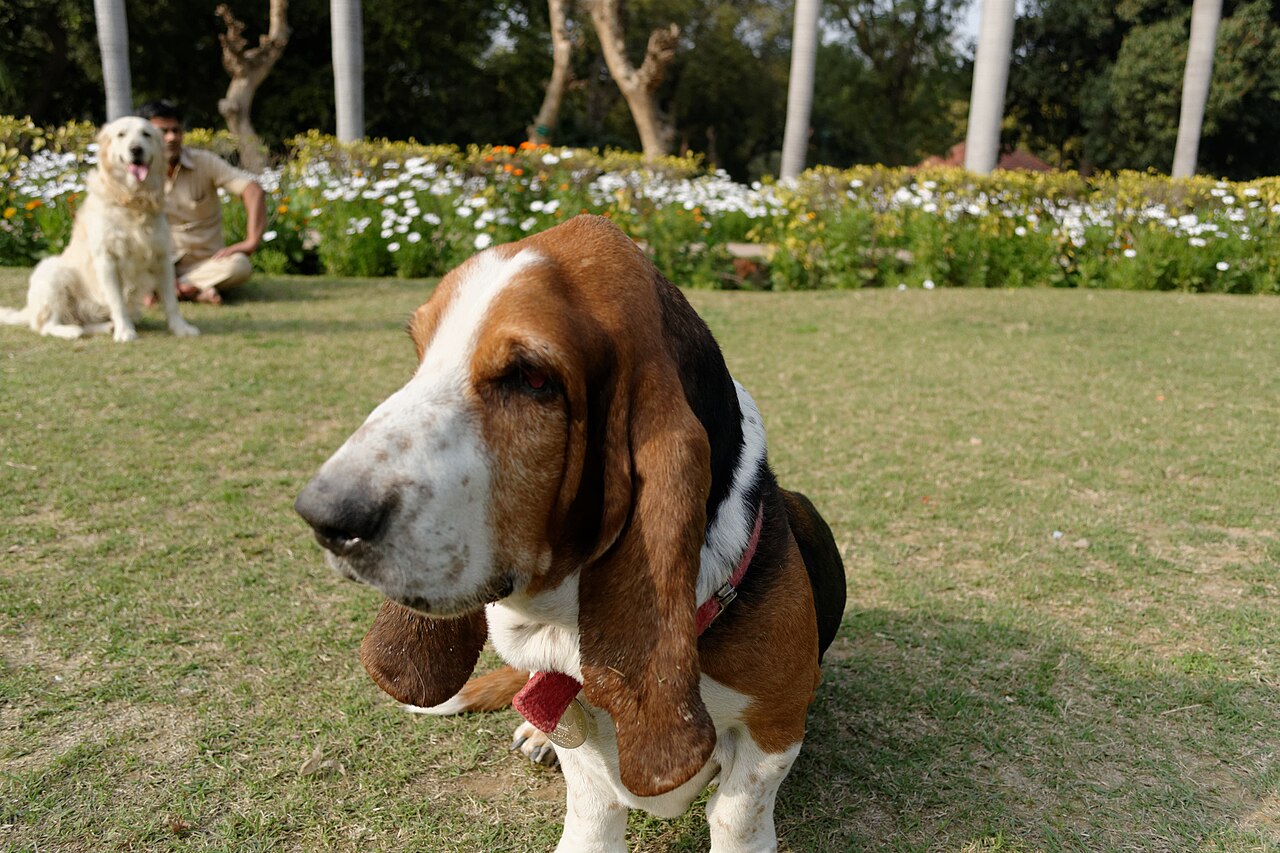
Hound group · France
Basset Hound
- SizeMedium
- Height33–38 cm; AKC standard should not exceed 35.6 cm, with >38.1 cm disqualified
- Weight18.1–29.5 kg (AKC overview); CKC overview 27–31.5 kg; major standards do not set adult weight
- GroupHound
- EnergyHigh
Photo: Slyronit, CC BY-SA 4.0, via Wikimedia Commons

Overview
The Basset Hound is a low-set scent hound with a long, deep body, heavy bone, short powerful legs, and a nose designed to stay close to a trail. Its comic outline—long velvety ears, loose skin, a domed head, and a solemn expression—has a practical foundation: the standards describe smooth, powerful movement and great endurance in the field. This is a deliberate rather than hurried worker, bred to follow hare and other small game by scent. At home the standard picture is mild, placid, affectionate, and devoted; on a scent, independence and persistence become more visible. Those are breed-purpose descriptions, not guarantees about every individual Basset.
History
French-rooted, developed in Britain. The word basset is associated with the French bas, low, and FCI says basset-type hounds were reputedly bred by monks in France during the Middle Ages to hunt in heavy cover; that is a cautious historical tradition, not a complete modern pedigree. French bassets, including Artois and Normandy types, were imported into England by the nineteenth century. The Royal Kennel Club identifies Sir Everett Millais and his hound Model as important to the modern English type, with later Beagle and Bloodhound influence attributed to his programme. The original work was pack scenting, especially hare and other small game. France is the short origin field used here because AKC and CKC describe the breed as originating there; FCI formally lists Great Britain and says it was developed to perfection in Britain. The useful summary is French-rooted, developed in Britain.
Type
Medium on this site because the available size enum has no medium-large option, but the Basset is short at the shoulder and substantial in body and bone. The Royal Kennel Club labels it Medium-Large and calls it a short-legged hound of considerable substance, while FCI places it among small-sized hounds within Group 6. Those are different classification systems, not competing measurements. AKC standard height should not exceed 14 inches and disqualifies more than 15 inches; FCI and The Royal Kennel Club publish 33–38 cm.
A hard, smooth, short, close coat with enough density for difficult weather. AKC says the skin is loose and elastic and disqualifies a distinctly long coat; FCI and The Royal Kennel Club likewise call for a smooth, short, close coat without feathering. Recognized hound colours are broad across registries, including tricolour and lemon-and-white patterns. Colour distribution is a standard matter, not a health or temperament ranking.
Temperament
The core standard temperament is mild and steady: AKC says mild, never sharp or timid and describes extreme devotion, while FCI and The Royal Kennel Club describe a placid, affectionate hound that is never aggressive or timid. The calm surface should not be confused with passivity. FCI calls the breed tenacious, gives it pack instinct and a deep melodious voice, and AKC notes that a scent hound may follow a track with little interest in a handler’s commands. Reward-based training, consistency, patience, and safe management fit that history better than expecting instant mechanical obedience. These are standards and breed-purpose descriptions, not a behavioral warranty.
Energy
High: this is a working scent hound, not a sprinting athlete. FCI describes a strong, active dog capable of great endurance in the field and lists a working trial; The Royal Kennel Club calls it a working hound, while AKC recommends regular, moderate exercise. Sniffing walks, age-appropriate movement, tracking or scent games, and calm training reflect the original job more naturally than forcing high-speed exercise. The right amount varies with age, conditioning, weather, body condition, and veterinary advice.
Intelligence
Moderate trainability is a useful shorthand for a specialist scent hound bred to follow a trail independently, not a ranking of mental ability. A Basset can learn household manners and useful skills, but the nose and the track may outrank a handler’s cue. Clear, humane, reward-based training and reliable management help channel that independence, while individuals vary.
Intelligence here means typical trainability, guided by Stanley Coren's survey of obedience judges. It is not a verdict on any one dog.
Care
Grooming
The short coat does not need elaborate styling. Weekly brushing with a bristle brush or hound mitt and an occasional bath are sensible, with nails, teeth, and skin folds checked routinely. The long, low-set ears deserve frequent inspection because droopy ears can reduce air circulation; look for dirt, odour, redness, or discomfort and ask a veterinarian about cleaning technique. Do not infer shedding or allergy claims from coat texture.
Health notes
Only conditions and screening protocols named by the Basset Hound Club of America, registry, or kennel-club health programme are listed; no prevalence or lifespan claim is inferred. BHCA’s July 2022 health policy identifies validated DNA tests for thrombopathia, primary open-angle glaucoma (POAG), mucopolysaccharidosis type I (MPS I), and Lafora disease, and advises knowing sire and dam results before breeding. AKC’s Hound Group page lists an ophthalmologist evaluation plus DNA tests for MPS I, Basset Hound thrombopathia, Lafora disease, and Basset Hound POAG. The BHCA policy also discusses eye examination, gonioscopy, and optional or history-driven joint screening. The Royal Kennel Club places eye testing with gonioscopy in Good Practice and Lafora DNA, POAG DNA, and elbow dysplasia testing in Best Practice. These protocols can change; ask for current, identifiable results and discuss the individual dog with a veterinarian.
Ordinary care
Care should respect both the Basset’s substantial frame and its scent-hound mind. Use humane, reward-based training for recall, loose-lead walking, impulse control, and attention around scent, with secure fencing or other reliable management because a determined hound may follow an interesting trail. Give regular, moderate, age-appropriate movement and chances to sniff; tracking games, scent work, and quiet exploratory walks can provide useful outlets. Keep body condition under review with a veterinarian’s hands-on assessment rather than a generic weight chart, and take special care with a growing puppy’s jumping and repetitive impact. Inspect ears, eyes, skin folds, feet, nails, and teeth, and ask breeders for named DNA and eye-screening documentation rather than a general claim that the parents are healthy.
Facts
- French roots, British development: AKC and CKC describe the Basset as originating in France, while FCI formally lists Great Britain and says the breed was developed to perfection there.
- The low build had a job: FCI describes a hound able to follow hare at a relatively slow pace over long distances, allowing the hunt to proceed on foot.
- The nose stays near the ground; the short legs are part of a working outline, not merely a visual novelty.
- FCI and The Royal Kennel Club describe the pack instinct and deep, melodious voice, though the standards do not promise how often an individual Basset will vocalize.
- The Royal Kennel Club identifies Sir Everett Millais’s imported hound Model as an important foundation in modern English development, with later Beagle and Bloodhound influence attributed to the programme.
- BHCA’s health policy strongly recommends DNA testing for thrombopathia, POAG, MPS I, and Lafora disease; those tests do not cover every health question.
The Dog Codex is an editorial reference, not veterinary advice. Health notes summarize conditions that appear in breed literature; they do not diagnose an individual dog and do not replace examination by a licensed veterinarian.