
Overview
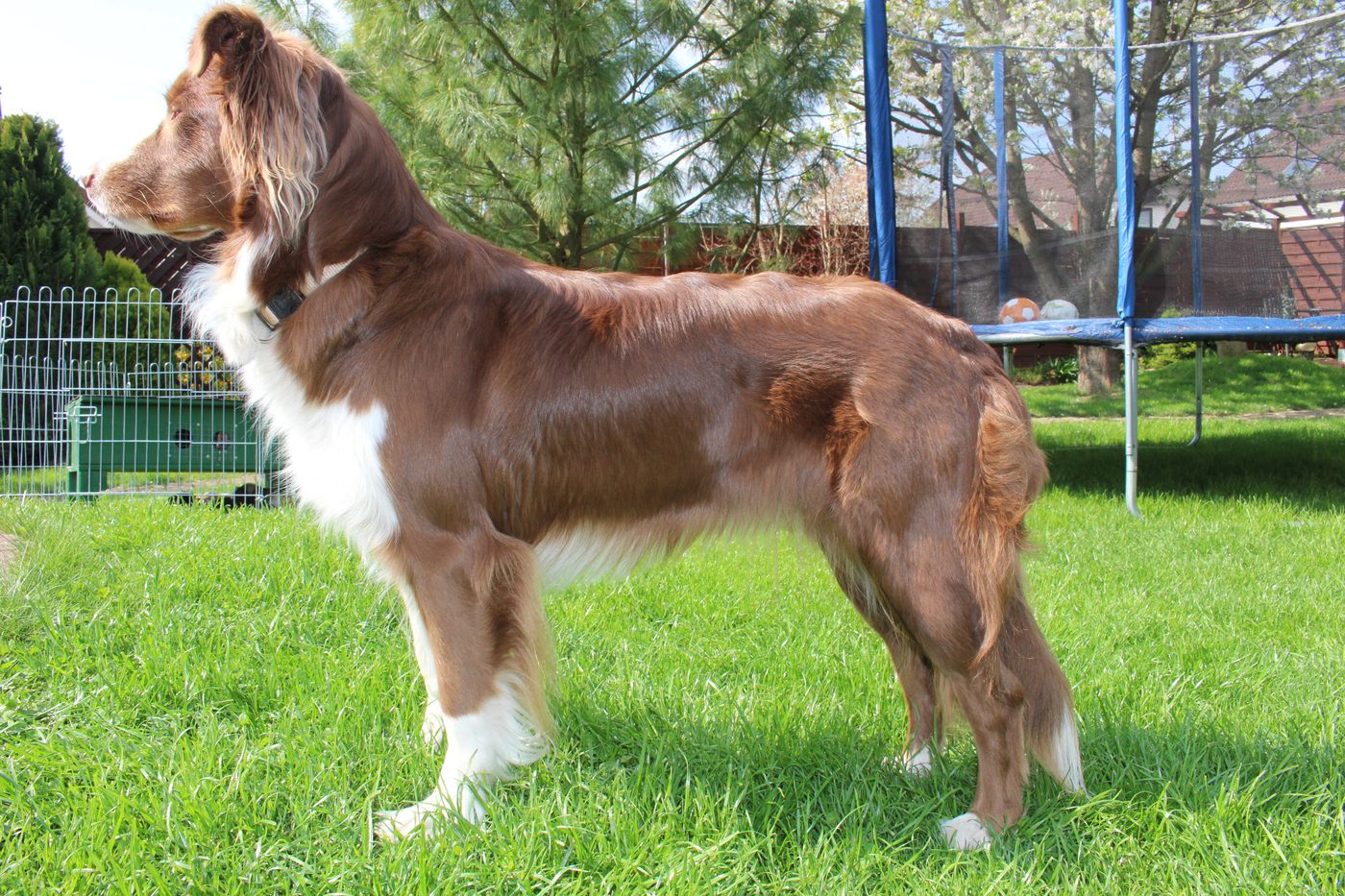
Despite its name, the Australian Shepherd is an American breed, developed on the farms and ranches of the western United States. The AKC standard describes an intelligent working dog with strong herding and guarding instincts and the stamina to work all day, attentive, animated and agile. Its coat comes in blue merle, red merle, black or red, with or without white and copper markings, and the tail is docked or naturally short. The breed rose to fame with the boom in western riding after the Second World War, through rodeos, horse shows, films and television.
History
The Australian Shepherd took shape in the American West in the nineteenth century, when the Gold Rush and the years after the Civil War brought huge flocks of sheep west. Some came from the eastern states with British-type collie sheepdogs, and others came from Australia with their own small, often merle dogs, which Americans called 'little blue dogs' and then Australian Shepherds. The name has traditionally been linked to Basque sheepherders said to have come from Australia, though the AKC notes that most Basques reached the West by way of South America and that their part in the breed is still debated. Genetic studies place the Aussie with British herding breeds such as the Collie, the Border Collie and the Shetland Sheepdog. After the Second World War, western riding, rodeos and television made the breed widely known. The AKC recognized it in 1991, and its standard took effect in 1993. In 2015 the AKC recognized the smaller Miniature American Shepherd as a separate breed.
Type
Both standards describe a dog of medium size and bone, slightly longer than tall, lithe and agile, and solid and muscular without being cloddy. The preferred height is 20 to 23 in (51 to 58 cm) for males and 18 to 21 in (46 to 53 cm) for females, and both add that quality is not to be sacrificed for size. Neither sets a weight; the AKC breed profile suggests 50 to 65 lb (23 to 29 kg) for males and 40 to 55 lb (18 to 25 kg) for females.
The coat is of medium texture and length, straight to wavy and weather resistant, with an undercoat that varies with the climate. Hair is short and smooth on the head and the front of the legs, with moderate feathering on the backs of the forelegs and britches, and a moderate mane and frill that is fuller in males. The four colors, blue merle, black, red merle and red, may each have white markings and copper points, in no order of preference. White on the head should not predominate, the eyes must be fully surrounded by color, and merles tend to darken with age.
Temperament
Both standards describe an intelligent, active dog with strong herding and guarding instincts and an even disposition: good-natured, seldom quarrelsome, and a loyal companion, though it may be somewhat reserved when meeting people for the first time. The FCI adds that Australian Shepherds show an unsurpassed devotion to their families.
Energy
High. The standards describe an active working dog with the stamina to work all day. The AKC calls it a high-energy athlete that needs a great deal of daily exercise, and says the best outlet is a job, whether herding, obedience, agility or dock diving.
Intelligence
The standards call the Aussie an intelligent working dog, and the AKC says its loyalty, intelligence and energy make it very easy to train. Stanley Coren's 1994 survey of obedience judges placed it 42nd, though the breed had only joined the AKC in 1991. Early socialization and obedience training are musts.
Intelligence here means typical trainability, guided by Stanley Coren's survey of obedience judges. It is not a verdict on any one dog.
Care
Grooming
A weekly brushing keeps the double coat in good order. In the shedding season, the AKC suggests an undercoat rake every two or three days, followed by a wire brush. Baths are needed only occasionally, and the nails should be trimmed regularly.
Health notes
The AKC gives a life expectancy of 12 to 15 years. For a CHIC number, the Orthopedic Foundation for Animals requires an OFA hip evaluation, an OFA elbow evaluation and an ACVO eye examination registered with OFA; optional CHIC tests are autoimmune thyroiditis and DNA tests for collie eye anomaly and multidrug sensitivity (MDR1). The breed club also recommends repeating the eye exam every year and a DNA test for hereditary cataracts (HSF4). MDR1, shared with other British herding breeds, makes affected dogs sensitive to ivermectin and some other drugs. The AKC also mentions epilepsy and certain cancers among the conditions breeders test for. Breeding two merles together is not recommended: puppies with two copies of the merle gene have a much higher chance of deafness and often have small, poorly working eyes.
Ordinary care
Aussies need plenty of daily exercise and something to do, and the AKC calls early socialization and obedience training musts. It also notes that Aussies bond closely with their families and can become destructive if left alone too often for long periods. Ask your vet about MDR1 status before giving drugs such as ivermectin, and look for parents with hip, elbow and eye results.
Facts
- The Australian Shepherd isn't Australian. Americans gave the name to the merle 'little blue dogs' that arrived with flocks of sheep from Australia, and in time it stuck to every merle sheepdog in the West. Tradition also links it to Basque shepherds said to have come by way of Australia, a story the AKC's historians now question.
- Some Aussies are born with naturally short tails. The AKC standard allows a tail that is docked or naturally bobbed, up to 4 in long, and the FCI allows docking only in countries where it isn't banned.
- The Aussie became famous with the boom in western riding after the Second World War, showing up at rodeos and horse shows and in films and on television.
- Aussie eyes can be brown, blue or amber, or any mix of these, including flecked and marbled eyes, and both standards accept them all.
- A merle Aussie's coat usually darkens as the dog gets older, something the AKC standard notes.
The Dog Codex is an editorial reference, not veterinary advice. Health notes summarize conditions that appear in breed literature; they do not diagnose an individual dog and do not replace examination by a licensed veterinarian.